
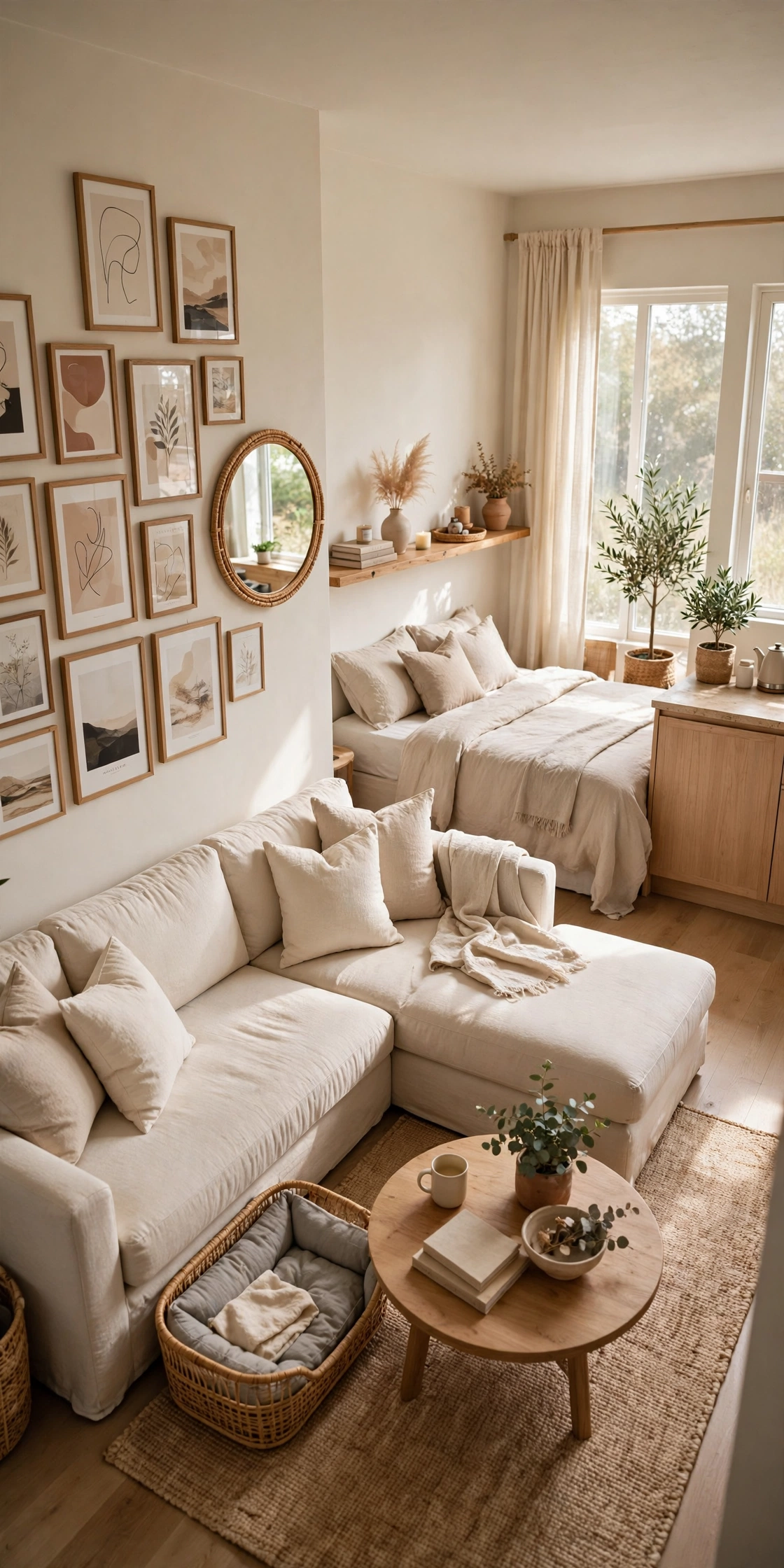
A dog-friendly studio gives your dog its own spot, keeps open floor space, and uses fabrics that handle pet hair. Living in a studio with a dog is a design challenge, not a compromise, and the question is whether the space works for both of you. Here are nine setups that do.
1. The Clean Modern Studio: Gallery Wall, Big Dog Bed, Zero Chaos

A cream sectional, a bold gallery wall, and a properly sized dog bed tucked into the living zone show what a grown-up studio with a dog looks like. The key is giving the dog its own designated spot so it isn’t competing for the sofa or the rug. A round mirror adds depth, a floating shelf above the bed adds vertical storage without bulk, and a linen-toned palette keeps everything light. For help picking the sofa, see how to choose a couch for a studio apartment.
Tip: A tight-weave or performance fabric sectional is worth the extra cost when you share the sofa with a dog.
2. The Bold Character Studio: Dark Wood, Velvet, and a Paw-Print Bed

Not everyone wants neutral. A plum velvet sofa, dark hardwood floors, floral bedding, and a metal shelving unit holding plants, books, and memories lean fully into personality. A paw-print dog bed on the floor fits the space like a piece of decor, and when the dog bed matches the room’s vibe, the whole space reads as intentional instead of cluttered.
Pro tip: Dark floors and jewel-toned textiles are more forgiving of pet hair than pale, flat surfaces.
3. The Compact European Studio: Every Inch Earns Its Place
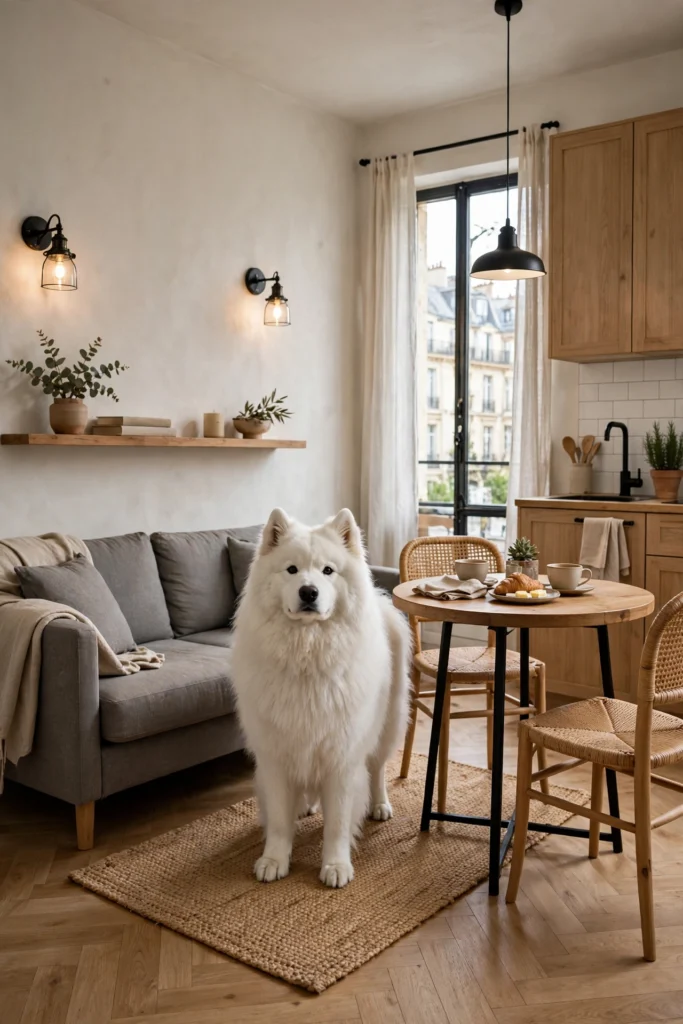
What makes this small studio work isn’t a design trick, it’s restraint. Every piece is sized for the room: a slim two-seater sofa, a round café table with just enough seats, and a simple pendant overhead. A floating shelf and wall-mounted sconces keep surfaces clear, which in a studio this size is a real advantage, and a fluffy dog standing in the middle pulls the room together.
Tip: A round dining table is almost always the right call in a studio, since it takes less visual space and seats the same number of people.
4. The Curtain-Divided Studio: Soft Walls, Green Accents, and a Sleeping Corgi

Ceiling-track curtains are one of the most underused tricks in studio decorating. They create a soft bedroom enclosure that opens fully during the day, giving the illusion of a separate room without a wall. An olive green accent behind the bed adds warmth, botanical print pillows tie it into the living zone, and a corgi in a house-shaped dog bed becomes part of the design. For more options, see studio apartment curtain divider ideas.
Tip: If you can’t drill into the ceiling, look for an adhesive-mount or tension track made for rentals.
5. The Bright Minimal Studio: Blue Headboard, Yellow Accents, and Plenty of Room to Roam

This layout prioritizes open floor space, which most studios forget. A low-profile bed and furniture kept away from the center of the room leave breathing room, which a larger dog needs as much as any person. A blue headboard pops against warm neutral walls, yellow throw pillows pull the color story together, and two drum pendant lights instead of one overhead give even, layered light.
Tip: With a large dog, resist filling every corner. Leave floor space, since the dog needs it and so do you.
6. The Industrial-Boho Studio: Dark Bedding, Kilim Rug, Work-From-Home Corner
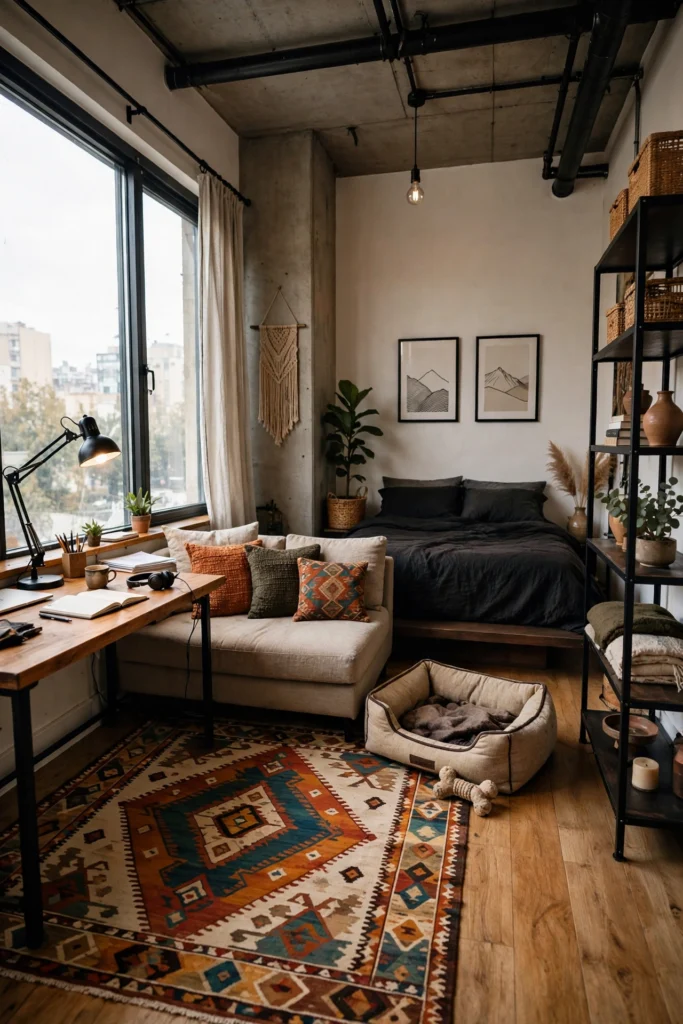
This setup solves the work-from-home-with-a-dog puzzle. The work corner runs along one wall with a wooden desk and task lighting near the window, so it gets natural light without sitting in the middle of the living zone. A kilim rug anchors the sofa and dog bed together, making that area feel like a proper living room, and dark bedding on a platform frame grounds the sleep zone. For more workspace ideas, see studio apartment ideas with a home office corner.
Pro tip: A black metal shelving unit does the job of a full bookcase in half the visual footprint.
7. The Space-Smart City Studio: Built-In Storage, Platform Bed With Drawers, Dog Bed in the Flow
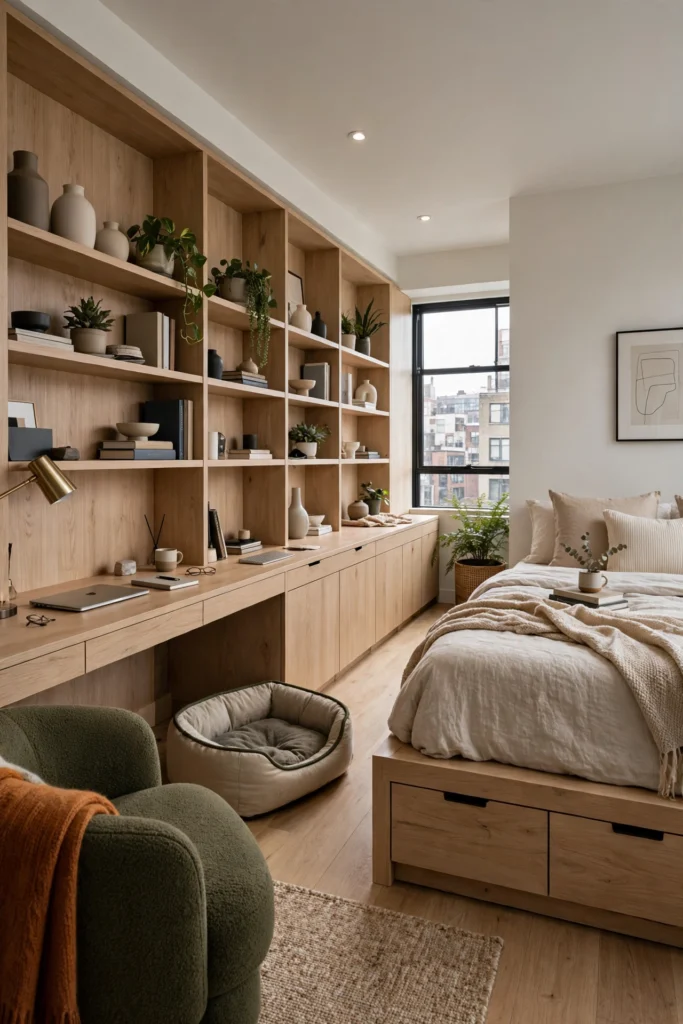
This layout was clearly planned in cubic feet. A platform bed with built-in drawers holds out-of-season clothes, extra dog supplies, and spare linens, and a full-wall built-in desk and shelving unit runs along one side without projecting into the room. The dog bed sits in the natural traffic path between the armchair and the desk, which is where a dog would choose to nap anyway.
Pro tip: A storage platform bed can replace a whole dresser, which is worth it when closet space is tight.
8. The Warm Boho Nest: Layers, Plants, and a Dog Who Lives Like Royalty

A studio can feel warm, personal, and livable even with a full wardrobe and a dog sharing the couch. A Moroccan-style rug anchors the living zone, an open clothing rack doubles as a room divider without closing off light, and a mustard throw with a neutral palette creates cohesion across every zone. For more rug options, see mini studio apartment rug ideas.
Pro tip: A patterned, textured rug hides pet hair between washes better than a flat weave, and facing the sofa away from the bed makes the living area feel like its own room.
9. The Colorful Maximalist Studio: Bookshelf Divider, Platform Bed, and a Happy Chihuahua
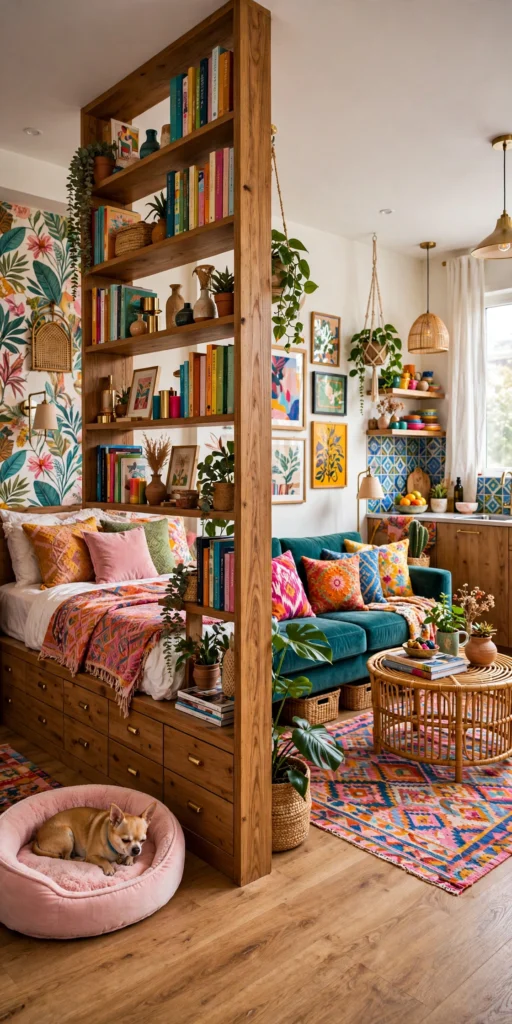
A tall bookshelf as a room divider separates the sleeping area from the living zone without using floor space, and it gives storage on both sides. A platform bed with built-in base storage underneath holds extra dog supplies, blankets, and toys, and a tiny chihuahua in a blush pink round bed adds the maximalist energy. For more layouts built around this divider, see studio apartment layout ideas using bookshelf room dividers.
Tip: A freestanding bookcase gives the same separation with no drilling, which suits renters.
Common mistakes in a studio with a dog
- Filling every corner. A dog needs open floor space as much as a person does, so keep the center of the room clear.
- Skipping a dedicated dog spot. Without its own bed, the dog competes for the sofa and the rug.
- Choosing delicate fabrics. Pale, flat surfaces show pet hair, while tight weaves, dark tones, and textured rugs hold up better.
Quick answers
How do I make a studio dog-friendly?
Give the dog its own bed, keep open floor space, and choose tight-weave or performance fabrics that handle pet hair.
Where should the dog bed go in a studio?
In the living zone or along the natural traffic path, near where the dog would nap anyway, and matched to the room’s style.
What fabrics work best with a dog?
Tight-weave linen, boucle, and performance fabrics, along with dark floors and jewel-toned textiles, are more forgiving of pet hair.
How do I divide a studio without losing floor space?
A tall bookshelf or a ceiling-track curtain separates the sleeping area without taking floor space.
How do I fit a home office with a dog?
Run a desk along one wall near the window, away from the main walkway, with task lighting.
What storage helps in a studio with a dog?
A platform bed with drawers holds dog supplies, blankets, and spare linens, and a wall-mounted shelf keeps surfaces clear.
Does a rug help with pet hair?
A textured, patterned rug hides pet hair between washes better than a flat weave.
A dog-friendly studio starts with the dog’s corner. Give your dog one fixed spot — a bed by the sofa or near the window — and keep it there. Dogs settle faster when their place does not move, and the room stays calmer when the bed, the bowl, and the leash all live in the same zone. A bed that matches the room’s colors reads as part of the design instead of an afterthought, and washable covers mean the bed never has to look tired.
Choose fabrics that forgive pet hair. A tight weave or a textured pattern hides hair between washes far better than a flat, pale fabric, and a washable throw over the sofa arm saves the upholstery where your dog leans. Keep a lint roller by the door and a small basket for toys near the dog’s bed, so the room can be reset in a minute when guests arrive. The goal is a studio that welcomes the dog and still looks like a home for people.
Leave open floor for play and for peace. A dog that can move freely without knocking things over is a calmer dog, so keep the main walkway clear and push furniture to the edges where you can. Low, stable pieces beat tall, tippy ones, and a rug with a low pile is easier to clean than a deep shag. When the layout gives the dog room to move and you room to sit, the studio works for both of you.
Final Thoughts
Your dog doesn’t care about square footage, it cares about a warm bed, an easy-to-find bowl, and you being nearby. Get the layout right by defining zones, giving the dog its own spot, and leaving open floor. Start with one change, such as moving the sofa or adding a dog bed that looks good in the room.

Hi, I'm Wasif — welcome to The Homes Decors. I write about home decor: the ideas, choices, and small details that make a space feel considered rather than accidental. If you've ever wondered why a room works, not just what's in it, you're in the right place.