
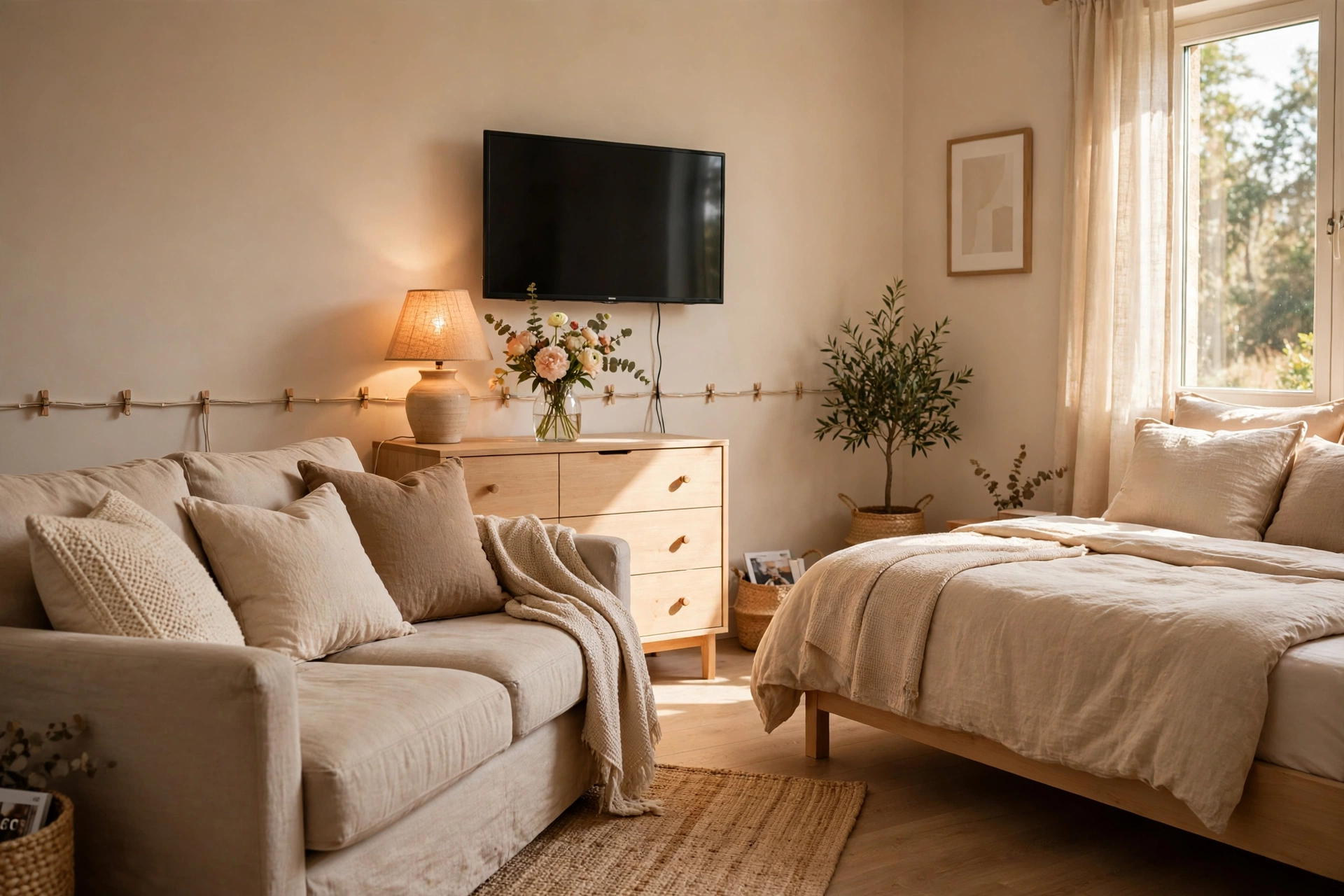
The best TV placement in a studio is on a wall that both your bed and your sofa can see, mounted or set low enough to be comfortable from where you sit. Place the sofa first, then the TV. These 17 ideas show real setups, each with a practical tip.
Where you put the TV is a layout decision, not just a decorating one. Get it right and the furniture flows and the zones feel intentional. If you want help planning the rest of the room, these small living room ideas are a good companion.
1. Mount it on the wall opposite your bed

Mounting the TV on the wall across from the bed is the studio classic because it works from anywhere. You can watch propped on pillows or from the sofa without craning your neck. Keep it high enough to clear furniture but low enough to feel natural. Wall mounting also frees the floor, which is worth a lot in a studio.
Pro tip: Center the TV on the wall, not on the window, so it anchors the space. Fix the mount into wall studs, and check the mount’s weight rating against your TV.
2. Center the TV between your two zones

When your sofa and bed sit at angles to each other, mount the TV on the wall that splits the difference. Both zones get a decent view, and neither feels like the loser. A floating shelf below keeps the floor clear. Pick a wall both areas naturally face, usually the one perpendicular to your window.
Pro tip: A wall-mounted TV over a floating shelf looks far more intentional than one balanced on a dresser. Mount the shelf into studs too.
3. Set it low at the foot of the bed

A low media console at the foot of the bed turns the mattress into the coziest theater seat. This layout suits studios where the bed doubles as the main lounging spot. Keep the console low and slim so it does not block light or feel bulky. Add a soft rug and a lamp, and the studio feels like a retreat.
Pro tip: Choose a console that is a bit lower than the mattress top, so the screen sits in a comfortable line of sight from the pillows.
4. Angle it to serve both bed and sofa

If your bed and sofa are close together, a console placed at a gentle angle lets both face the screen comfortably. You do not need a fancy swivel mount. Position the unit so the TV splits its attention. This makes a studio feel like it has a real living area, even when the bed is three feet away. Warm lighting ties the two zones together.
Pro tip: Use a slim, sturdy stand you can reposition, and keep cords tidy so you can move it without pulling anything loose.
5. Use a low console facing the seating area

A low wooden console along the wall gives the TV a home without dominating the room. Placed beside the bed and facing the seating area, it keeps sightlines open. Light wood is a favorite for small studios because it adds warmth without visual weight. Use the shelves for books and a plant so it earns its footprint. For more light, airy styling, see these Scandinavian living room ideas.
Pro tip: Put the money into the rug, since it defines the whole seating zone, and keep the console simple.
6. Mount it above a dresser

Mounting the TV above a dresser is a double-duty move, with storage below and a screen above. It works well across from the bed, where the dresser top holds lamps and flowers. The result feels styled, not cramped. Make sure the dresser is deep enough to look proportional under the screen, and keep the top tidy.
Pro tip: Anchor the dresser to the wall, and keep lamps and cords clear of the TV’s vents so heat does not build up.
7. Wall-mount to save every inch of floor

In a truly tiny studio, wall mounting is not optional. Getting the TV off the floor leaves room for a console below, or nothing at all. The screen faces the bed directly, so you can watch from the comfiest seat in the house. Flank it with woven wall art so it does not read as a black rectangle floating alone.
Pro tip: Skip the giant screen. In a small studio, an oversized TV overwhelms the room, so choose a size that fits your viewing distance.
8. Give it a dedicated console on a shared wall
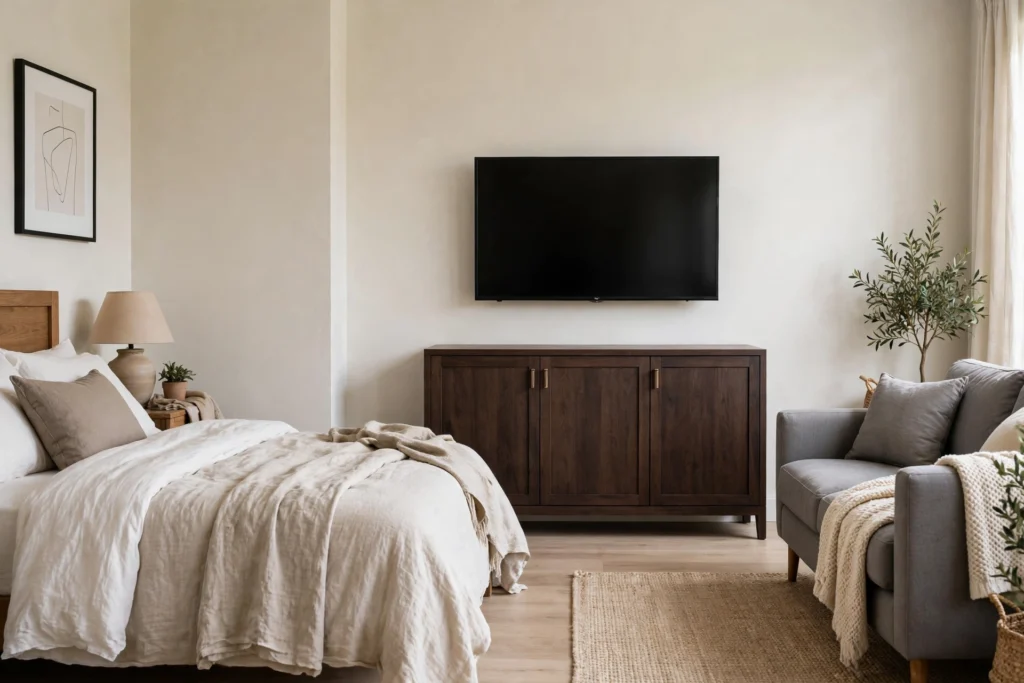
A dedicated console on a shared wall lets one TV serve every part of the room. Position it where both the bed and the sofa have a clear line of sight, and you solve the studio’s biggest layout puzzle. A dark wood unit grounds a light room and hides cords behind closed doors. Keep surrounding walls simple. For more dark wood looks, see these brown living room ideas.
Pro tip: Run cords through a paintable cable cover that matches the wall. Do not run standard power cords inside the wall itself unless an electrician fits a rated kit.
9. Try a perpendicular wall placement
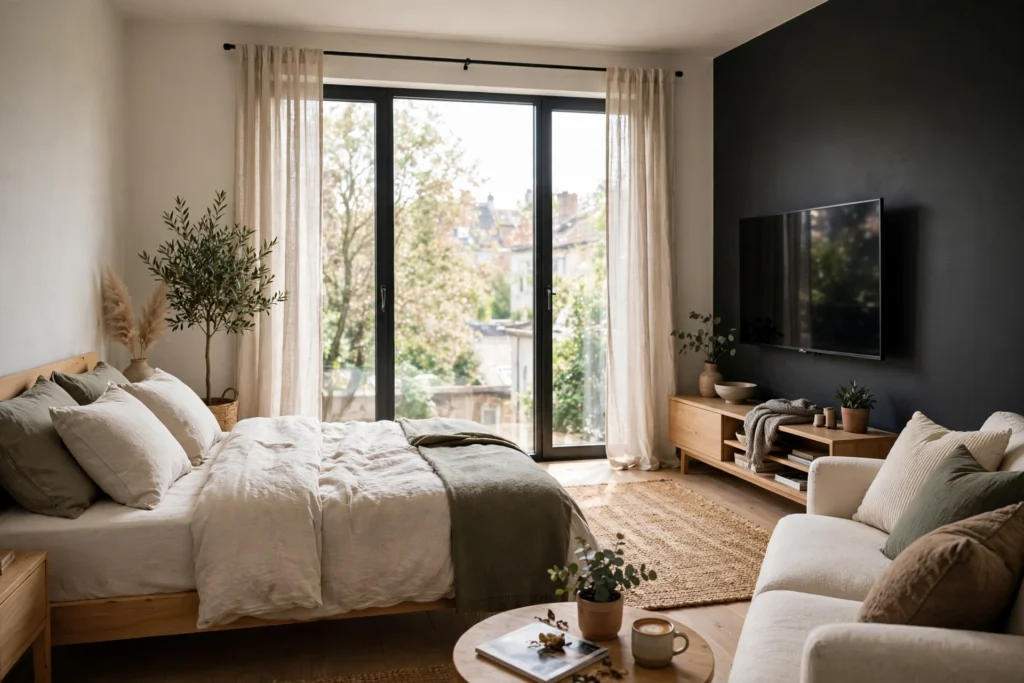
Placing the TV on a wall perpendicular to both bed and sofa keeps the window as the room’s focal point. The screen sits off to the side, visible from both zones but never stealing the show. A low media unit with hidden storage keeps the area tidy. A jute rug warms the open floor. For more relaxed layered looks, see these modern boho living room ideas.
Pro tip: Place the TV so it does not sit across from the window, since glare on the screen makes daytime viewing tiring.
10. Build the TV into a room-divider shelf

This is a smart studio trick. Build the TV into an open shelving unit that doubles as a room divider. The screen faces the living zone while the shelf separates the bed from the sofa. Fill the cubbies with books, baskets and trailing plants so it feels like a design feature.
Pro tip: Anchor tall shelves to the wall where you can, keep heavy items low, and leave a gap behind the TV for airflow and cords.
11. Mount it on a feature wall and let color do the work

A wall-mounted TV looks only as good as the wall behind it. Mount it on a clean white wall opposite a bold accent wall, and the contrast does the work. Your eye moves between the two focal points, so the room feels curated, not cramped. If you cannot paint, a peel-and-stick panel can create the same contrast.
Pro tip: Test peel-and-stick panels on a small hidden patch first, and avoid textured walls, where they may not hold.
12. Use a TV stand that doubles as a room divider

When a TV stand is chunky enough to anchor a room, it becomes a divider even without separating the space. A dark media console between the sofa and the bed draws a soft boundary between living room and bedroom without walls or curtains.
Pro tip: Choose a console at least 55 inches wide so it reads as a room anchor, not as furniture floating in space.
13. Anchor the living zone with a low-profile media setup

Low console, small TV, big rug. That is the formula. A low setup centered on the long wall lets the eye travel across the room, so the space reads wider. The sofa and bed face the same general direction without fighting for attention.
Pro tip: A 43 to 50 inch TV is a sweet spot for most small studios. Sit roughly 5 to 8 feet from the screen, and bigger does not mean better at that distance.
14. Build a full living room zone around the TV wall

If your studio has enough width, treat one wall as the entertainment wall, with the TV centered, storage on each side and art above. Even simple cube units flanking a media console tell the room this wall means business. It grounds the living area so everything else, like the dining table and kitchen, falls into place.
Pro tip: Secure the units to each other and to the wall, and keep the TV centered at a comfortable eye level when you are seated.
15. Mount it on the bedroom wall facing the sofa

In a narrow studio, the TV may serve both bed and sofa, and that is fine. The trick is mounting height. Set it comfortable for the sofa when you sit upright, not tilted toward the ceiling. Just above dresser height works well. A tilting wall mount lets you angle it slightly for viewing from bed.
Pro tip: Sit where you will watch and mark the center of the screen at about seated eye level before you drill, which is often around 40 to 45 inches from the floor for a sofa.
16. Let the TV share wall space with a gallery display

The TV does not have to own the wall. Mount it to one side while a gallery of prints fills the other, so the same wall shows two personalities. This works when the TV is on the smaller side, so it does not swallow the art. Leave a gap of about 12 to 15 inches between the TV edge and the nearest frame.
Pro tip: Lay out frames on the floor first and mark the wall with painter’s tape, so you place both the TV mount and the frames only once.
17. Float the media console for a polished look

Not every studio is a starter apartment. A TV mounted on a floating wall panel beside a window wall lets the view and the screen share a sightline, and a floating console keeps the floor clear so you can see the flooring. Even on a smaller budget, the principle holds: lifting the console off the floor makes a room feel more polished.
Pro tip: Floating consoles must be fixed into studs or solid backing, and the weight limit counts the TV plus everything on the shelf. If you are unsure, hire a pro.
Quick answers
Where should I put the TV in a studio apartment?
Put it on a wall both your bed and your sofa can see, ideally perpendicular to the window to avoid glare.
How high should I mount a TV in a studio?
The center of the screen should be roughly at seated eye level, often around 40 to 45 inches from the floor for sofa viewing. Go a little higher if you mainly watch from bed.
What TV size works best in a small studio?
A 43 to 50 inch TV is a good size for most small studios, with a viewing distance of about 5 to 8 feet.
Is a wall mount or a stand better for a studio?
A wall mount saves floor space, while a stand is easier for renters since it needs no drilling. Choose by your lease and how often you rearrange.
How do I hide TV cords?
Use a paintable cable cover along the wall, or a console with a cable hole. Do not run standard power cords inside walls unless an electrician installs a rated kit.
Can I mount a TV on a rental wall?
Ask your landlord first, since a mount leaves holes. A stand or a floating shelf unit can be a better choice.
How do I make a TV look less dominant?
Frame it with art or shelves, keep it on a calm wall, and choose a size that fits the room.
Should the TV face the bed or the sofa?
Plan the sofa first, then place the TV so the sofa has the best view. If it also needs to serve the bed, choose a wall both can see.
Final thoughts
TV placement in a studio is not about finding a spot where the screen fits. It is about building the room around a decision that suits how you live. Wall-mounted and minimal, or a full entertainment wall, the best placement respects the flow of the room and does not push furniture into awkward angles. Start with your sofa position, then work back to the TV. Most people do it the other way around, which is why their studio feels slightly off. Once it is done, these cozy living room ideas can help you warm up the space.
Your studio should feel like a home, not a hotel room with a bad sightline.

Hi, I'm Wasif — welcome to The Homes Decors. I write about home decor: the ideas, choices, and small details that make a space feel considered rather than accidental. If you've ever wondered why a room works, not just what's in it, you're in the right place.
1 thought on “17 TV Placement Ideas That Actually Work in a Studio Apartment”