
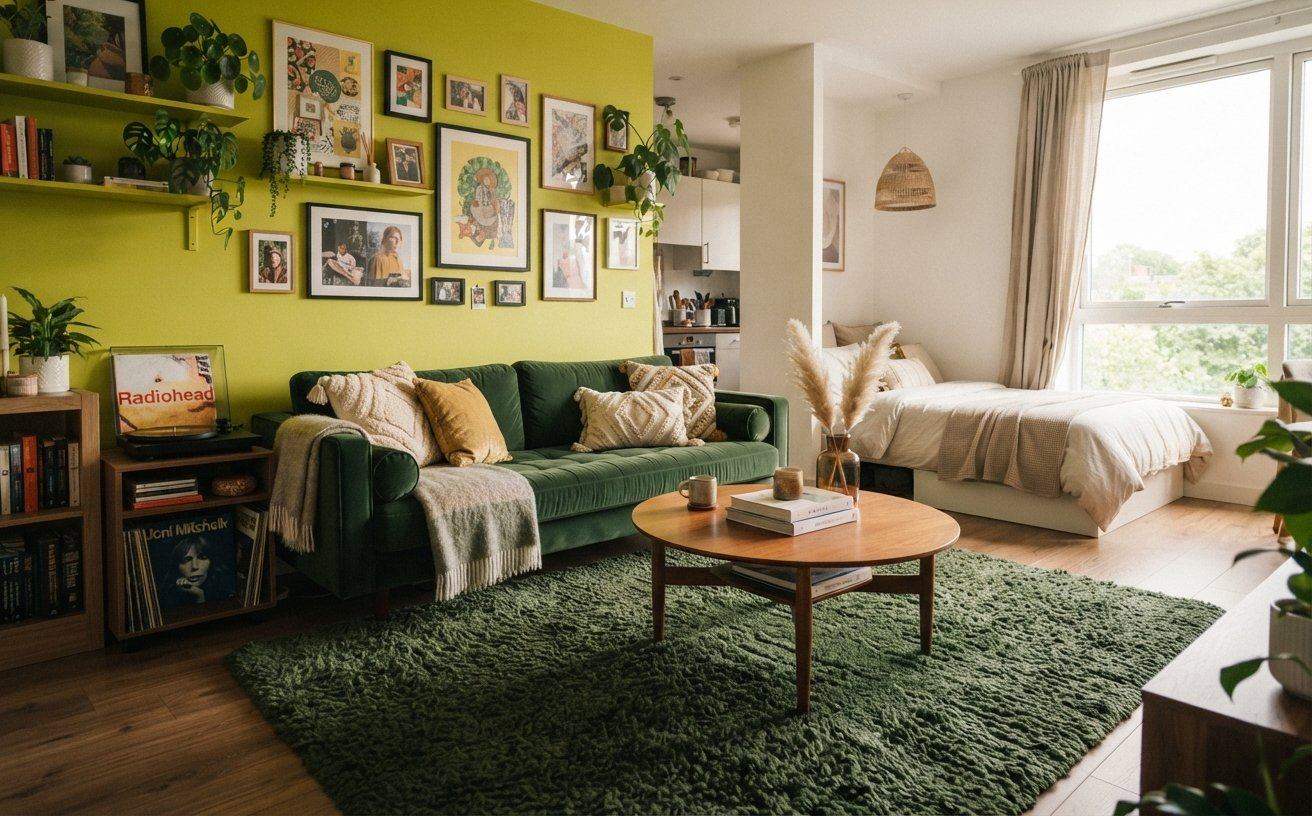
A studio doesn’t need more square footage to feel beautiful, it needs more intention. These 15 real layouts show exactly what that looks like in practice.
1. Go Bold With Color — Don’t Play It Safe
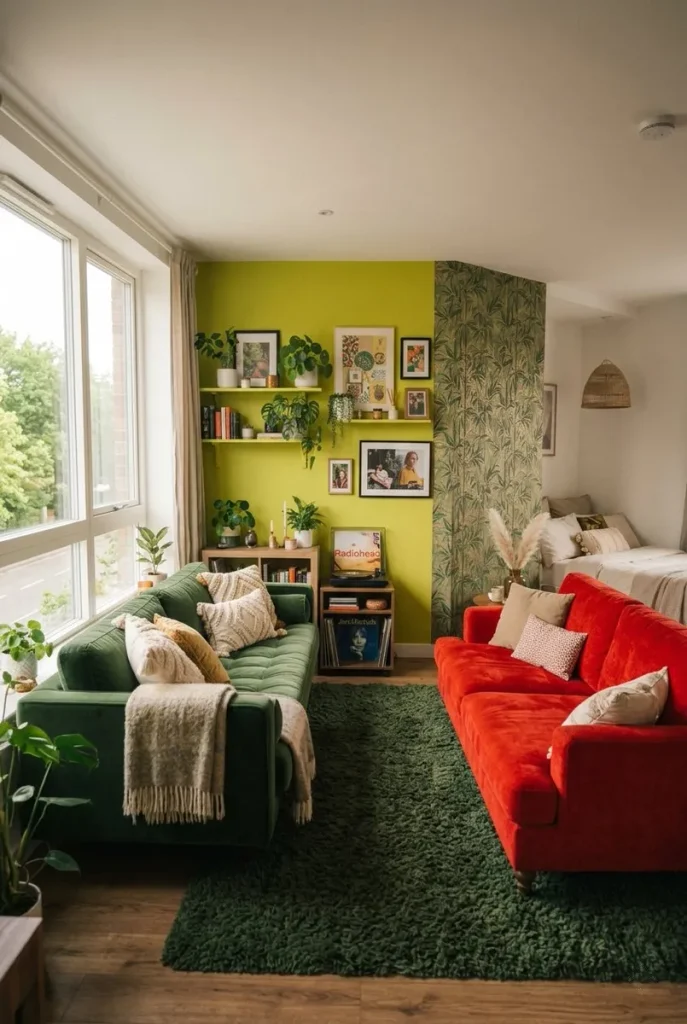
The biggest myth in small-space decorating is that white and beige are the only safe choice. A lime green accent wall, bamboo-print wallpaper on the adjacent corner, a forest green sofa, and a bold red one opposite blow that idea apart, and it works because the colors are fully committed rather than half-measured.
Tip: Limit bold color to two walls maximum and let the rest breathe in white or cream so the room doesn’t feel like a terrarium.
2. Use a Rug to Define the Living Zone
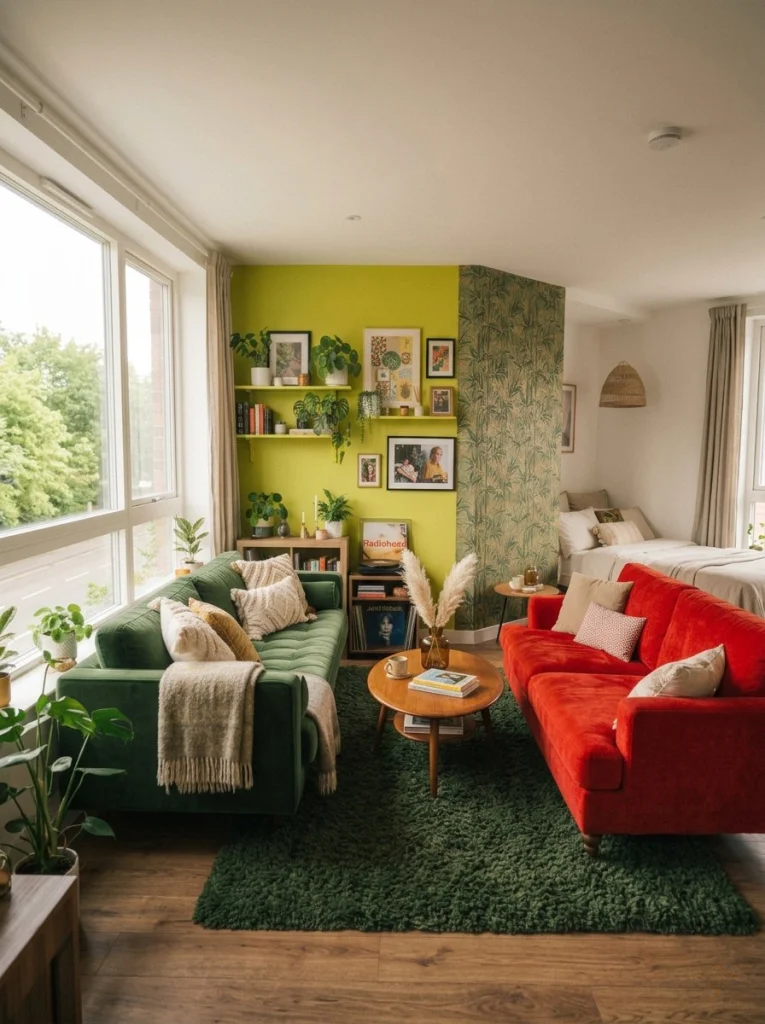
When a sofa and a bed share the same room, visual separation does most of the work. A chunky green shag rug anchors the sofa and coffee table into a distinct living room, while the bed behind it reads as its own zone even with no wall between them. It’s one of the cheapest layout tricks that actually works.
Tip: Go bigger than feels right with a rug — the sofa legs should sit on it, not beside it.
3. A Statement Sofa Is Worth the Investment
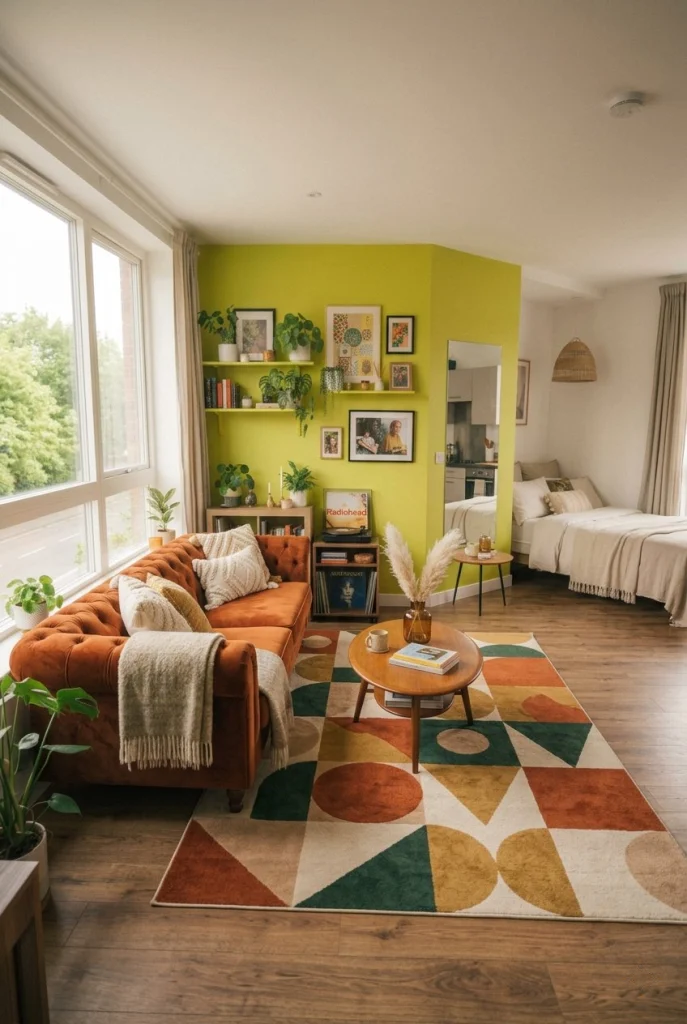
A tufted burnt-orange sofa becomes the entire personality of a room, and paired with a bold geometric rug and a simple round wood table, it pulls the whole space together without needing a single piece of expensive art. In a studio, the sofa is the centerpiece, not a background piece to settle on. For more on choosing a statement piece like this, see choose a couch for a studio apartment.
Tip: A removable sofa cover in a statement color gives the same look for a fraction of the price, and it’s washable.
4. Bring Your Work Desk Into the Bedroom Zone
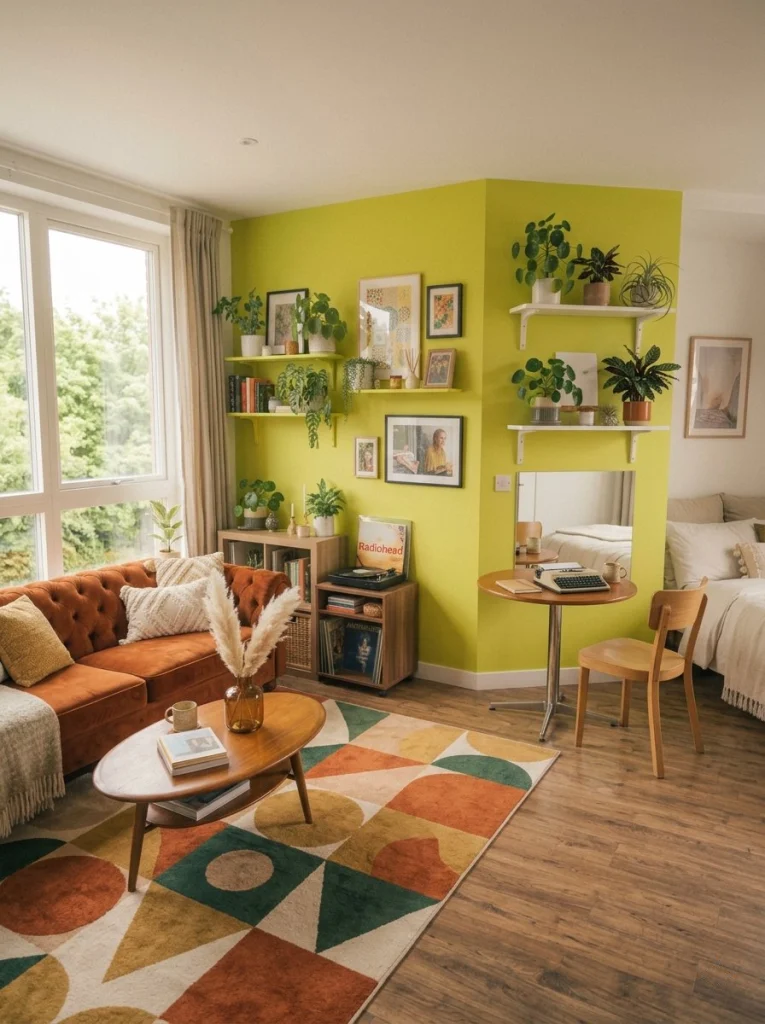
Working from a studio doesn’t mean sacrificing a proper desk setup. A compact round bistro-style table beside the bed doubles as a work surface during the day, with floating white shelves above holding plants and supplies to keep the desk clear. A lime green wall behind it makes even a laptop session feel intentional. For more on building a workspace into a layout like this, see studio apartment ideas with a home office corner.
Tip: Save on the desk itself with a simple tabletop-and-legs setup, and spend more on the chair, since the difference shows by midday.
5. Let the View Do the Decorating
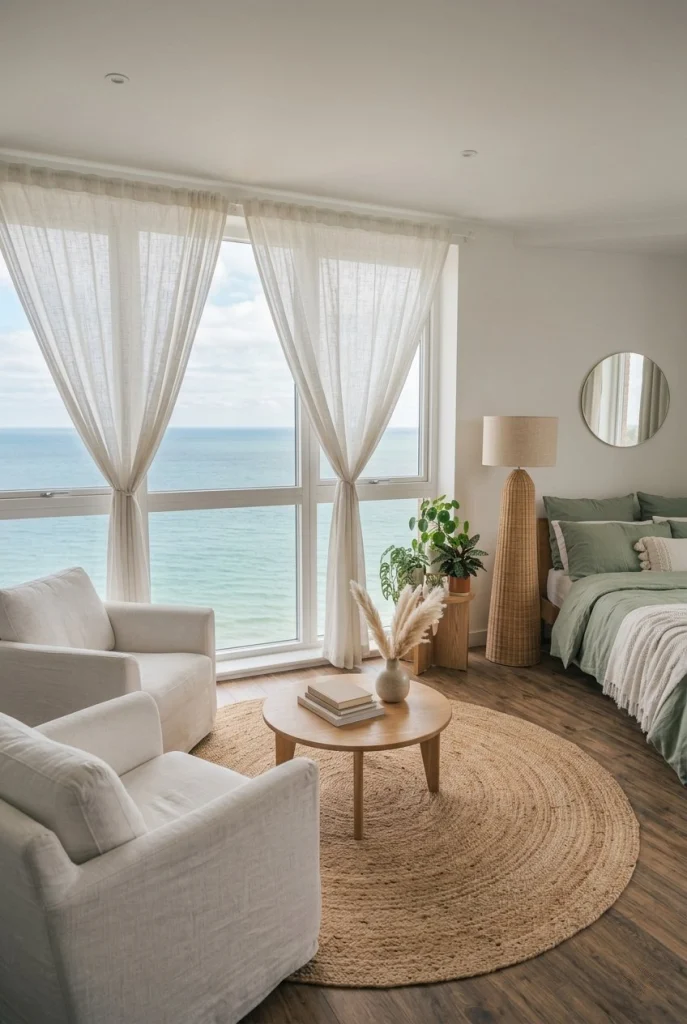
A good view deserves to be framed, not competed with. A soft palette of white armchairs, sage green bedding, a jute rug, and wicker accents stays quiet on purpose, with lavender curtains pulled back to let the ocean fill the room visually instead of adding a gallery wall.
Tip: Sheer curtains in a neutral linen tone diffuse bright light without blocking a good view, which works better than blackout panels in a room like this.
6. Embrace the Minimalist Layout
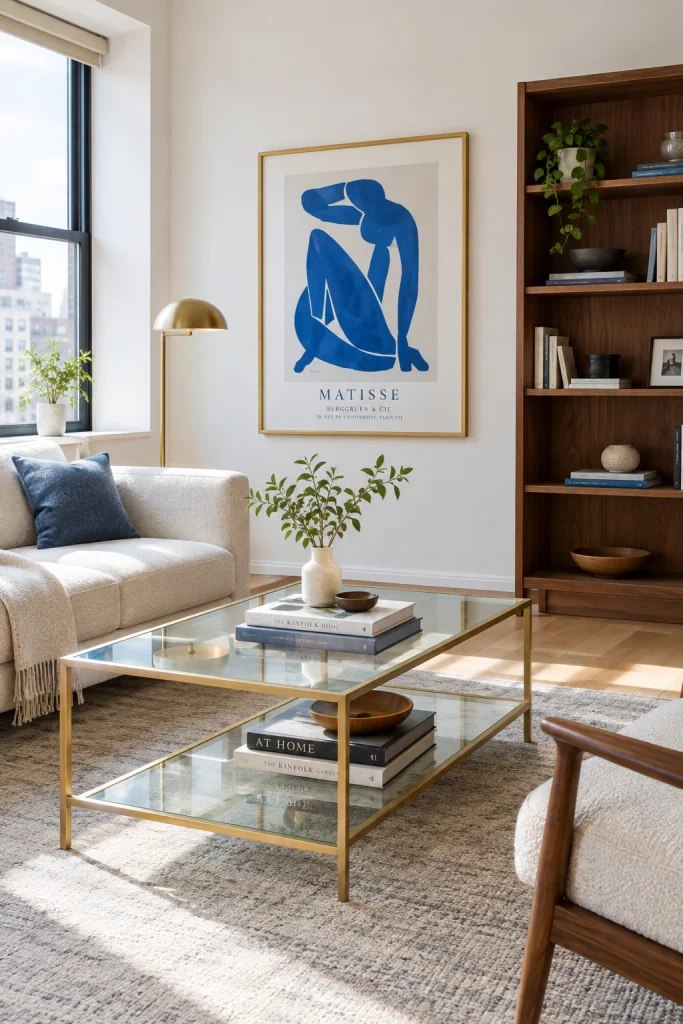
Clean lines and intentional pieces prove minimal doesn’t mean cold. A gold-frame glass coffee table keeps the floor visually open, a walnut bookshelf adds warmth while earning its square footage as storage, and one oversized art print grounds the living corner without any filler pieces around it.
Tip: A glass or lucite coffee table is one of the best small-space furniture tricks, since the eye passes through it and the room feels larger immediately.
7. Build a Sleep Nook With Curtains and Shelving
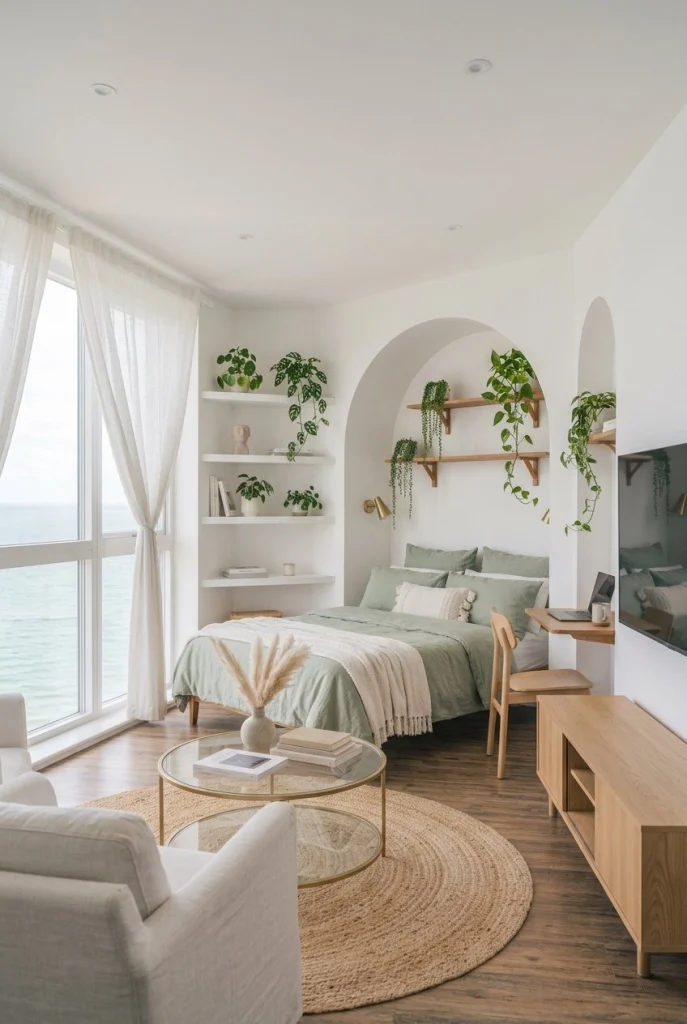
An architectural arch can frame the bed area into its own visual nook with no construction required, just clever furniture placement. Floating oak shelves along the adjacent wall hold trailing plants and decorative objects, drawing the eye upward, while a compact desk beside the TV unit completes a full living setup in a tight footprint.
Tip: Floating shelves with trailing plants like pothos or string of pearls add life and height to a wall without crowding the floor.
8. Mix Warm Wood Tones for a Cozy, Lived-In Feel
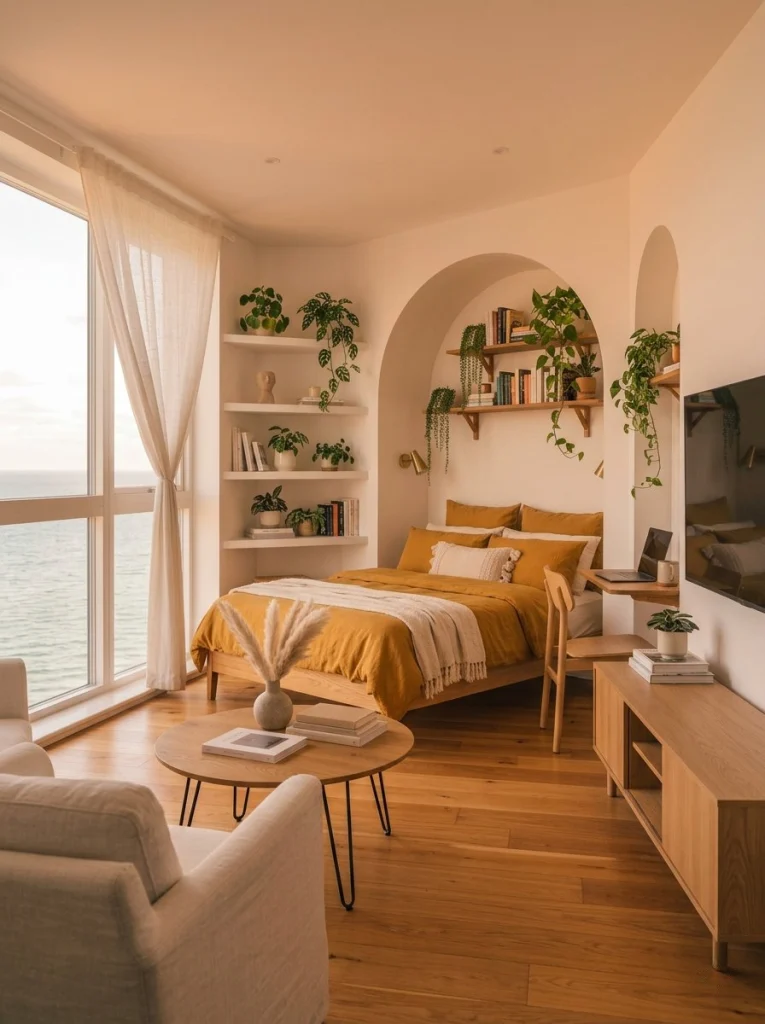
Warm honey-toned hardwood floors, a hairpin-leg coffee table in matching oak, and a light wood bed frame create a cohesive palette that reads as a whole home rather than a single room. A yellow duvet and striped jute rug add texture, and a towering bookshelf overflowing with books and plants in the corner gives the space genuine character.
Tip: Mixing wood tones within the same warm family looks more intentional than a perfectly matched furniture set.
9. Commit to a Single Color Story
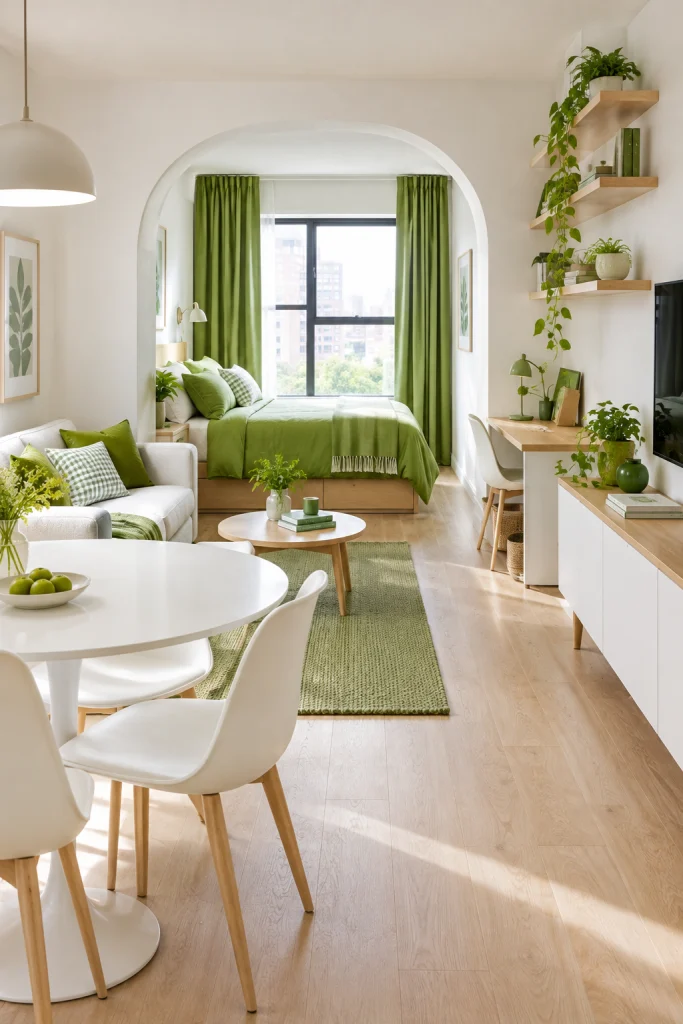
Repeating one color across every zone — curtains, bedding, gallery frames, a table runner, plants — makes a studio read as designed rather than random. Lime green runs from floor to ceiling here in the softest way, with white walls and light wood floors keeping it from feeling overwhelming, and a white dining set and TV console give the eye a place to rest between the green moments.
Tip: Tone-on-tone works best when the texture varies within the same hue, like matte bedding against sheer curtains and glossy frames.
10. Make Plants Your Primary Décor
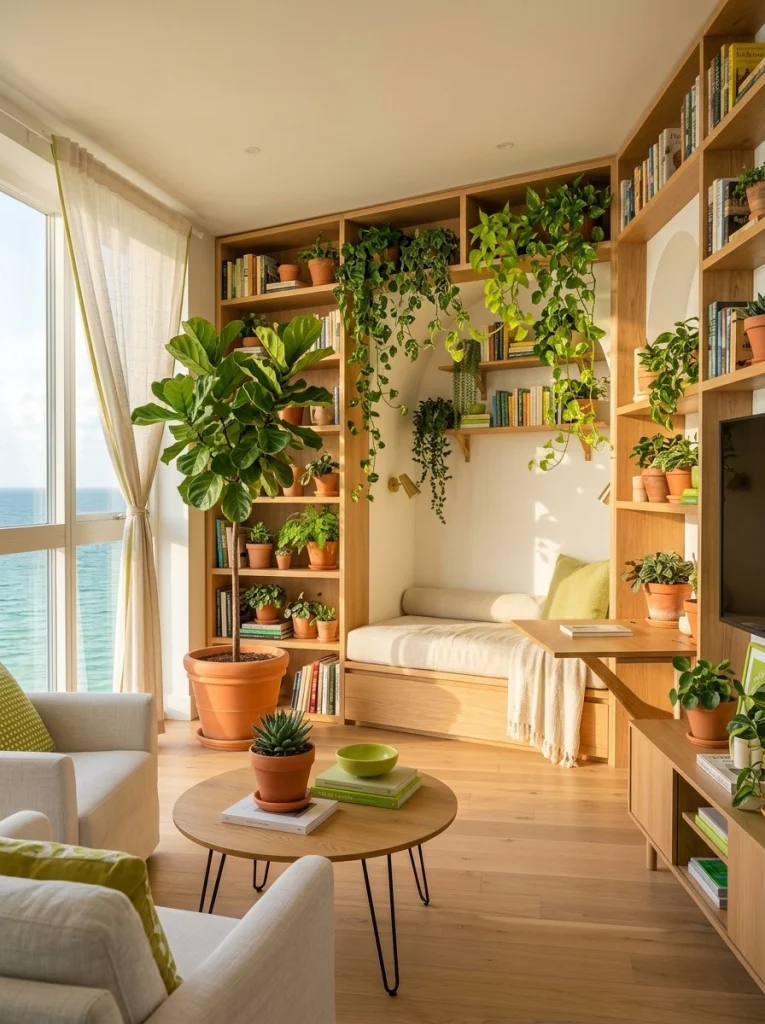
Books and plants carry a surprising amount of a room’s personality on their own. A tall open bookshelf in the corner holds a fiddle-leaf fig, a trailing pothos, and terracotta pots tucked between paperbacks, while window ledge plants bring the outside in at essentially no cost. For more plant ideas sized for a small footprint, see mini studio apartment plant ideas.
Tip: Start with pothos or a ZZ plant if plants tend to die quickly — both are nearly indestructible and thrive on neglect.
11. Use an Accent Wall to Anchor the Bedroom Zone
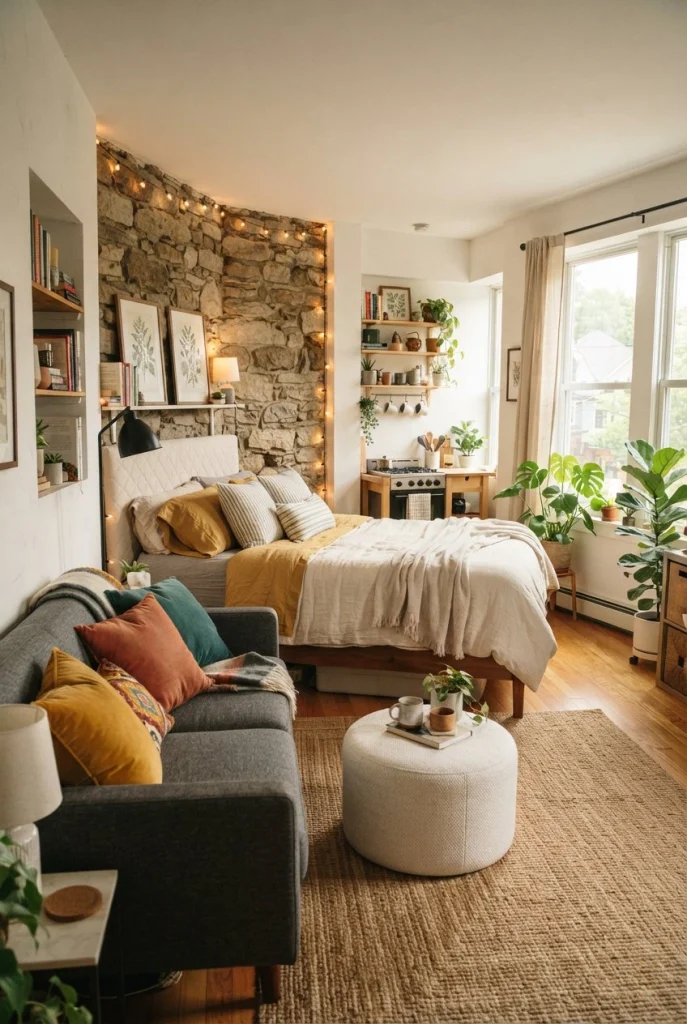
Original architectural character, like an exposed stone wall, deserves to lead the room. The stone becomes a natural headboard backdrop, giving the bed its own visual territory without needing a divider, while a grey sofa with colorful pillows pops against the neutral stone and a fluffy white ottoman replaces a coffee table for texture and flexibility.
Tip: Without a real stone wall, peel-and-stick brick panels come down cleanly when moving and give a similar effect.
12. Layer Textures to Add Warmth Without Color
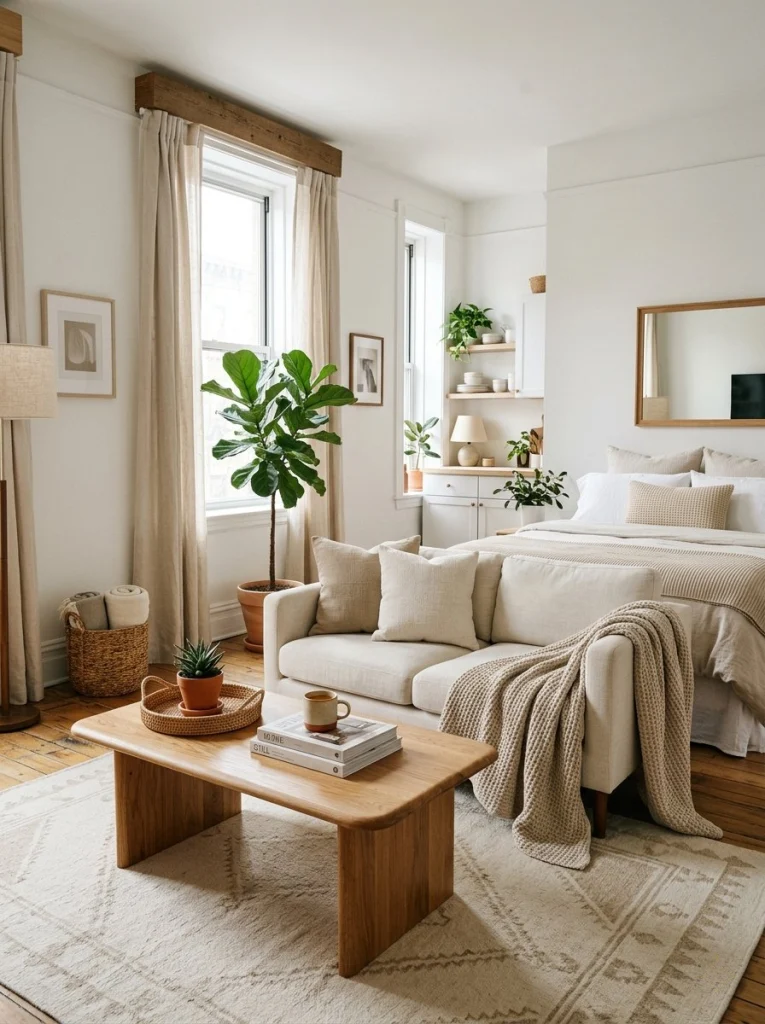
Keeping walls completely white doesn’t have to feel flat when every surface carries texture — linen curtains, a wool-blend geometric rug, a wood coffee table, a waffle-knit throw, botanical art in natural oak frames, and woven gold mirrors. Texture is what makes a neutral palette feel like something instead of just looking clean.
Tip: Save on throw pillows and art prints, and spend more on curtains, since floor-to-ceiling linen panels make a room feel taller and more expensive.
13. A Single Accent Wall Changes Everything
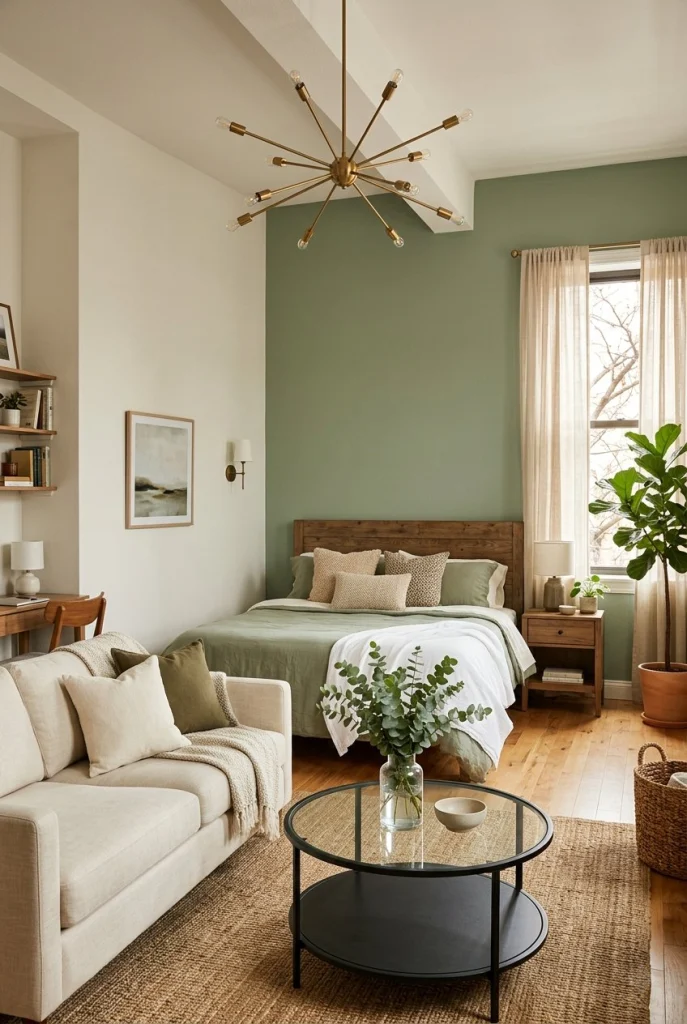
Sage green behind the bed zone anchors the entire space and makes the room feel like it has a real bedroom rather than just a mattress on the floor. A sputnik chandelier adds industrial edge while a cream sofa softens it, and a round black coffee table with eucalyptus branches keeps the look grounded.
Tip: Sage green reads warm or cool depending on the lighting, so always test a sample swatch in the actual space before committing.
14. Build a Proper Work-From-Home Corner
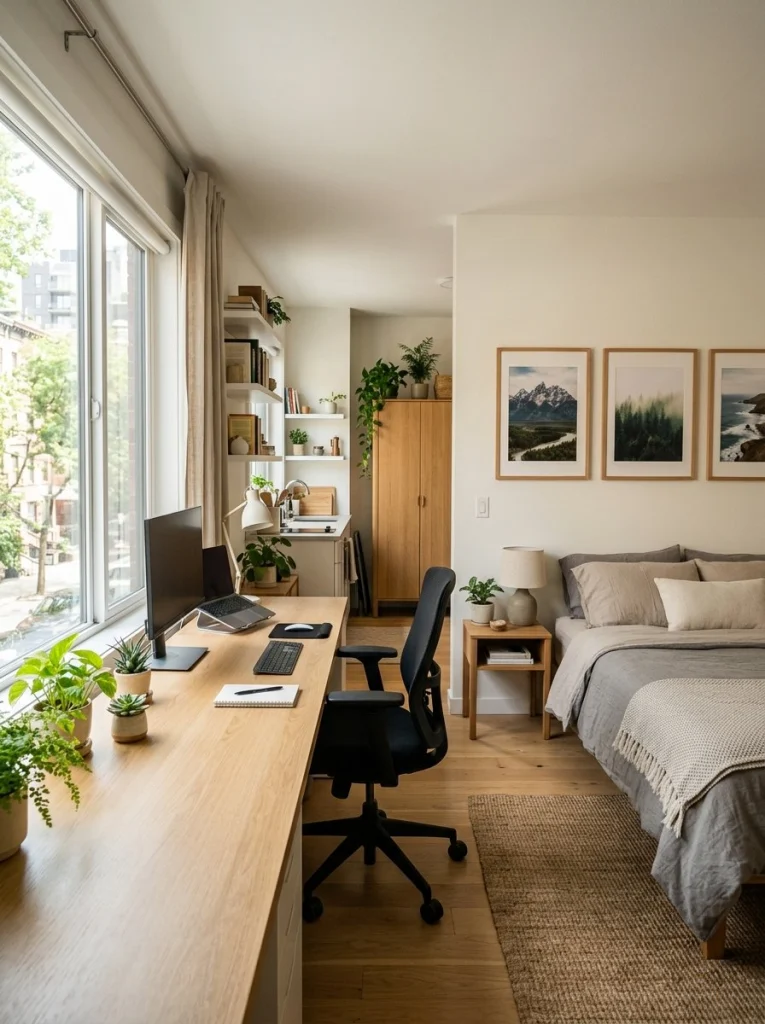
A full desk running along the entire window wall gives ample surface area for a laptop, lamp, and small plants, with an ergonomic chair keeping posture honest during long sessions. Three framed landscape prints above the bed add personality without taking any floor space, making the whole setup feel purposeful rather than improvised.
Tip: Position the desk perpendicular to the window rather than facing it, to avoid screen glare while still getting natural side light.
15. Embrace the Industrial Loft Spirit
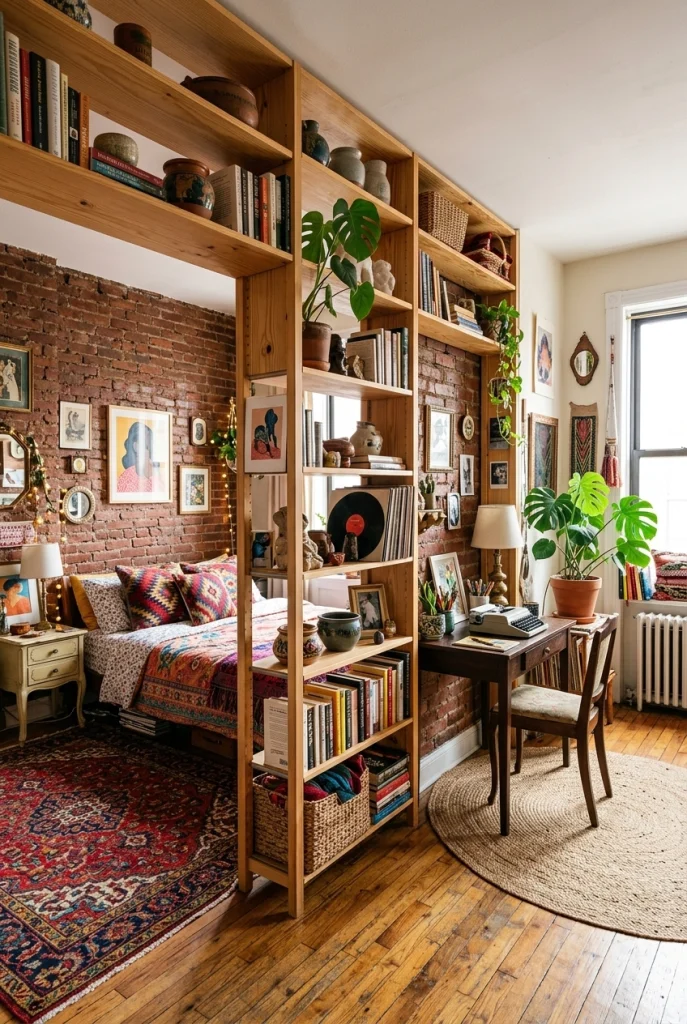
Exposed brick, floor-to-ceiling shelving, a patterned rug under the bed, and a jute rug under the desk all stack together here, with a monstera in the corner and books mixed with ceramics and candles. A pine shelving unit does triple duty as room divider, storage wall, and display surface in one piece, proving a small space can go fully maximalist and still feel intentional.
Tip: A well-curated shelf of objects, books, and plants tells a more interesting story on the walls than art bought just to fill space.
Common small-but-beautiful mistakes
- Playing it too safe with color. Half-measured color choices read as muddled; committing fully to one or two bold walls reads as intentional.
- Choosing a rug that’s too small. A rug under a sofa should hold all four legs, not just the front two, or the zone it’s meant to define won’t read clearly.
- Filling walls with art bought to match the room. A curated mix of books, plants, and objects on a shelf usually tells a more personal story than purchased art.
Quick answers
Does bold color work in a small studio apartment?
Yes, as long as it’s committed to fully, usually on no more than two walls, with the rest of the room staying neutral to balance it.
What’s the cheapest way to define a living zone in a studio?
A large rug under the sofa and coffee table, sized so all four sofa legs sit on it, creates a clear visual boundary at a low cost.
Can a view replace the need for wall art in a studio?
Yes, keeping the palette soft and the window treatments minimal lets a strong view carry the room’s visual interest instead.
What’s the easiest way to build a desk into a studio bedroom?
A small round table beside the bed, paired with a floating shelf above it for supplies, works as a desk by day without looking like an office.
Does an accent wall need real architectural character to work?
No, a single painted wall behind the bed does the same job even without original stone or brick, as long as the rest of the room stays neutral.
How do I keep an all-white studio from feeling flat?
Layer texture instead of color, like linen curtains, a wool rug, and woven accents, so the neutral palette feels rich rather than empty.
Is it better to buy matching furniture or mixed wood tones in a studio?
Mixed wood tones within the same warm family usually look more intentional and collected than a fully matched furniture set.
Final Thoughts
Every idea here comes back to the same point: the size of a space has almost nothing to do with how beautiful it can feel, intention does the real work. Start with one change, a bold wall, the right-sized rug, or floor-length curtains, and let that single decision shift how the rest of the room reads.