
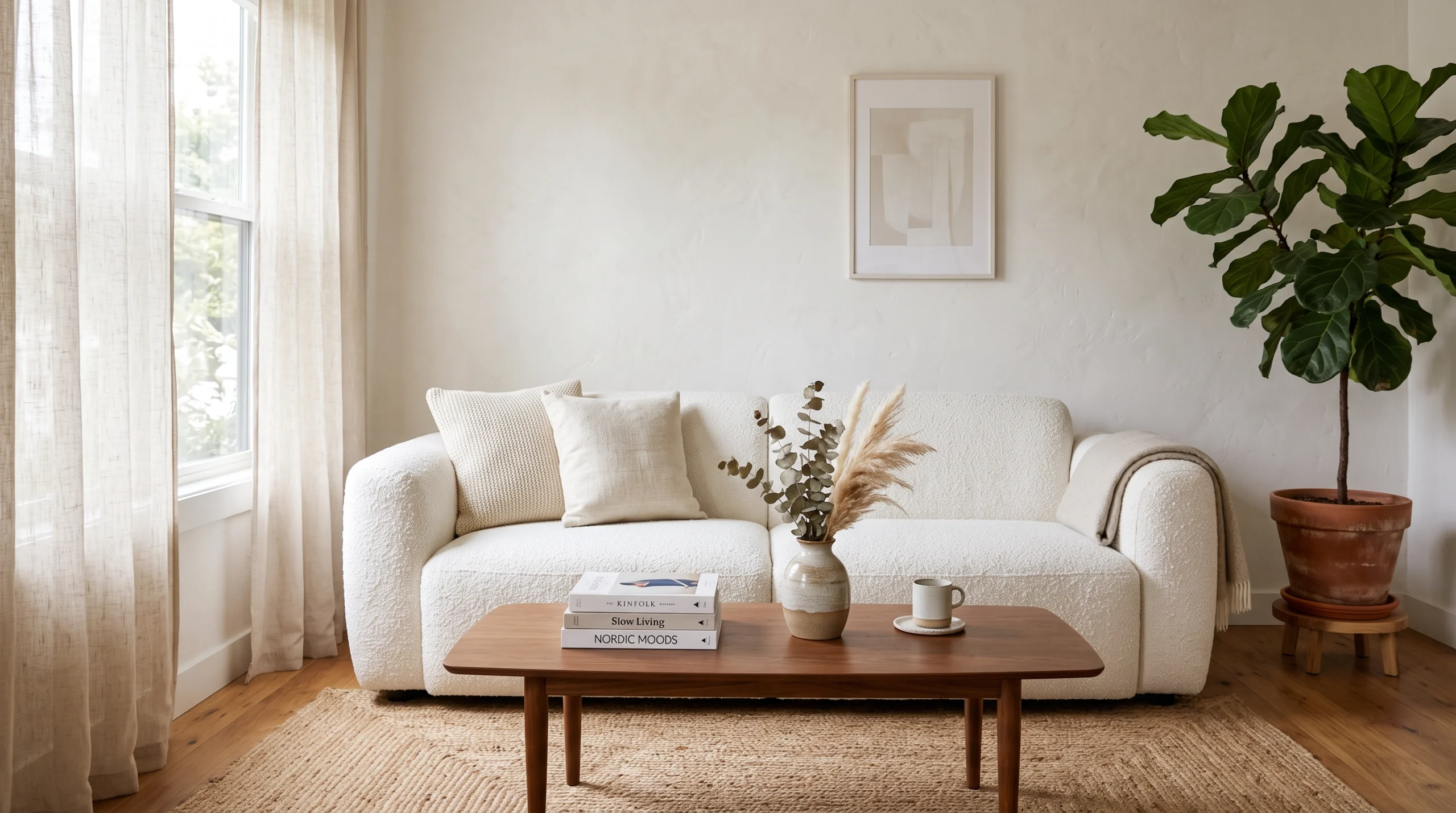
A white couch works in almost any living room because it reflects light instead of absorbing it, which makes the whole space read bigger and calmer.
The trick is texture and layering — a flat white sofa on its own looks like a showroom, but pair it with wood, jute, or one strong color and it looks intentional. Below are 21 ways to do that, from budget swaps to full room plans.
Which white couch look is right for you?
| If you are… | Go with… | Why it works |
|---|---|---|
| Renting an apartment | Slipcovered white couch + rugs/pillows for color | No paint or drilling needed, fully reversible |
| Living with kids or pets | Performance fabric (Crypton, Sunbrella-type) white couch | Wipes clean, resists staining and odor |
| On a tight budget | One white couch + secondhand wood pieces | The couch does the “expensive” work, everything else can be thrifted |
| In a small apartment | Low-profile white couch, no dark rug underneath | Keeps sightlines open so the room doesn’t feel boxed in |
| Wanting a bold, designer look | White couch + one saturated wall or drapery color | High contrast reads as curated, not accidental |
1. Choose a performance-fabric white couch if you have kids or pets

A performance fabric — often labeled Crypton, Sunbrella, or “stain-resistant weave” — is woven or treated so spills sit on top of the fibers instead of soaking in, which means you can blot most messes with just water.
It costs more upfront than a basic cotton-blend, usually by a few hundred dollars, but it’s the difference between a white couch you actually relax on and one you’re constantly protecting. Skip anything labeled “dry clean only” if you have a toddler or a dog that jumps on furniture.
2. Ground it with a jute or sisal rug

A white couch floating on a white or light floor can look unfinished. A jute or sisal rug in a natural tan tone adds warmth and a visible boundary for the seating area without competing with the sofa’s color.
Layer it under the front couch legs only, not the whole sofa, so the rug reads as an anchor rather than wall-to-wall carpet.
3. Go high contrast with black-and-white styling

Pairing a white couch with black-framed art, black metal lamps, or a black coffee table creates instant contrast that photographs well and never feels dated.
It’s one of the most forgiving combinations because black and white don’t compete with an existing wall color, so it works whether you rent or own.
If you want a full room plan built around this pairing, our black-and-white living room ideas guide has more layout options.
4. Pick a slipcovered white couch for a relaxed, coastal feel

Slipcovered sofas have a looser, more casual silhouette than a tailored one, and the covers usually unzip for washing, which matters a lot with a white sofa.
They tend to look best in rooms with linen curtains, woven baskets, and lighter wood tones rather than dark, formal furniture. The trade-off is the slipcover needs occasional re-fitting since it can shift or bunch after washing.
5. Build a full monochrome white room
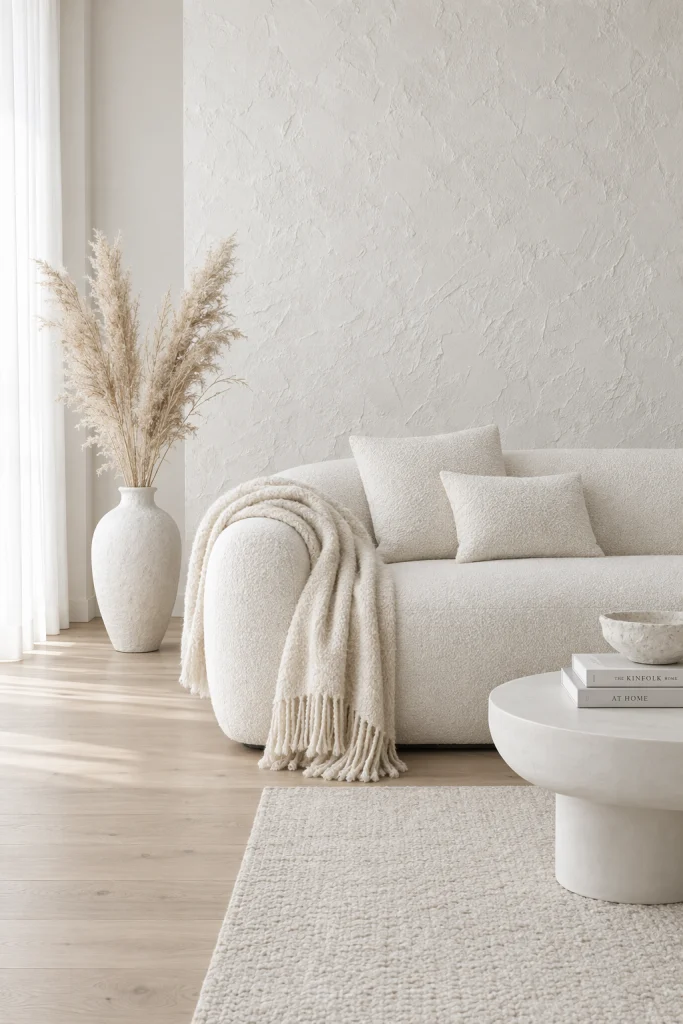
A monochrome living room uses several shades of white and off-white — the couch, the walls, the rug — and lets texture do all the visual work instead of color contrast.
This is the look that photographs cleanest for Pinterest, but it only works if every material is slightly different: matte plaster walls, a nubby wool throw, a smooth ceramic vase.
If every surface is the same flat white and the same smooth finish, the room reads unfinished rather than intentional. For more ways to keep an all-light palette from looking cold, see our light color living room ideas.
6. Warm it up with a beige and cream palette

If an all-white room feels sterile to you, a white couch paired with beige walls, cream curtains, and a camel leather chair softens the whole space.
Beige and white sit close together on the color wheel, so nothing clashes, and the room still photographs bright. This combination hides everyday dust better than pure white walls too.
Our beige living room ideas post has more palette combinations if this direction appeals to you.
7. Add navy blue for a crisp, classic contrast

Navy and white is a pairing that never really goes out of style — think nautical stripes without being literal about it.
A few navy throw pillows, a patterned rug in navy and cream, or navy curtains against a white couch reads polished and put-together fast, and it’s an easy rental-friendly swap since none of it is permanent.
Check out navy blue living room ideas for full room layouts built around this combination.
8. Bring in plants for a biophilic feel

Biophilic design just means bringing natural elements — plants, wood, natural light — into a space so it feels connected to the outdoors rather than closed off.
Against a white couch, greenery reads as the main pop of color, so you don’t need patterned textiles to make the room feel alive.
A 6-inch pothos on a side table fills a bare corner without blocking light, and a larger fiddle leaf fig or rubber plant near a window adds height. For more plant-forward palettes, see our green living room ideas.
9. Use a white couch to make a small living room feel bigger
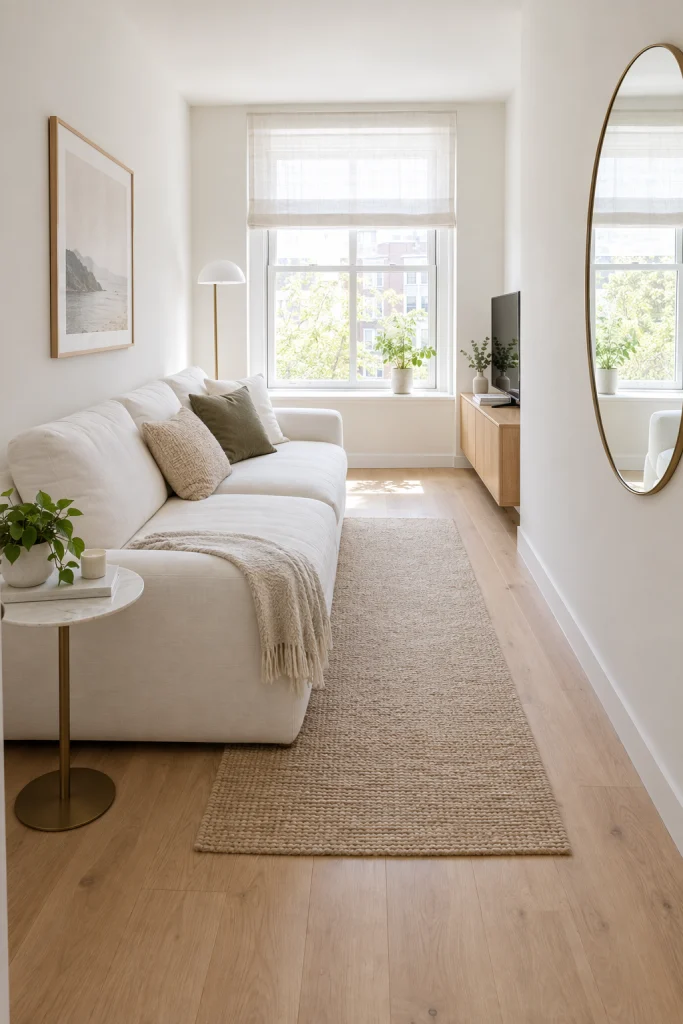
Light-colored, low-profile furniture doesn’t visually “cut” the room the way a dark, boxy sofa does, so a white couch is one of the better choices for a small living room.
Skip anything with high rolled arms or a tall tufted back — a low, simple silhouette keeps sightlines open across the whole room.
Push the couch against a wall rather than floating it if your square footage is under about 150 square feet. Our small living room ideas guide covers more layout tricks for tight spaces.
10. Keep it Scandinavian and minimal
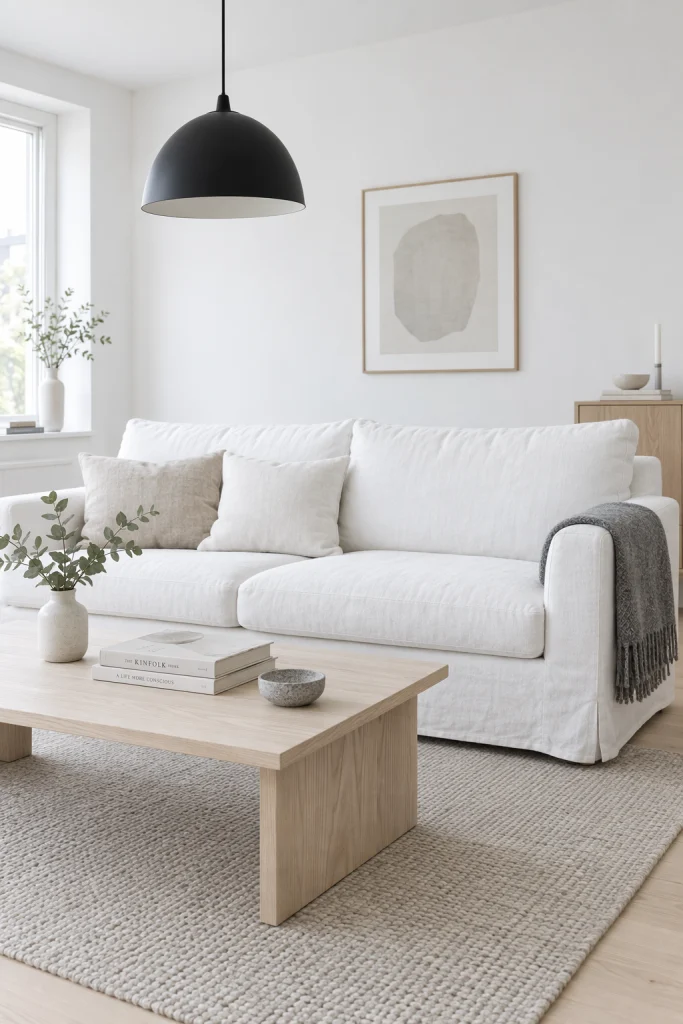
Scandinavian styling means functional, pared-back furniture, light wood, and no more than a couple of accent colors in the whole room.
A white couch is basically the starting point for this look add one light wood coffee table, a single wool throw, and stop there.
The common mistake is adding too many “cozy” layers until it stops looking Scandinavian and starts looking cluttered. For a full breakdown of the style, see Scandinavian living room ideas.
11. Mix in rattan for a modern boho feel

Rattan and white together avoid the “too matchy” trap because the natural, irregular weave of rattan contrasts with the couch’s clean lines.
A rattan accent chair, a woven pendant light, or even just a rattan mirror frame is usually enough — this look gets busy fast if you add more than two or three woven pieces. For a fuller boho room plan, check modern boho living room ideas.
12. Add a moody accent wall behind it
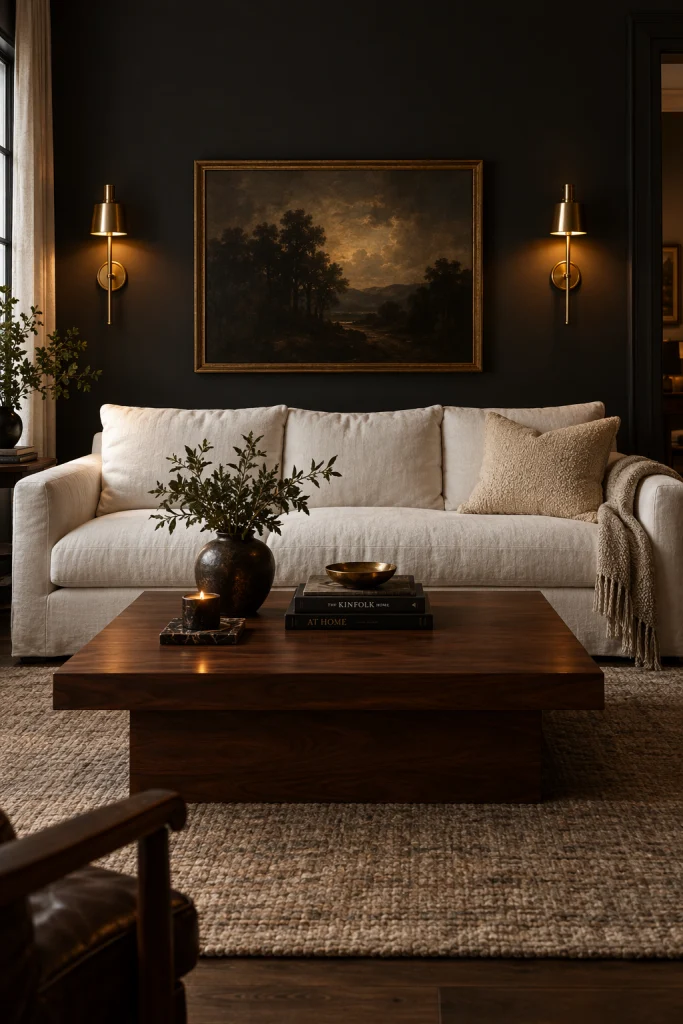
A dark accent wall — charcoal, deep green, or near-black — behind a white couch is one of the highest-contrast, most photogenic combinations you can do, and it makes the sofa the visual focal point of the room.
It’s a bigger commitment than swapping pillows since it usually means painting, so it suits owners more than renters unless your lease allows an accent wall. See moody living room ideas for more dark-wall pairings.
13. Soften it with grey undertones

Not every white couch needs a bright, punchy pairing. A soft dove-grey rug, grey linen curtains, and grey-toned wood furniture keep the whole room in a quiet, contemporary register that’s easy to live with long-term because nothing fights for attention.
This combination also hides everyday shadows and creasing on the sofa fabric better than pure white accessories do. Our grey living room ideas has more on building a full grey-and-white palette.
14. Choose a bouclé or textured white couch instead of smooth cotton
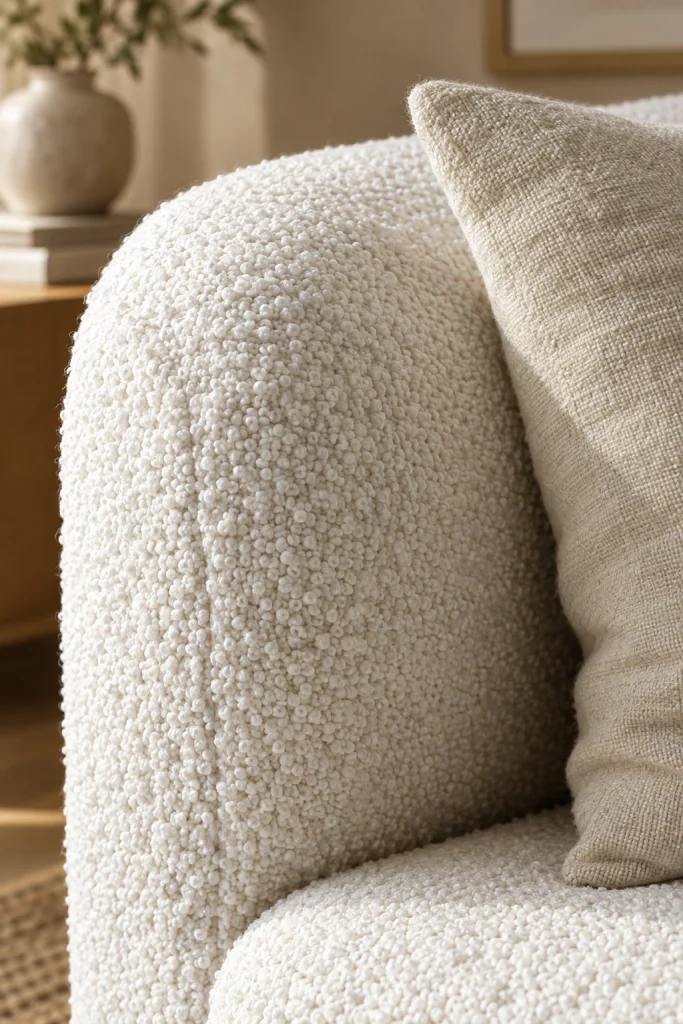
Bouclé fabric has a nubby, looped texture that catches light differently across the cushion, so the couch reads as more dimensional and less flat than a plain cotton-blend white sofa.
It’s become one of the most requested fabrics for exactly this reason — it hides minor wrinkling and lint better than smooth weaves too. The downside is bouclé tends to attract pet hair and can be harder to spot-clean than a tight, flat weave.
15. Layer mismatched white and cream pillows instead of matching sets
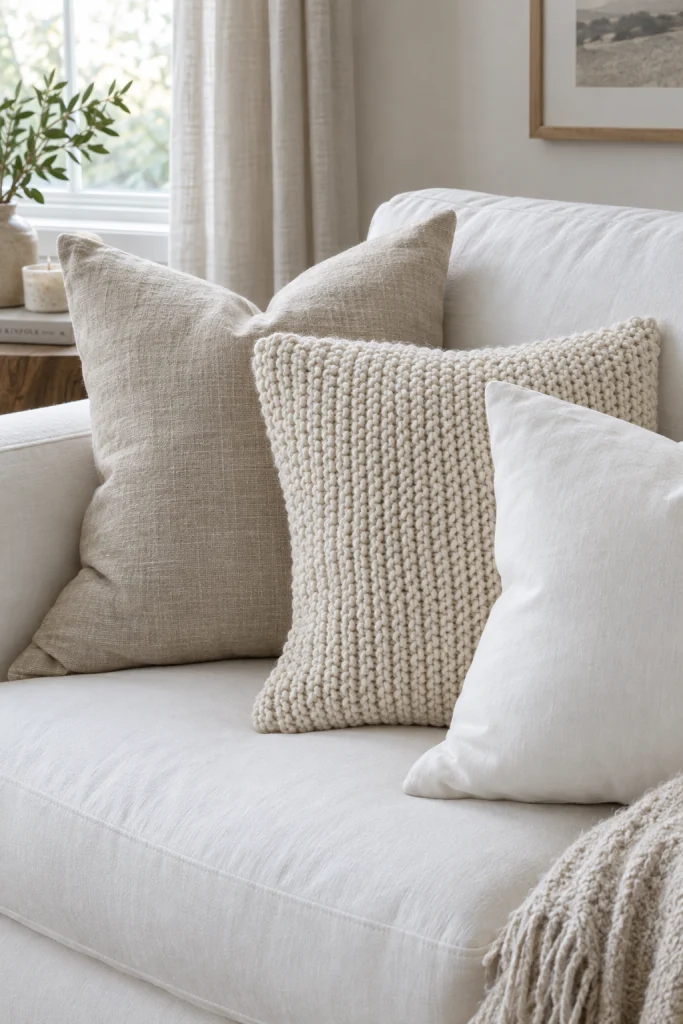
A matching three-pillow set from one collection tends to look like a hotel lobby. Instead, mix two or three different whites and creams in different textures — a linen lumbar pillow, a chunky knit round pillow, a smooth cotton square — and let the texture create the interest instead of a print or pattern. Odd numbers, usually three or five pillows total, look more intentional than an even set.
16. Warm it up with a wood or brass coffee table

A glass or white coffee table in front of a white couch can make the whole seating area feel flat and cold. Swap it for a warm wood table, or a brass-and-glass one if you want something more formal, and the contrast in material immediately grounds the room.
This is one of the cheapest single swaps that changes the whole feel of a white-couch living room, especially if you thrift the table.
17. Try color drenching on the walls and trim
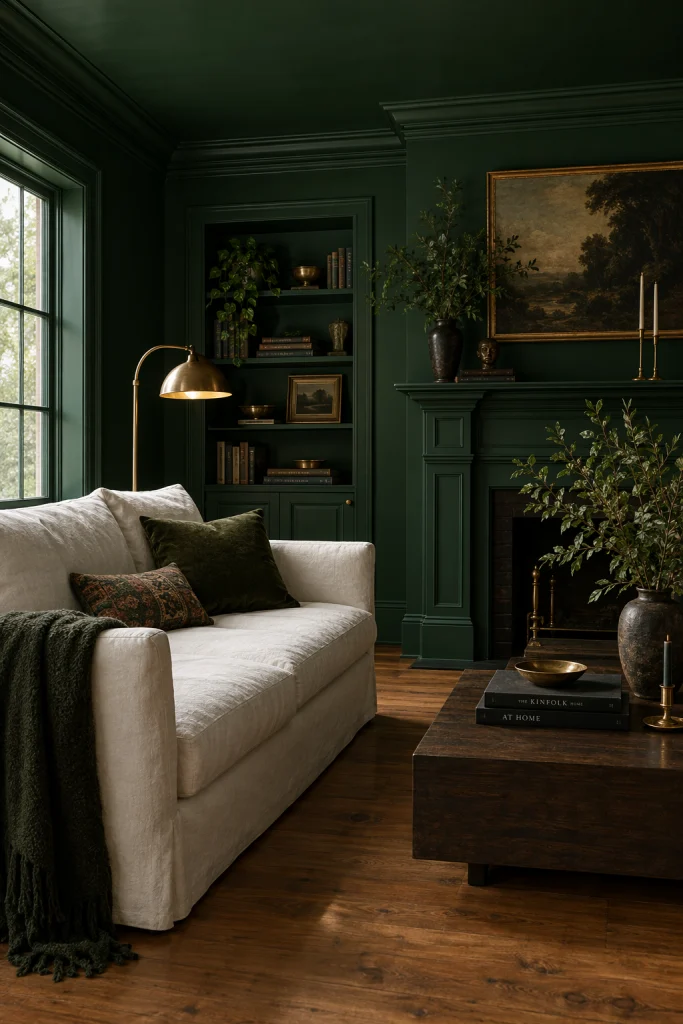
Color drenching means painting the walls, trim, and sometimes the ceiling all in the same color, so the room reads as one continuous tone instead of a white box with colored walls.
Done in a deep terracotta, forest green, or navy, it makes a white couch pop as the single light object in the room. It’s a bigger paint job than a normal wall, since trim and ceiling are included, so budget for more paint and more time.
18. Hang a gallery wall above the sofa

A gallery wall is a cluster of framed art or photos arranged as one visual grouping, usually five to nine pieces of mixed sizes. Above a white couch it gives the eye somewhere to land since the sofa itself has no pattern.
Keep the bottom row of frames roughly 6 to 8 inches above the sofa back so it reads as connected to the seating, not floating near the ceiling. Renters can use adhesive picture-hanging strips rated for the frame weight instead of nails.
19. Go low-back for open-concept sightlines

In an open-concept home where the living room connects to the kitchen or dining area, a low-back white couch (around 30 inches or under) keeps sightlines open across the whole floor plan instead of visually walling off the seating area.
It also tends to look less bulky in photos taken from the kitchen looking in, which matters if you’re staging or planning to sell.
20. Protect a white couch if you’re renting

You don’t need to avoid a white couch just because you’re renting — a washable slipcover, a stain-resistant fabric protector spray rated for upholstery, and a “shoes off” habit near the seating area handle most of the risk.
Keep a spare slipcover on hand if yours is machine washable so you’re never without a couch while one is in the wash.
Skip DIY bleach-based stain removal on colored fabrics nearby, since splashes can discolor a rug or curtain even if the couch itself is fine.
21. Refresh it seasonally with pillows and a throw

A white couch is the easiest base to reset for a season since you’re only changing two or three small items instead of the whole room.
Swap in a plaid wool throw and burgundy pillows for winter, then linen and pale blue for summer, and the couch itself never has to change.
If you like a full seasonal plan around the holidays specifically, our Christmas living room decor ideas post has more on that.
How to choose and style a white couch, step by step
- Pick the fabric based on your household first, not the color. Performance fabric for kids or pets, bouclé or linen if it’s a low-traffic formal room.
- Add one grounding texture underneath — a jute rug or wood floor showing around the edges. This keeps the couch from looking like it’s floating.
- Pick one accent color or one dark material (black, navy, charcoal) to repeat twice in the room. Once is a coincidence, twice reads as a decision.
- Layer three to five mismatched pillows and one throw in different textures, not a matching boxed set.
Common mistake: buying every accessory in the exact same shade of white. Without texture or contrast, the whole room reads unfinished in photos, even though it looked fine in the store.
Why I did this in my own home
I put off buying a white couch for years because I have a shedding dog and a habit of eating on the sofa. What actually made it work was skipping cotton entirely and going with a performance-weave fabric, plus keeping a machine-washable throw over the seat cushions during the week. It’s not spotless. It’s just fast to clean, and that’s the part that actually matters day to day.
Common mistakes with a white couch living room
- No texture variation — every surface the same flat white looks unfinished, not clean.
- Skipping a rug — a white couch on bare floor with no rug can look staged and cold.
- Choosing a dry-clean-only fabric with kids or pets in the house — you’ll avoid using the couch to keep it clean, which defeats the point.
- Matching pillow sets — reads like a hotel room instead of a lived-in space.
- Placing it under direct, unfiltered south-facing sun for years — light fabrics can yellow unevenly over time; sheer curtains help.
Quick answers
Does a white couch make a small room look bigger? Yes — light, low-profile furniture doesn’t visually break up the room the way a dark, bulky sofa does, which helps a small living room feel more open.
What’s the easiest fabric to maintain for a white couch? A performance fabric labeled Crypton, Sunbrella-type, or “stain-resistant weave” is the easiest to maintain since most spills wipe off with just water.
Will a white couch turn yellow over time? Direct, unfiltered sunlight over years can yellow light fabrics unevenly, especially cotton blends. Sheer curtains or UV window film slow this down.
Is a white couch a bad idea with kids or pets? Not if you choose a performance fabric and a washable slipcover — the fabric matters far more than the color for how well it holds up.
What colors pair best with a white couch? Navy, charcoal or black, warm beige, and sage green all pair well since they contrast without clashing against a neutral base.
Do I need a rug under a white couch? Not always, but a rug — especially jute or a soft neutral weave — grounds the seating area and keeps the room from feeling unfinished.
Can renters have a white couch? Yes. A slipcovered white couch is one of the most rental-friendly choices since the cover is washable and none of the styling around it requires paint or drilling.
How often does a white slipcover need washing? Roughly every one to two months with normal use, or sooner with pets or young kids, depending on how visibly it’s marked.
About this guide
This guide is written from real, hands-on decorating experience, not a brand catalog or a press release. Every trade-off mentioned here — fabric maintenance, sunlight fading, rental restrictions — comes from actually living with these choices, not just photographing them.