
A bed doesn’t need a wall to disappear from view — a curtain, a screen, or a strategically placed wardrobe can visually remove it from the room entirely. Here are 13 ways to hide, frame, or soften a studio bed so the room reads as a real home instead of one giant bedroom.
Which bed-hiding method fits your studio?
| Method | Privacy Level | Renter-Friendly |
|---|---|---|
| Blackout curtains | Full — blocks light and sightline | Yes, tension track or rod |
| Sheer curtains | Visual only, light still passes | Yes, no drilling needed |
| Wooden slat screen | Partial — light passes, view softened | Only if freestanding |
| Wardrobe/closet unit | Full sightline block, no light block | Yes, freestanding |
| Glass sliding doors | Full when closed, full light always | Only with a track system you own |
1. Charcoal Blackout Curtains for Real Sleep Privacy
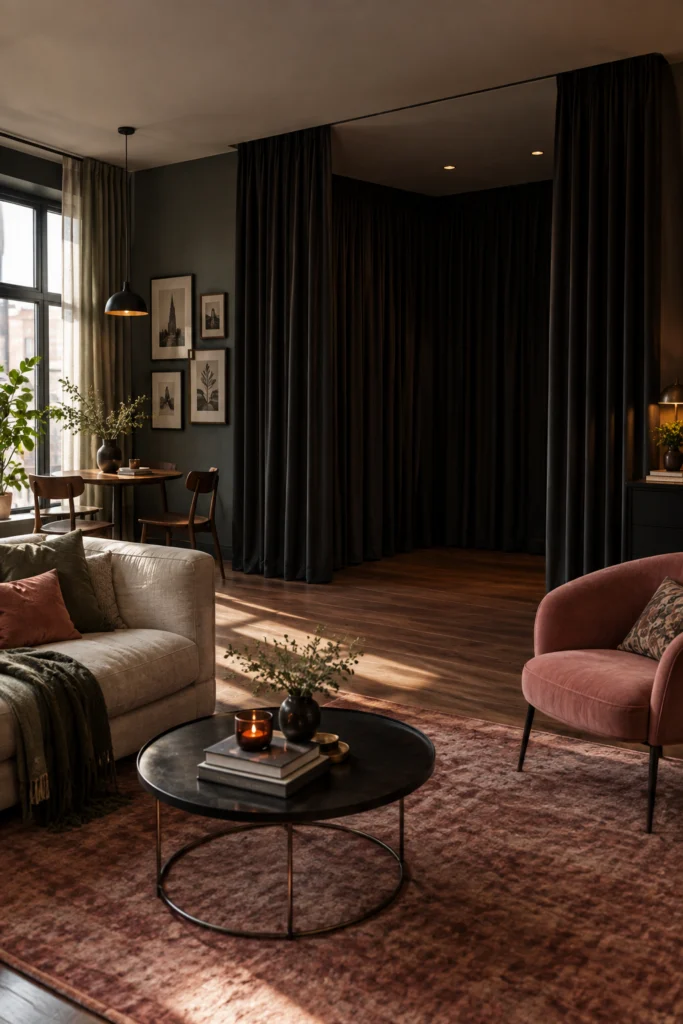
When natural light floods a studio all day — especially through a skylight — blackout curtains on the bed side solve the problem a sheer panel never could. Closing them fully during a nap or an early bedtime blocks both light and sightline, while a soft-colored rug on the living side keeps the rest of the room from feeling as heavy as the curtain fabric itself.
2. Cream Linen Curtains with an Industrial Backdrop

Soft linen against raw concrete and a dark accent wall keeps an industrial studio from feeling cold, without sacrificing any of its edge. A ceiling track lets the curtain slide fully closed at night or tuck away completely during the day, which matters when the rest of the room’s materials — concrete, exposed pipe — stay deliberately rough.
3. White Sheer Curtains with Knotted Tiebacks

Sheer fabric hides a bed from direct sightline while still letting light move through the room, so a studio never feels chopped into two separate spaces. A loose hand-tied knot instead of hardware tiebacks reads as a deliberate styling choice rather than an afterthought curtain job.
Pro tip: Skip the metal tieback hardware entirely — a simple knot tied into the fabric itself looks more relaxed and modern than anything bought separately.
4. Sheer Panels Around a Bright, Cozy Alcove

A ceiling-mounted curtain track turns an ordinary bed corner into a self-contained vignette that reads as its own small room when closed, and disappears back into the open studio when pulled aside. Warm lighting and a round mirror inside the alcove keep it from feeling like a leftover corner rather than a designed one.
5. Layered Navy and Camel Curtains for a Hotel Suite Feel

Layering two curtain colors instead of one signals “designed” rather than “decorated” the moment you walk in, since a single flat panel rarely reads as intentional on its own. Keeping the darker tone closest to the window and the lighter tone on the outer layer adds visual depth that a matched pair of curtains can’t achieve.
6. A Single Curtain Panel for Subtle Zoning

One curtain panel, rather than two meeting in the middle, is often enough to signal a separate zone when the wall behind it is already doing visual work, like a patterned wallpaper. This lighter approach keeps a smaller studio feeling open, since only half the window or alcove is ever covered by fabric at once.
7. A Wooden Slat Screen Instead of Curtains

A slat screen brings the same softening effect as a curtain but with far more texture, since the vertical wood lines add warmth a flat fabric panel never will. You can still see through it, which keeps the bed from fully dominating the room’s sightline while adding a permanent, furniture-grade piece to the space.
Wasif’s honest take: Slat screens are one of the most underrated studio fixes available — they cost less than building a wall and look considerably better in photos.
8. Gray Curtains Framing a Cozy Bed Alcove

Framing curtains that never actually need to close still give a bed its own defined corner, purely through the visual boundary the fabric creates on either side. A matching light fixture and sconces turn the alcove into a proper bedroom vignette even while it stays fully open to the rest of the room most of the time.
9. A Sheer Canopy Draped from the Ceiling

A ceiling-hung canopy doesn’t add real privacy, but it turns the bed into the most atmospheric corner of the room instead of the most exposed one — the effect is entirely about mood, not function. Pairing it with a warm light fixture nearby keeps the canopy from reading flat or costume-like against the rest of the studio.
10. A Built-In Wardrobe as a Room Divider

A wardrobe placed as a divider solves two problems in one purchase — it hides the bed from the room’s main sightline and absorbs the storage a studio usually lacks a closet for. Positioning it so light can still pass around the sides keeps the room from feeling boxed in the way a solid wall-to-wall unit would.
11. Glass Sliding Doors for a Real Bedroom Feel

Glass sliding doors are the biggest commitment on this list, but they’re the only option that closes off the bed completely while never blocking a single ray of natural light through the room. Adding a curtain behind the glass gives you the option of full darkness at night without sacrificing the open, bright feeling the glass provides during the day.
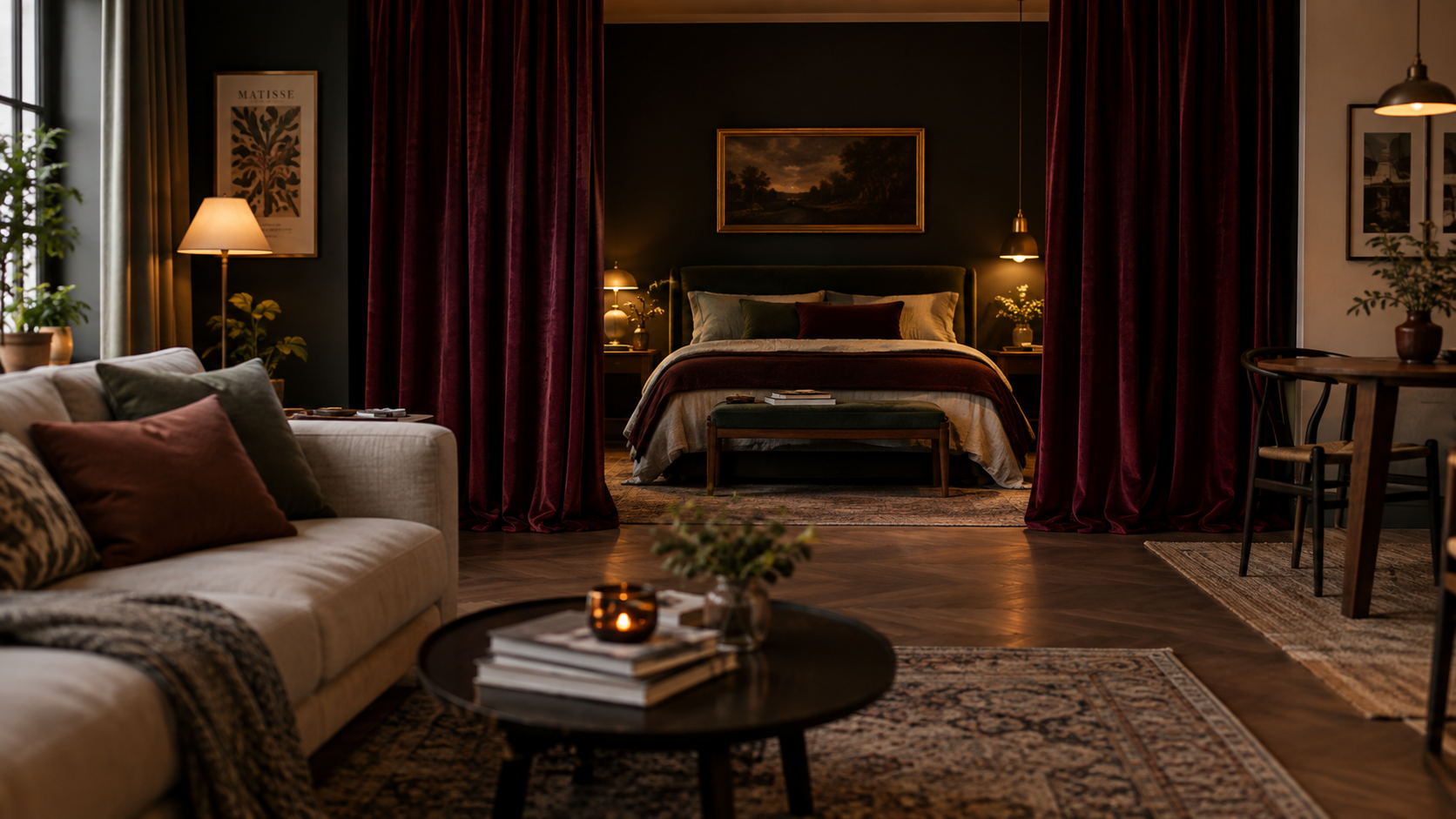
12. Rich Burgundy Velvet Curtains for a Bedroom Nook

Velvet in a deep, saturated color turns a curtain from a purely functional divider into a design statement, especially against a dark wall that lets the fabric catch low light dramatically. Sliding the panels open each morning and closed each night makes the routine itself feel intentional rather than a chore.
13. Soft Linen Curtains That Frame a Cozy Living Zone

Neutral linen curtains do their zoning job quietly, without pulling attention away from whatever the living area’s focal piece is — here, a sage sofa gets to be the star instead of competing with a bold curtain color. Linen also breathes better than heavier fabrics, so the bed side avoids feeling stuffy or cave-like even fully closed.
Common bed-hiding mistakes to avoid
- Choosing blackout fabric when you don’t actually need full darkness. A sheer or linen curtain does the zoning job for most studios without cutting off natural light during the day.
- Picking a solid divider in a small studio. A wardrobe or slat screen works, but a fully solid, floor-to-ceiling panel can make a small room feel smaller instead of more private, a trade-off covered in these studio apartment divider ideas for small spaces.
- Skipping hardware planning before buying curtains. A ceiling track needs to be measured and mounted correctly, or the fabric won’t close fully enough to hide the bed.
- Matching the curtain color exactly to the walls. A slight contrast, even in a neutral palette, keeps the divider from disappearing into the background entirely, worth cross-referencing against these beautiful studio apartment color schemes.
- Assuming a bed-hiding method has to be permanent. Curtains and screens can be swapped seasonally or removed entirely when moving, unlike a glass door installation.
Quick answers
What’s the easiest way to hide a bed in a studio apartment without drilling?
A curtain on a tension rod hides the sightline immediately and requires no permanent installation, making it the most renter-friendly option on this list.
Do blackout curtains work well in a studio apartment?
Yes, especially in studios with excess natural light from skylights or large windows — they fully block both light and sightline when the bed area needs real privacy.
Can a wardrobe double as a room divider in a studio?
Yes — positioning a freestanding wardrobe between the bed and living area blocks the direct sightline while still functioning as normal closet storage.
Are glass sliding doors worth the investment in a studio apartment?
They’re worth it for anyone renting or owning long-term who wants full closure without ever sacrificing natural light, since they’re the only option that does both at once.
What curtain fabric keeps a small studio from feeling closed in?
Sheer or linen fabrics let light pass through even when fully closed, which keeps the studio from feeling chopped into two separate rooms.
Does hiding the bed actually make a studio apartment feel bigger?
Yes — removing the bed from the immediate sightline shifts the room’s visual focus to the living area, which reads as more spacious even though the square footage hasn’t changed.
The linen curtain was the cheapest fix I made in my own studio, and it did more to make the space feel like an actual apartment than any furniture change — guests stopped commenting on the bed the moment it wasn’t the first thing they saw.