
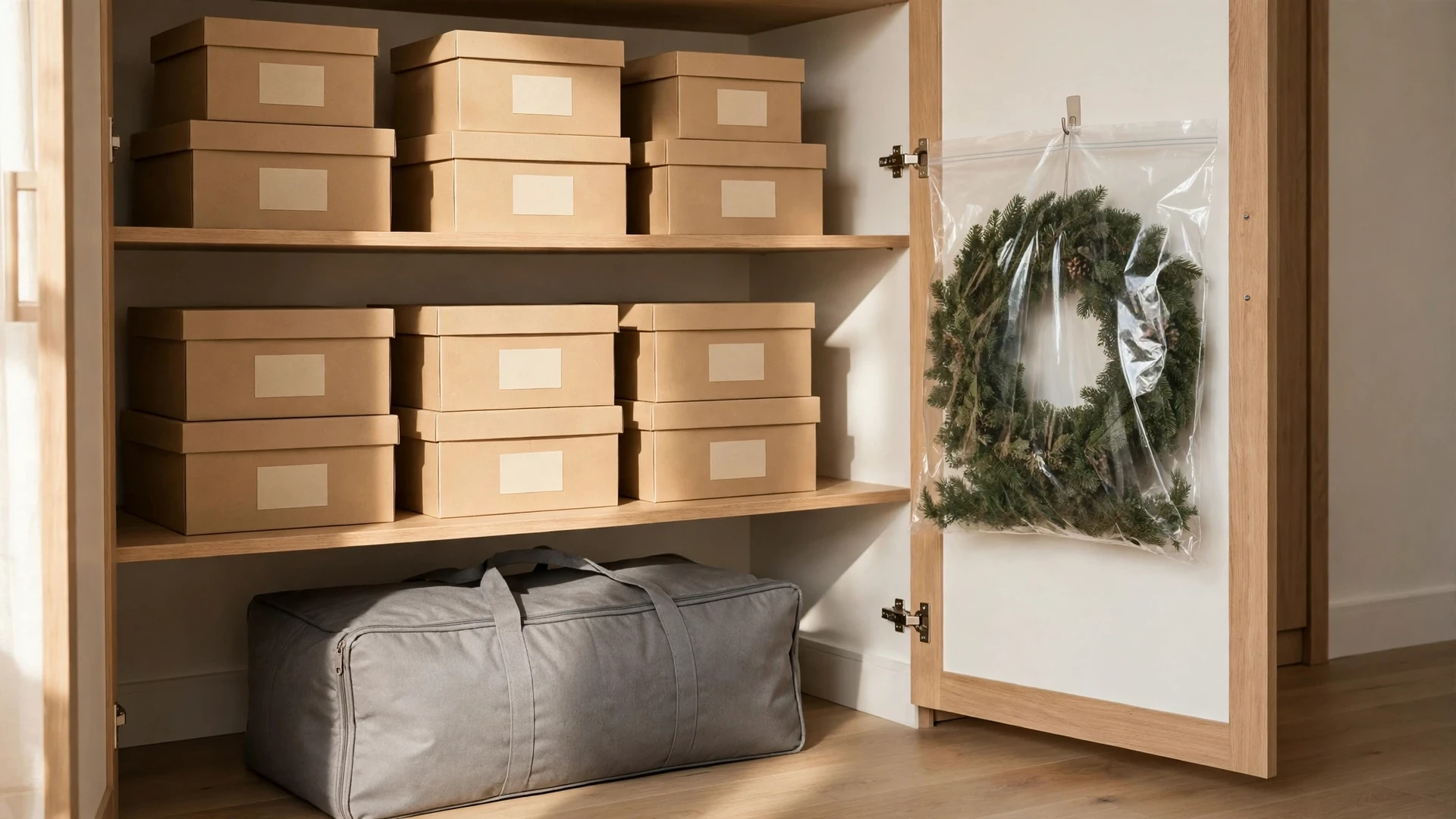
Christmas decorations are an investment, and most of the damage happens in the eleven months they spend in storage, not the one month they spend on display. The difference between decorations that last five years and decorations that last twenty is almost entirely how you pack them away.
Sort Before You Store (Keep / Donate / Throw Away)
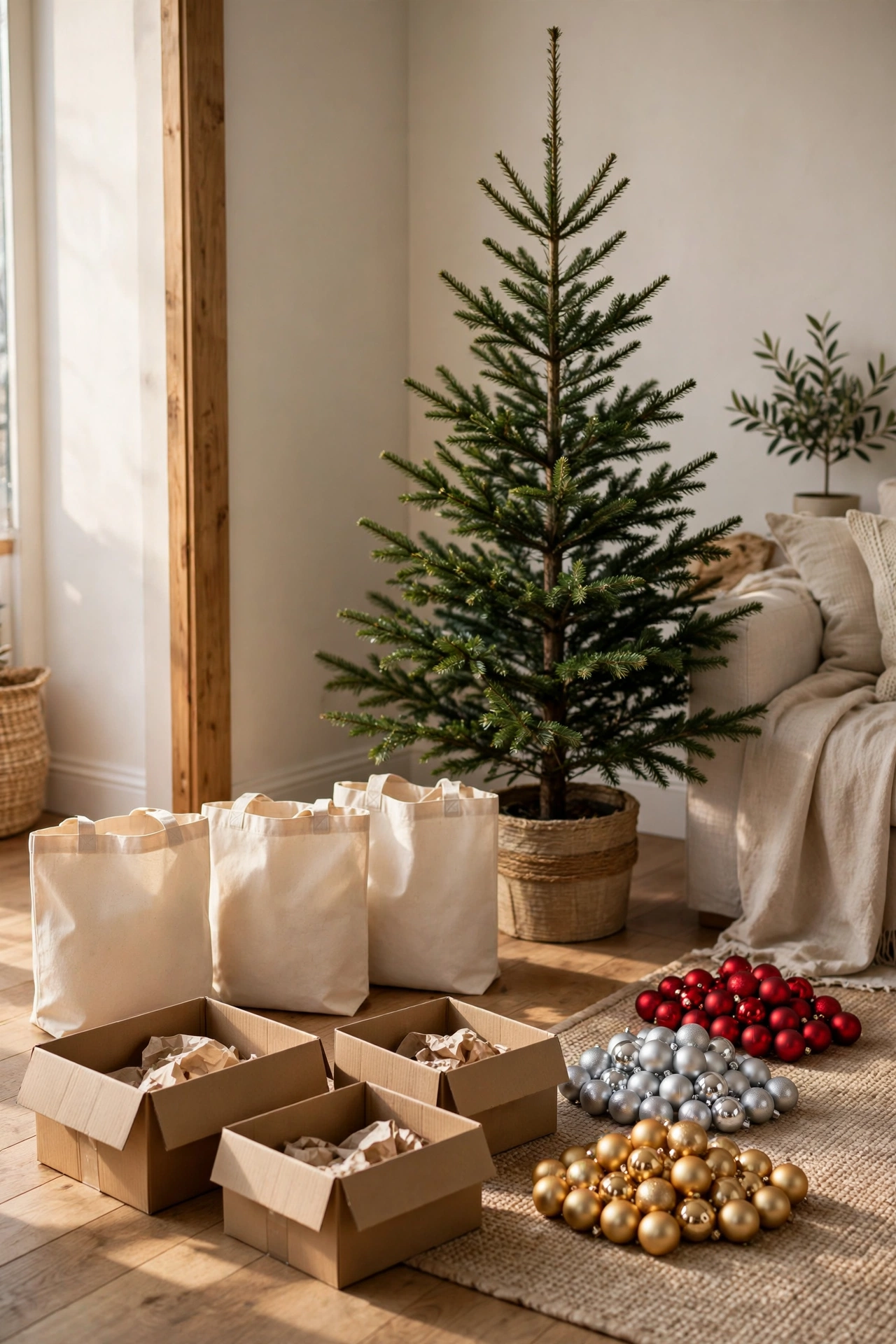
Do the sorting while you take the decorations down, not in June when you have forgotten what you own. Set out three bags or boxes labelled keep, donate, and throw away, and everything comes off the tree and into one of the three. No fourth pile, and no “maybe” box.
Keep means you used it this year, or you love it enough to display it again next year: a handmade ornament from a child, a set of glass balls in your main color, the star that has topped your tree for years. Donate means it is in good shape but unused for two Christmases in a row, including duplicates.
Throw away means broken, faded, or missing parts. A string of lights with half the bulbs dead and no spare bulbs is not a decoration, it is a chore you are postponing, and a cracked ornament is not going to fix itself in a box. Be honest about it now, because in December you will not want to do this job again.
Most households can cut 20 to 30 percent of their decoration volume in this one step — a whole box you no longer have to store, carry, and trip over. 17 Unique Christmas Tree Ideas to Dazzle Your Holiday Decor
Ornaments: The Wrap That Actually Prevents Breakage
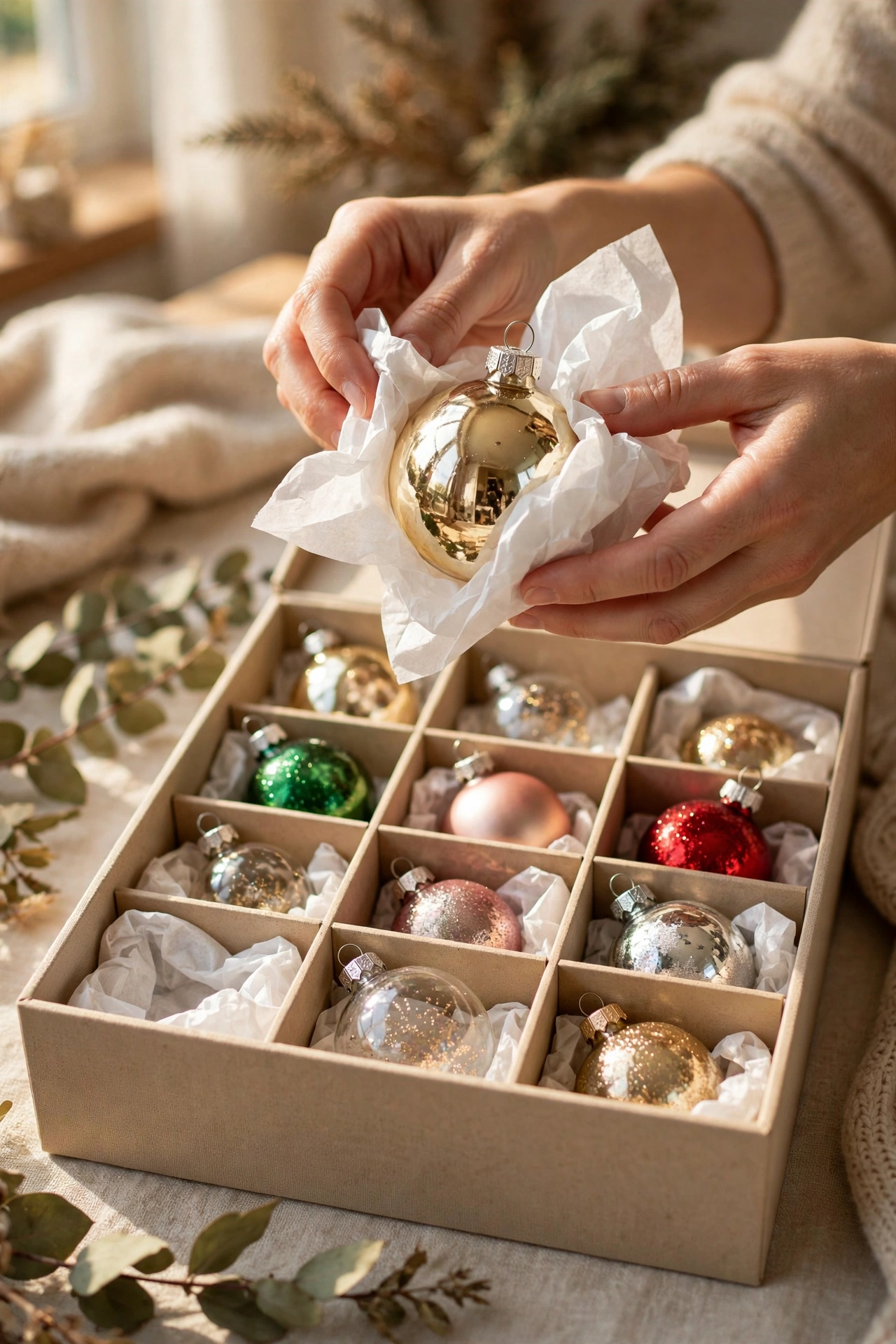
Ornaments break for two reasons: they knock against each other, and something heavy lands on them. Good storage solves both. Wrap each fragile ornament individually in tissue paper — not newspaper, which can transfer ink, and not a shared wad of paper, which lets them knock together anyway.
Then put them in a box with dividers. Purpose-made ornament boxes with cardboard compartments work best, because each ornament gets its own cell and cannot slide into its neighbour — a sturdy box with dividers cut to size works just as well. Put the heaviest ornaments at the bottom and the lightest at the top, and never stack a heavy box on an ornament box.
Glass baubles should never share a compartment — one per cell, no exceptions. Shatterproof ornaments are more forgiving and can share a larger compartment, but they still need tissue between them so the finish does not scratch. Remove hooks before packing, or tape each hook flat, because a loose hook scratches the ornament next to it.
For small ornaments, an egg carton works surprisingly well as a divider — one ornament per cup, tissue on top, lid closed. Whatever box you use, store it upright, label it fragile on two sides, and never put an ornament box at the bottom of a stack.
Lights: The Wrap-and-Coil Method That Stops Tangles
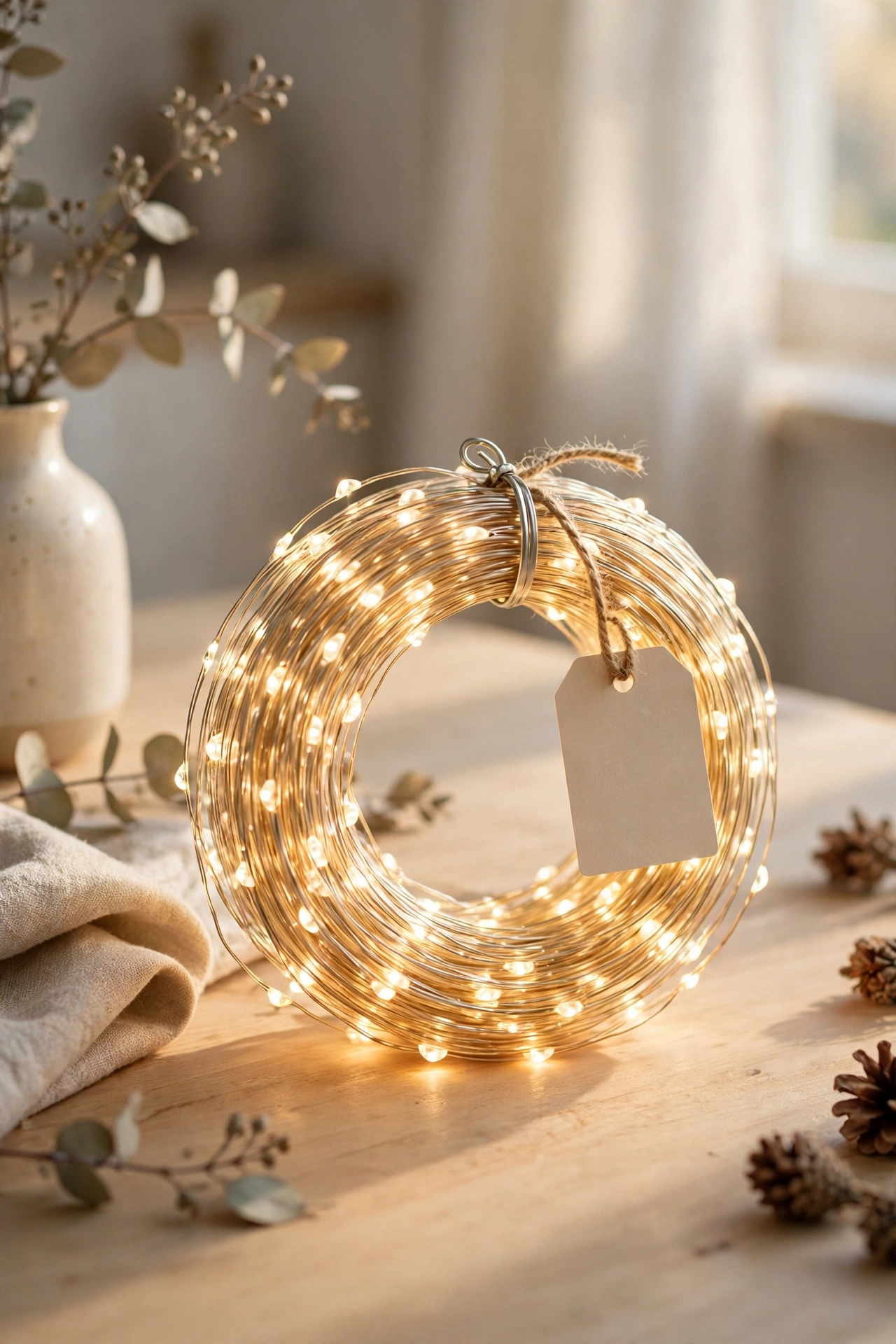
Tangled lights are the single most common reason people throw decorations away and buy new ones.
First, test every strand before you pack it. Plug it in, check every bulb, and replace the dead ones now while you still remember which strand they belong to. If more than a third of a strand is dead, replace the strand rather than storing a problem for next year.
Then coil the strand. Hold one end in your hand and wrap the strand around your elbow and back to your hand, making a neat loop about 30 cm across — or wrap it around a flat piece of cardboard cut to roughly the same size. Secure it with a twist tie or a fabric strap, never a knot, because a knot is where the tangle starts.
One strand per bundle, always — two strands coiled together will tangle no matter how carefully you wrap them. Label each bundle with its length and where it goes: “tree, 100 lights” or “mantel, 50 lights”. Store the bundles flat in a box or a bag, not hanging in a heap from a hook, where the weight pulls the coils apart over the months.
The Tree: Bag vs Box, and Where to Keep It
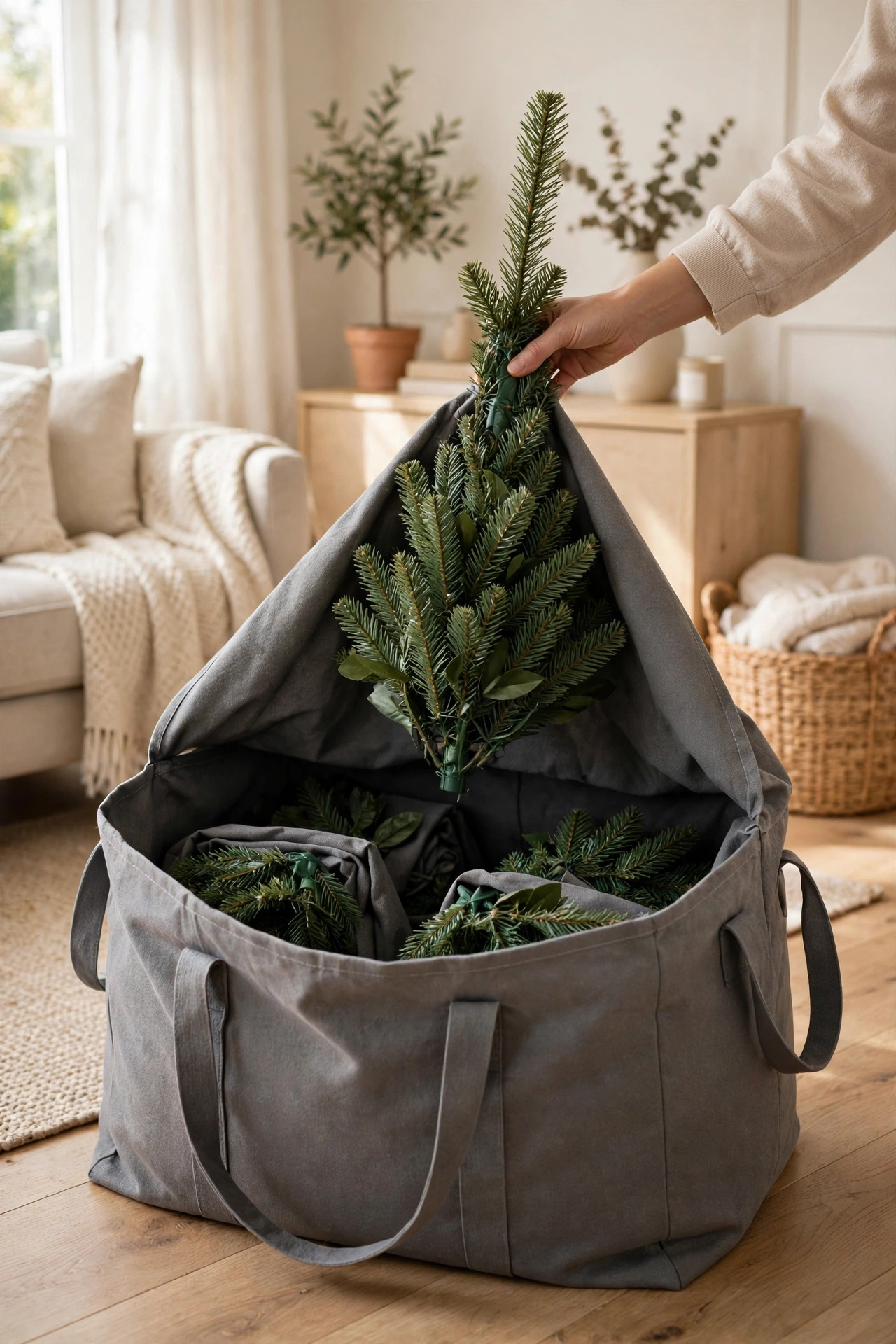
For an artificial tree, you have two real choices: the original box or a storage bag. The box protects the shape better, but it is awkward to carry and falls apart after a few years. A storage bag with handles is easier to move, kinder to the branches, and lasts longer. I recommend the bag for most people, as long as it is a proper tree bag, not a bin liner that splits the first time you lift it.
Pack the tree in its sections, working from the top down. Compress the branches gently upward toward the trunk — never crush them flat or bend them backwards — and fold hinged branches in the direction they were designed to fold. Stuffing a tree into a bag that is too small is how branches snap, so buy the bag one size larger than you think you need.
The tree skirt and the topper go in their own bag, stored flat or rolled, never folded hard into a small square.
Where the tree lives matters as much as how it is packed. Dry, cool, and off the floor is the rule. A spare-room cupboard or a dry closet is ideal; a dry garage works too if the bag sits on a shelf rather than on concrete. Avoid hot attics if you can — sustained heat dries out the branches and fades the color over a few summers. And a real tree does not get stored at all: take it to a recycling point or a collection service in January and start fresh next year. 19 White Christmas Tree Ideas Designers Swear By This Year
Wreaths and Garlands Without Crushing Them
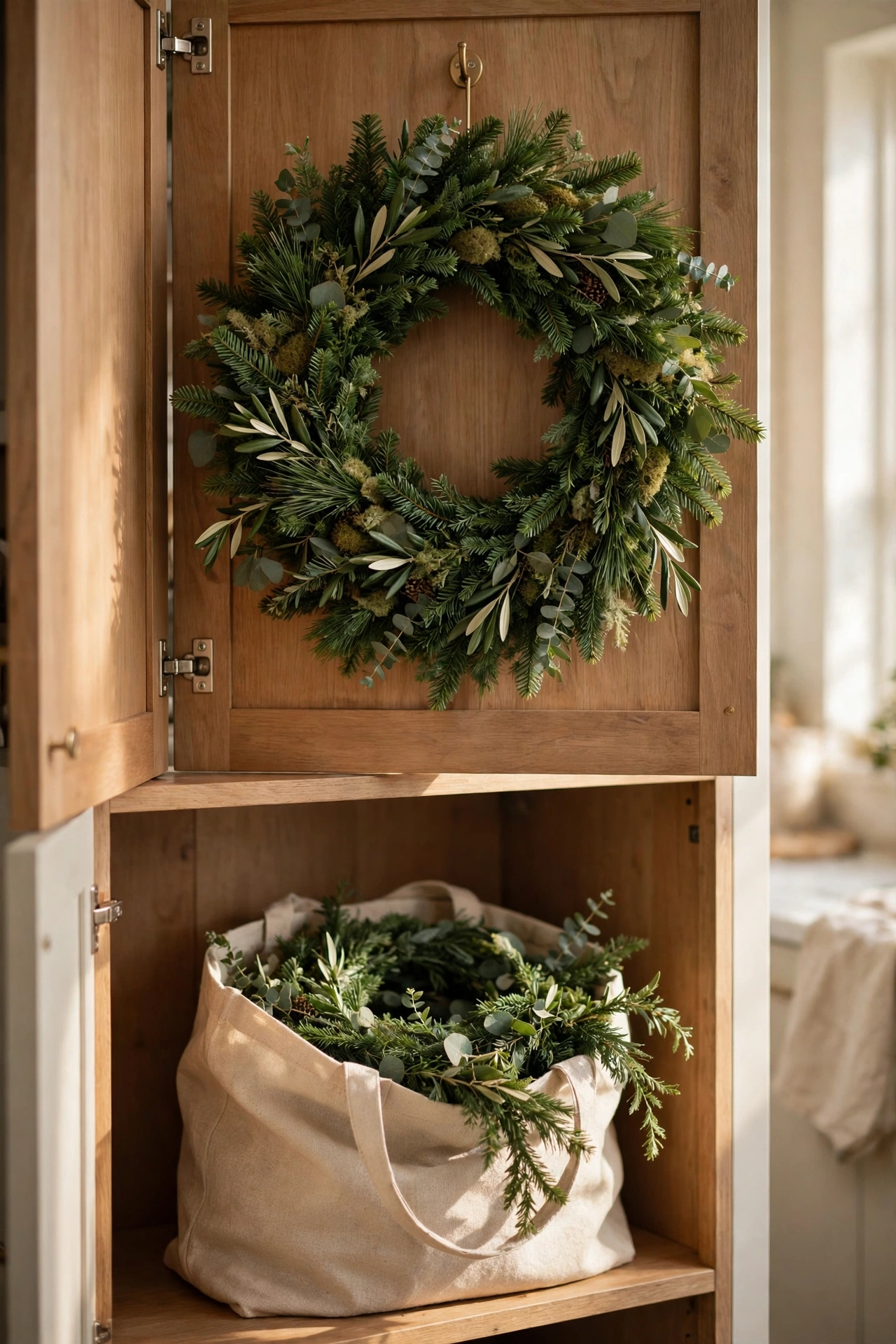
Wreaths and garlands are the decorations most often ruined in storage, and the reason is simple: people stack things on top of them. A wreath is a circle of delicate material — put a box on it and it will be flat by February.
The best way to store a wreath is to hang it: a hook on the inside of a storage cupboard door, a nail on a garage wall, or a hanger inside a garment bag all work. A purpose-made wreath bag with a hanger loop is the tidiest option, and it keeps dust off too. If you must lay a wreath flat, put it in its own box with nothing on top of it, and label the box “do not stack” in large letters.
Garlands need the same thinking. Coil a garland loosely in a large bag or box, the way you would coil a rope, and do not fold it tight or kink it. Keep berries, picks, and pinecones attached if you can, but protect them with tissue so they do not snag the garland next to them. A garland folded hard in the same place every year will eventually break at that fold.
Store wreaths and garlands away from anything heavy, and away from damp. A damp garage will grow mould on a natural wreath in one winter, and a garland stored under a box of books will come out flat.
Labelling That Saves an Hour Next December
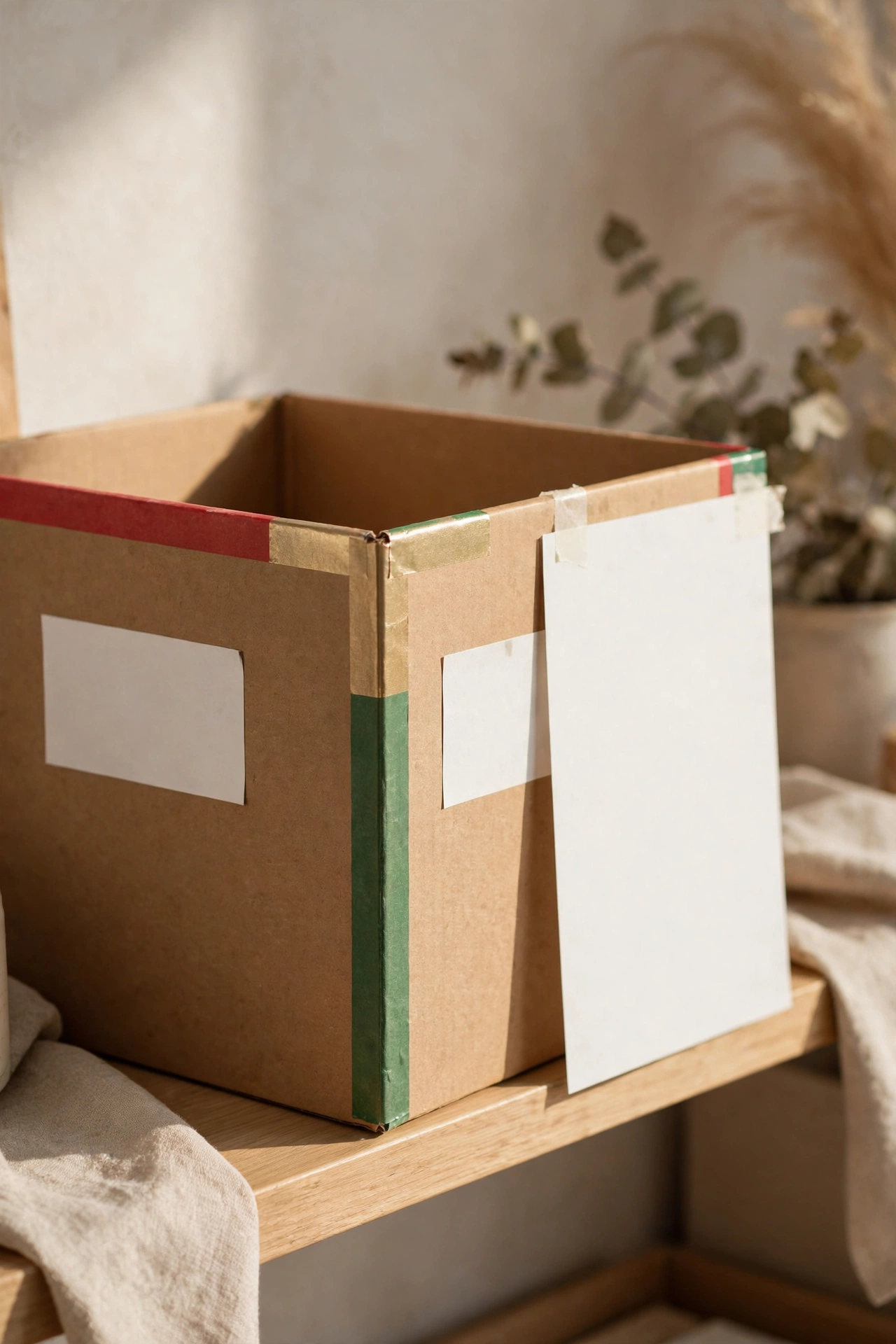
Good labelling is the difference between a calm hour of decorating and an afternoon of opening every box to find the tree topper. Label every box on two sides and the top, because you will never remember which side faces out in a cupboard. Write what is inside and which room it belongs to — “tree ornaments — living room” is far more useful than “Christmas”.
Number the boxes and keep a one-page list: box 1, tree ornaments; box 2, lights and extension cords; box 3, wreaths and garlands. Tape the list inside the cupboard door, or keep it in the first box you open. When you buy something new in the January sales, add it to the list at the same time, while you still remember what it is.
Label the lights by location as well as by length — “tree, 100 lights” and “porch, 50 lights” stop you uncoiling three strands to find the right one.
Color-coded tape is the fastest system of all if you have a lot of boxes: one color per room — red tape for the living room, green for the porch, gold for the tree — and you can find the right box without reading a single label. 23 Christmas Front Porch Ideas That Will Have Everyone Stopping to Look
Where to Store It All (Closet, Under-Bed, Garage Rules)

Wherever you store your decorations, three rules apply: dry, cool, and off the floor. Everything else is detail.
A spare-room closet is the best spot for most people: dry, inside the house, and easy to reach. Ornaments and small boxes go here, on shelves rather than on the floor, with the fragile boxes on top.
Under the bed works well for flat things: wreaths in flat boxes, garlands in long shallow bins, the tree skirt rolled in a bag. Measure the clearance first — most beds give you 15 to 20 cm, enough for a flat wreath box but not for a deep ornament box.
A garage is fine only if it is dry. Use sealed plastic bins, never cardboard, because cardboard wicks moisture from concrete and softens over a winter. Put the bins on a shelf or a wooden pallet, never directly on the floor, and check the garage roof for leaks before you trust it with a box of glass ornaments.
Attics are the riskiest option. Summer heat can soften glue, melt candle wax, and fade colours, and it can damage anything with batteries left inside. If the attic is your only option, keep candles, glued ornaments, and battery decorations in the house, and use the attic only for the tree, the garland, and the plastic bins. Basements have the opposite problem: damp — if the walls ever feel wet, do not store decorations there at all.
Finally, keep one box accessible at the front of wherever you store things. Call it the first box: tree skirt, topper, tree lights, and the extension cord.
Quick answers
What is the best way to store glass ornaments? Wrap each one individually in tissue paper and put it in its own compartment in a divided box, heaviest at the bottom. Never pile loose glass ornaments together in a bag, and never stack a heavy box on top of an ornament box.
How do I keep Christmas lights from tangling? Coil each strand separately around your elbow or a flat piece of cardboard, secure it with a twist tie, and label it with its length and location. One strand per bundle, stored flat — never knot a strand, and never coil two together.
Can I store decorations in the garage? Yes, if the garage is dry. Use sealed plastic bins on a shelf or pallet, never cardboard on concrete. Check for roof leaks first, and keep anything fragile or valuable in the house instead.
Should I keep the original boxes? Keep the tree’s original box only if it is still in good shape; a proper storage bag is usually easier and lasts longer.
How long do Christmas decorations last? With proper storage, glass ornaments last ten to twenty years, artificial trees last seven to ten seasons, and light strands last five to ten seasons. Most decorations fail in storage, not on display — which is why the packing method matters more than the price.
Final thoughts
Storing Christmas decorations well is not complicated. Sort them while you take them down, wrap what breaks, coil what tangles, label what you will forget, and keep everything dry, cool, and off the floor. Do that once, and next December you will open boxes that look the way you left them.

Hi, I'm Wasif — welcome to The Homes Decors. I write about home decor: the ideas, choices, and small details that make a space feel considered rather than accidental. If you've ever wondered why a room works, not just what's in it, you're in the right place.