
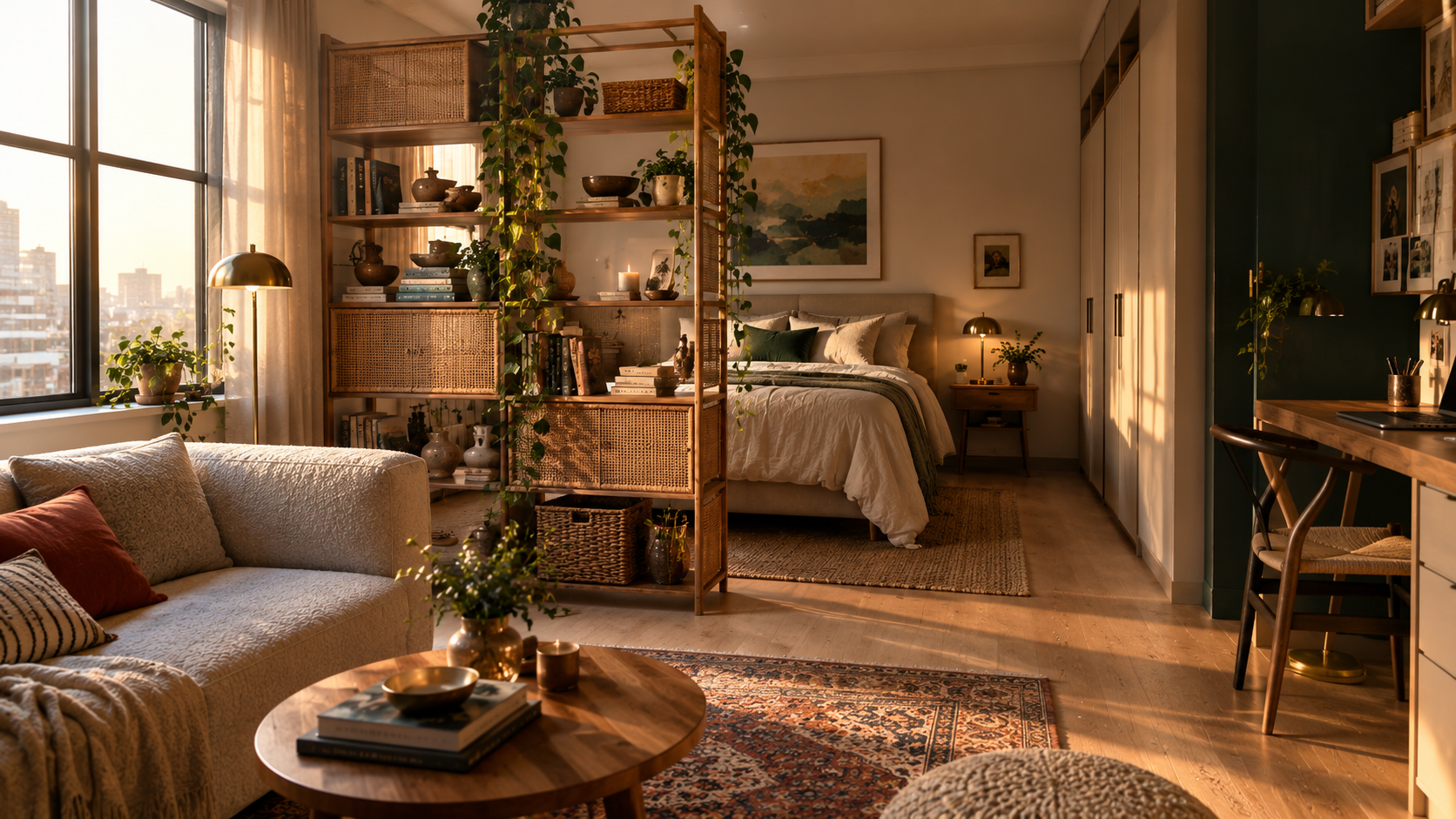
A studio works when three zones — sleep, seating, and storage — read as separate rooms without a single wall going up. The fastest way there is a shelving divider, a curtain, or deliberate color blocking, paired with furniture actually sized for the square footage you have. Here are 14 layouts, each built around one specific technique that does the zoning.
Which zoning method fits your studio?
| Method | Renter-Friendly | Privacy Level | Best For |
|---|---|---|---|
| Open shelving/bookcase | Yes (freestanding) | Medium — see-through | Storage-short studios |
| Curtain track | Yes, no drilling with tension rods | Low-medium | Visual softness |
| Glass or acrylic partition | Only if freestanding | High light, low sound privacy | Bright rooms, one window |
| Paint or wallpaper zoning | Check lease first | None (visual only) | Owners, long-term renters |
| Plants + furniture layout | Always | None (visual only) | Anyone, zero installation |
1. Neutral Scandinavian Minimalism with Warm Lighting
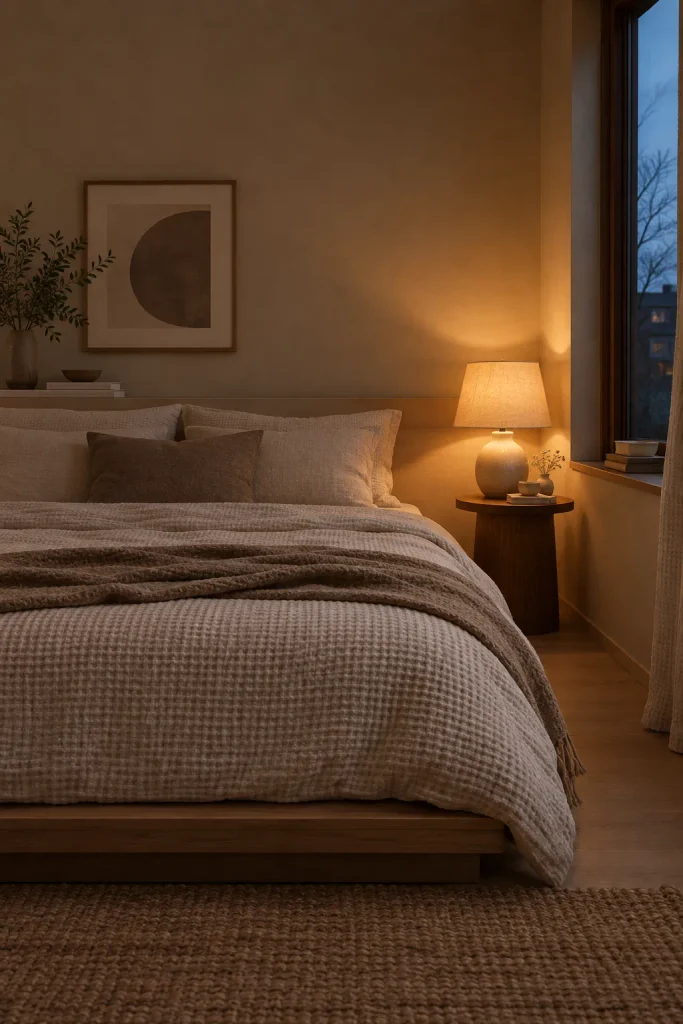
Scandinavian minimalism in a studio isn’t about having less — it’s about making sure every lamp is doing double duty as light source and zone marker. Skip the ceiling fixture entirely and rely on two or three warm-toned table and floor lamps placed at the edges of each zone. The eye reads “different room” the moment the light source changes, even without a wall.
2. All-White Airy Studio with Soft Lavender Accents
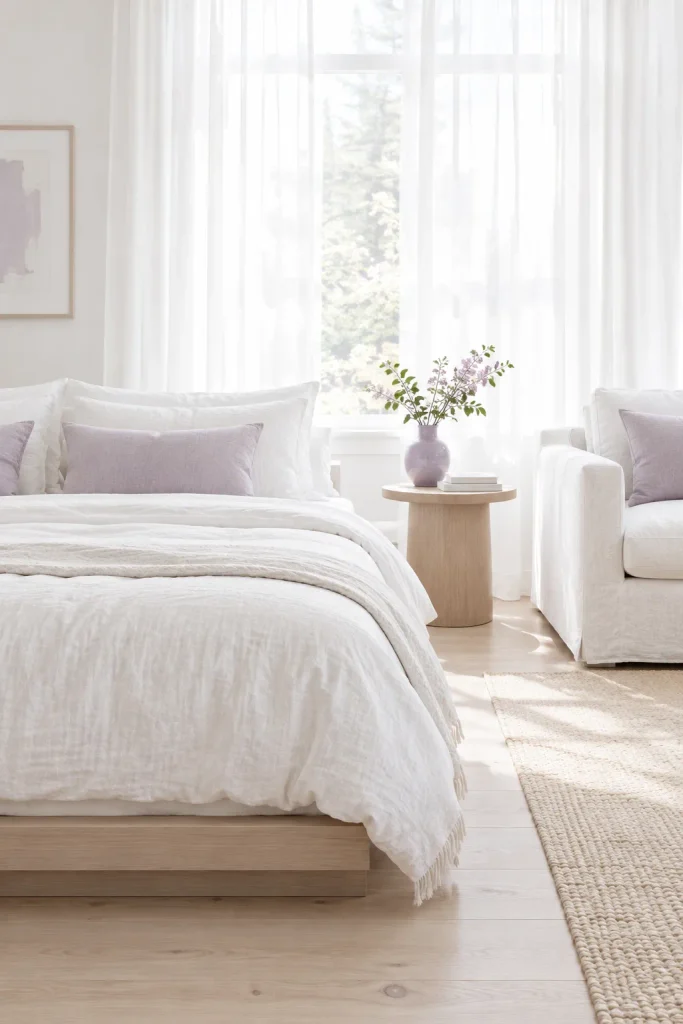
White studios photograph larger because light bounces instead of getting absorbed — but an all-white room with zero color reads clinical. One muted color, kept strictly to soft goods (pillows, a vase, a throw), fixes that without touching the walls. Lavender specifically reads calm rather than cold, which matters in a room that’s also your bedroom.
3. Warm Gold Walls with a Multi-Zone Layout
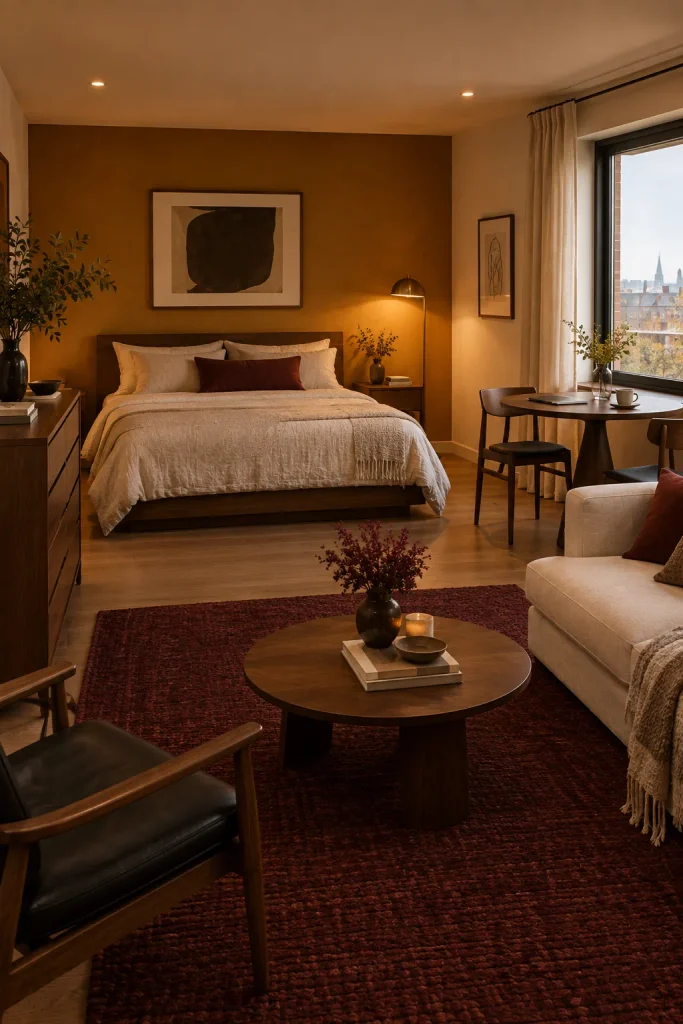
One warm wall color, used consistently across the whole studio rather than confined to a single accent, is what actually ties three separate zones together visually. Paint the wall behind the bed, then repeat the same undertone in a rug or a throw in the seating area — the color, not a physical divider, is doing the zoning here.
4. Cozy Classic with White Brick and Yellow Bedding
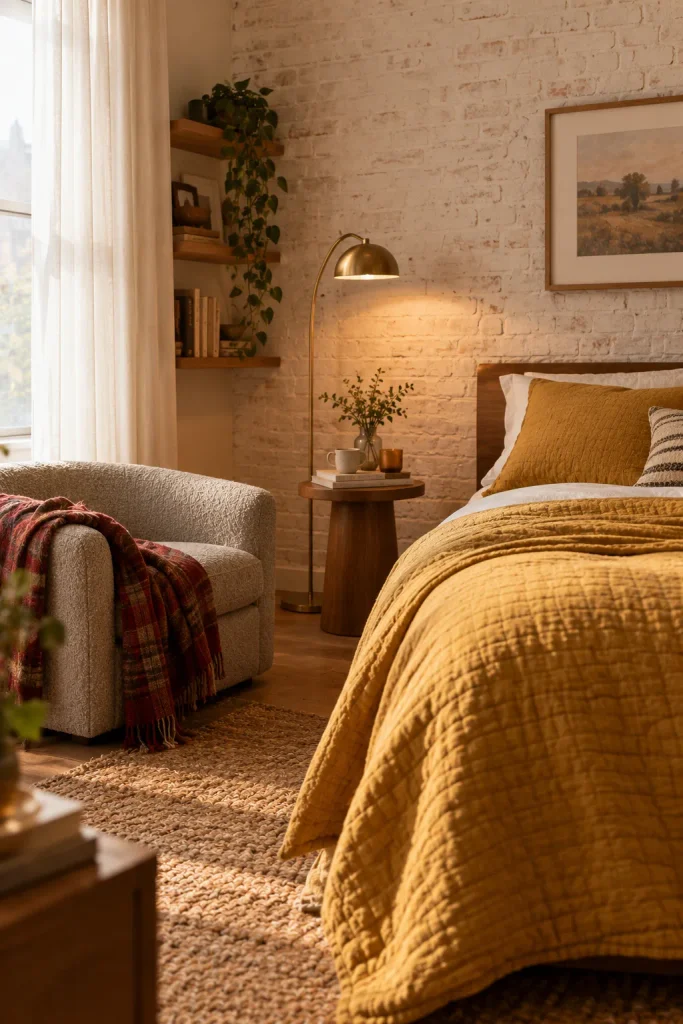
Exposed brick adds texture to a flat wall without eating into floor space, and whitewashing it keeps the room bright instead of turning it into a basement-bar look. Mustard bedding against white brick reads warm and collected rather than themed, especially when the rest of the palette (grey, jute, wood) stays quiet.
5. Hygge-Style Studio with Layered Textures
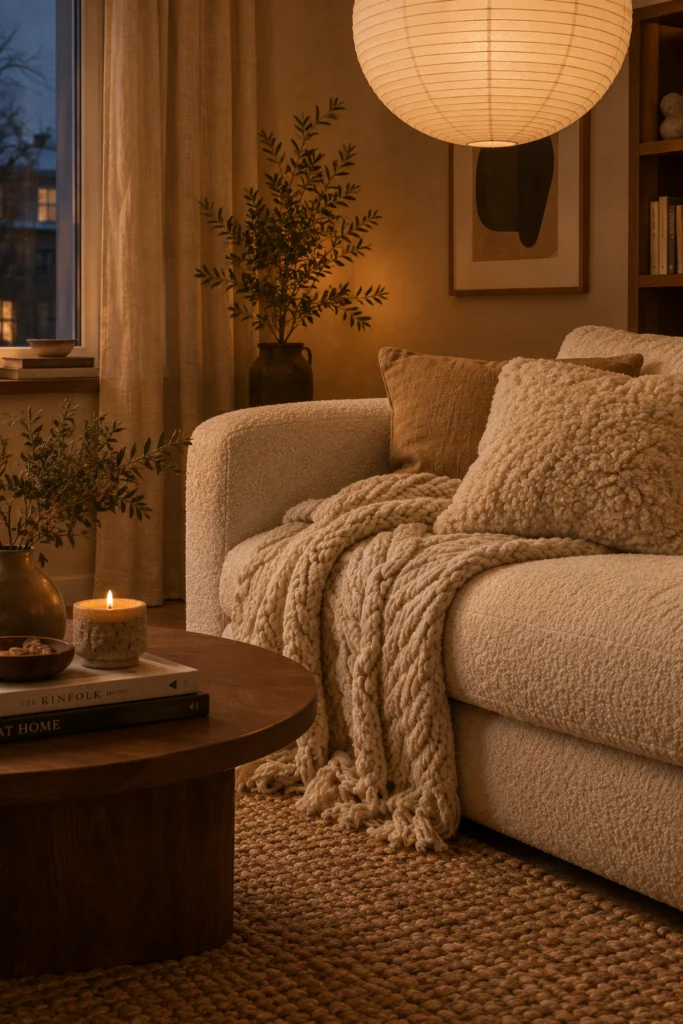
Texture does more visual work than color in a small room — it reads as “styled” even in an all-neutral palette. Stack at least three different textures within arm’s reach of the sofa: something knit, something woven, something soft-pile. A single paper or linen pendant overhead keeps the light warm instead of clinical.
6. Grey and Red with a Bookshelf Room Divider
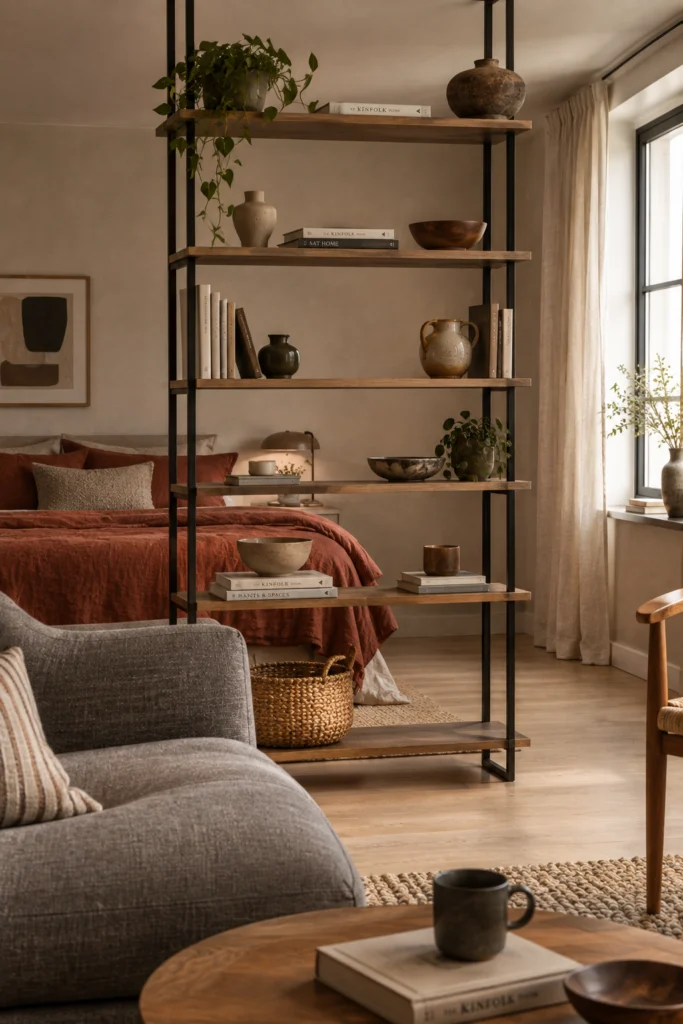
An open shelf divider works as a wall substitute only if you resist the urge to fill every cube — leave roughly a third of the shelving empty so light and sightlines still pass through. Grey furniture with one saturated red accent (bedding, a single chair) keeps the divided room from feeling chopped into two competing spaces.
7. Colorful Curtain Zoning with Purple and Green
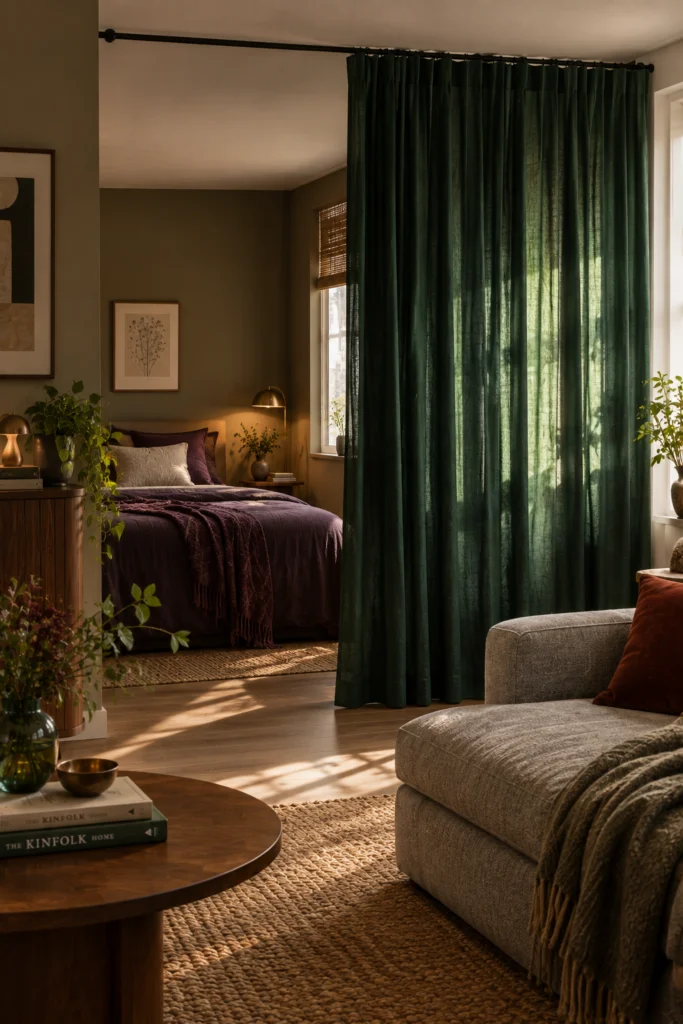
A curtain is the only divider on this list that costs under fifty dollars and needs zero tools — a tension rod holds most curtain weights without any drilling, which matters if you’re renting. Pick one bold curtain color and let the bedding pick up a second, complementary tone rather than matching it exactly; matching too closely reads flat in photos.
8. Minimalist Studio with a Sheer Curtain Divider
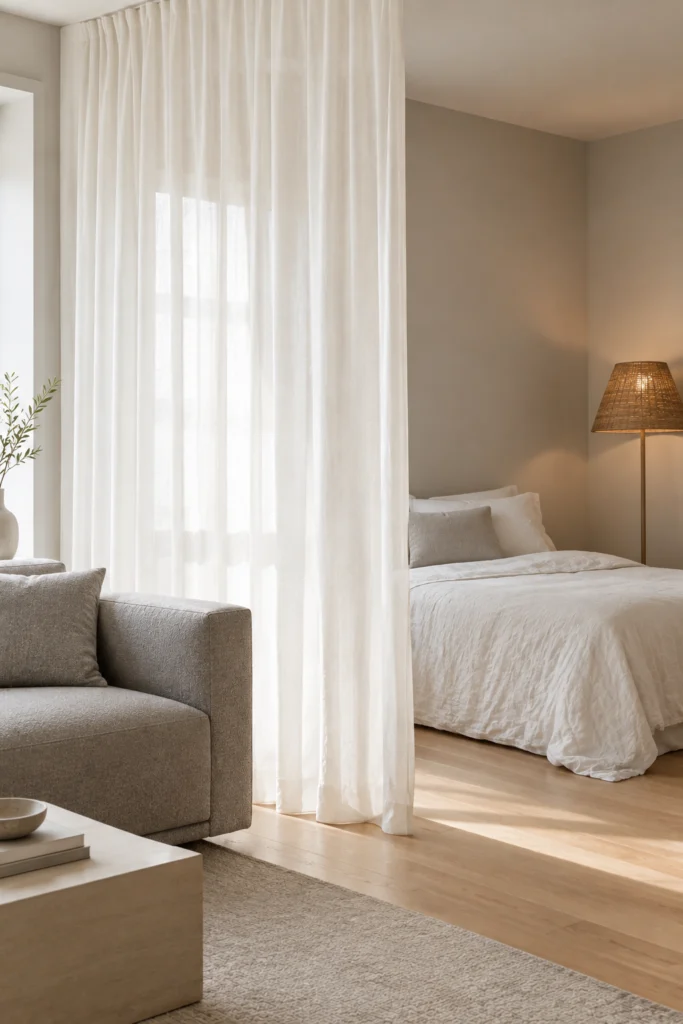
Sheer fabric is the lightest-touch divider possible — it signals “different zone” without ever fully blocking the room visually or physically. This only works in a genuinely minimalist studio; if the rest of the room has heavy pattern or clutter, a sheer curtain reads as an afterthought instead of an intentional design choice.
9. Modern White Studio with a Glass Partition
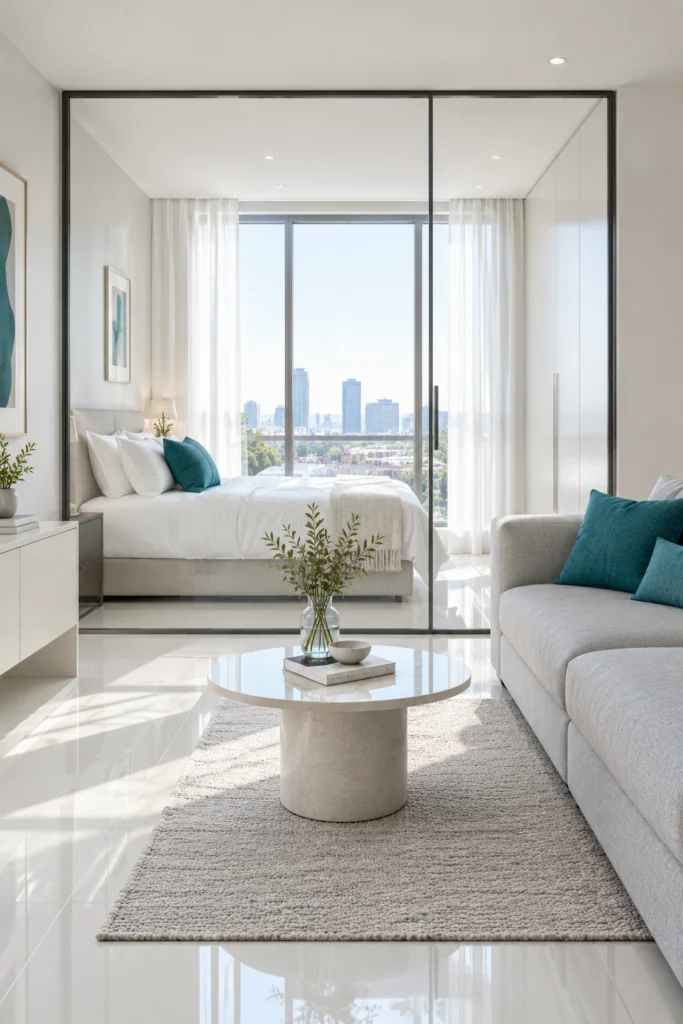
Glass is the only true divider that adds real separation without sacrificing a single ray of natural light — worth the higher cost specifically in a studio with only one window, since blocking it with anything solid would darken the whole room. Keep the glass frameless or thin-black-framed so it doesn’t visually compete with the rest of the room.
10. Scandinavian Studio with a Built-In Workspace
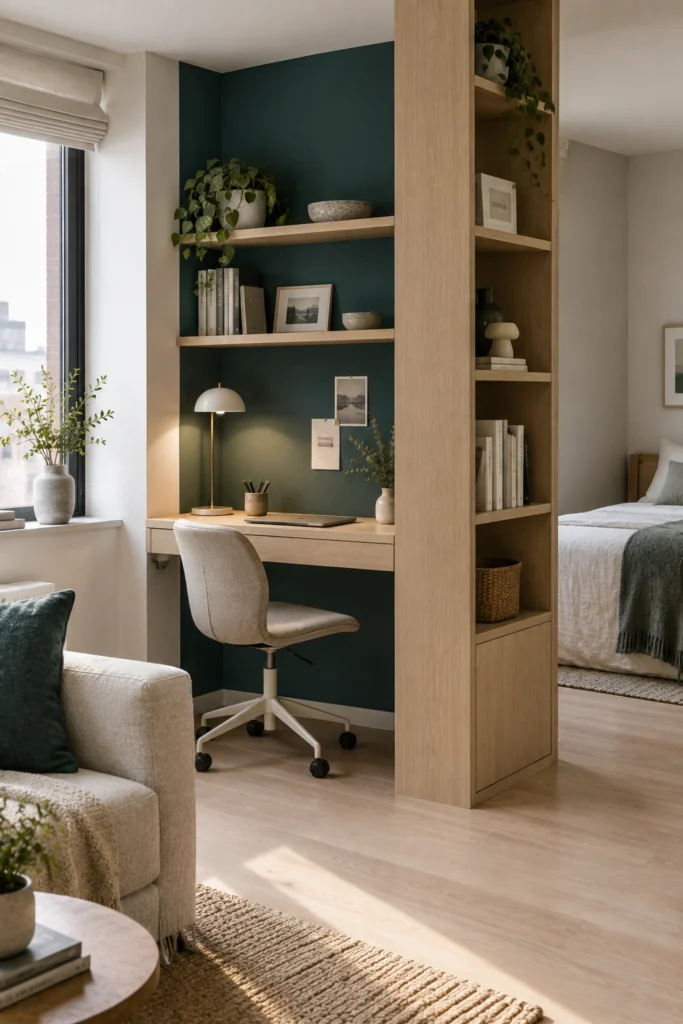
A dedicated work corner needs its own visual signal or it bleeds into the living space and stays cluttered — a single accent wall color, used only behind the desk, marks it as a distinct zone the same way a curtain or shelf would. Keep the desk footprint under two feet deep so it doesn’t eat into walkway space.
11. Bright White Studio with Bold Red Accents
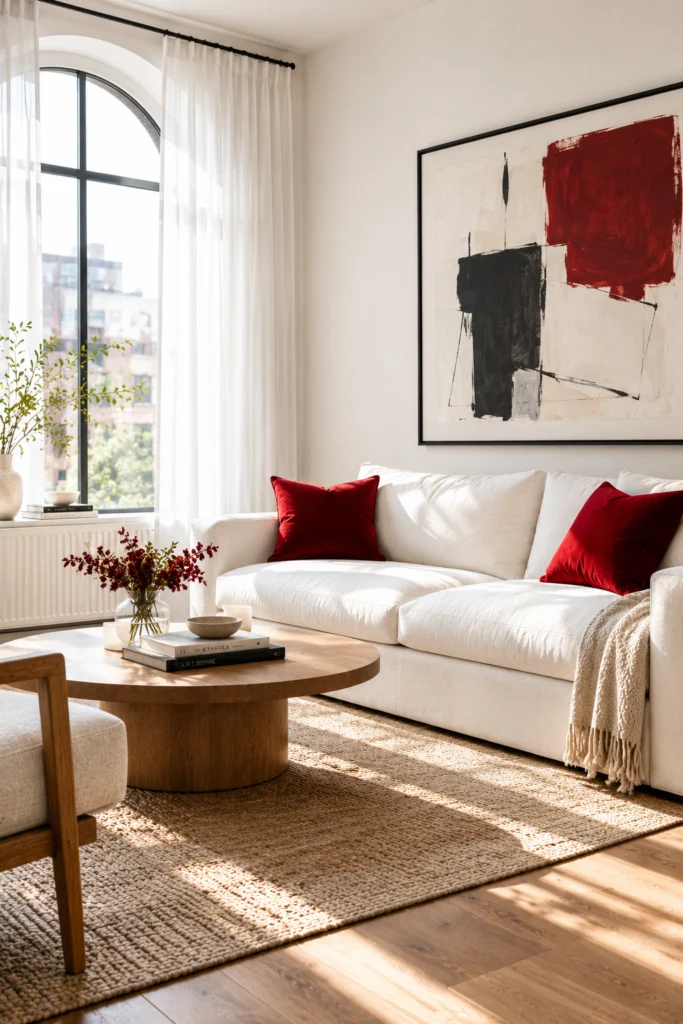
A fully white room only needs one strong accent color to read intentional rather than unfinished, and red specifically photographs well against white for Pinterest because the contrast is immediate. Keep the red confined to two or three objects — pillows and one art piece — so it reads as a deliberate accent, not a second competing scheme.
12. Bold Maximalist Studio with Jewel-Tone Colors
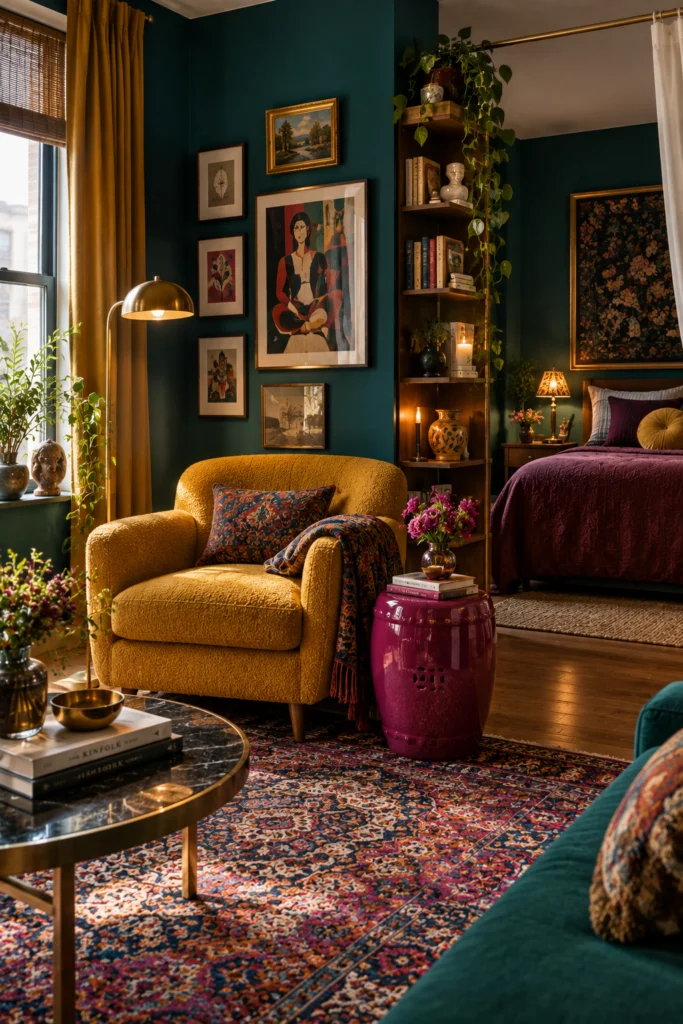
Maximalism in a studio works only if every color commits fully — one hesitant pastel next to three bold jewel tones reads like an unfinished room, not an eclectic one. Anchor the palette with a patterned rug first, then pull two or three of its colors into furniture pieces so the boldness feels coordinated instead of random.
13. Glam Pink Studio with a Sputnik Chandelier
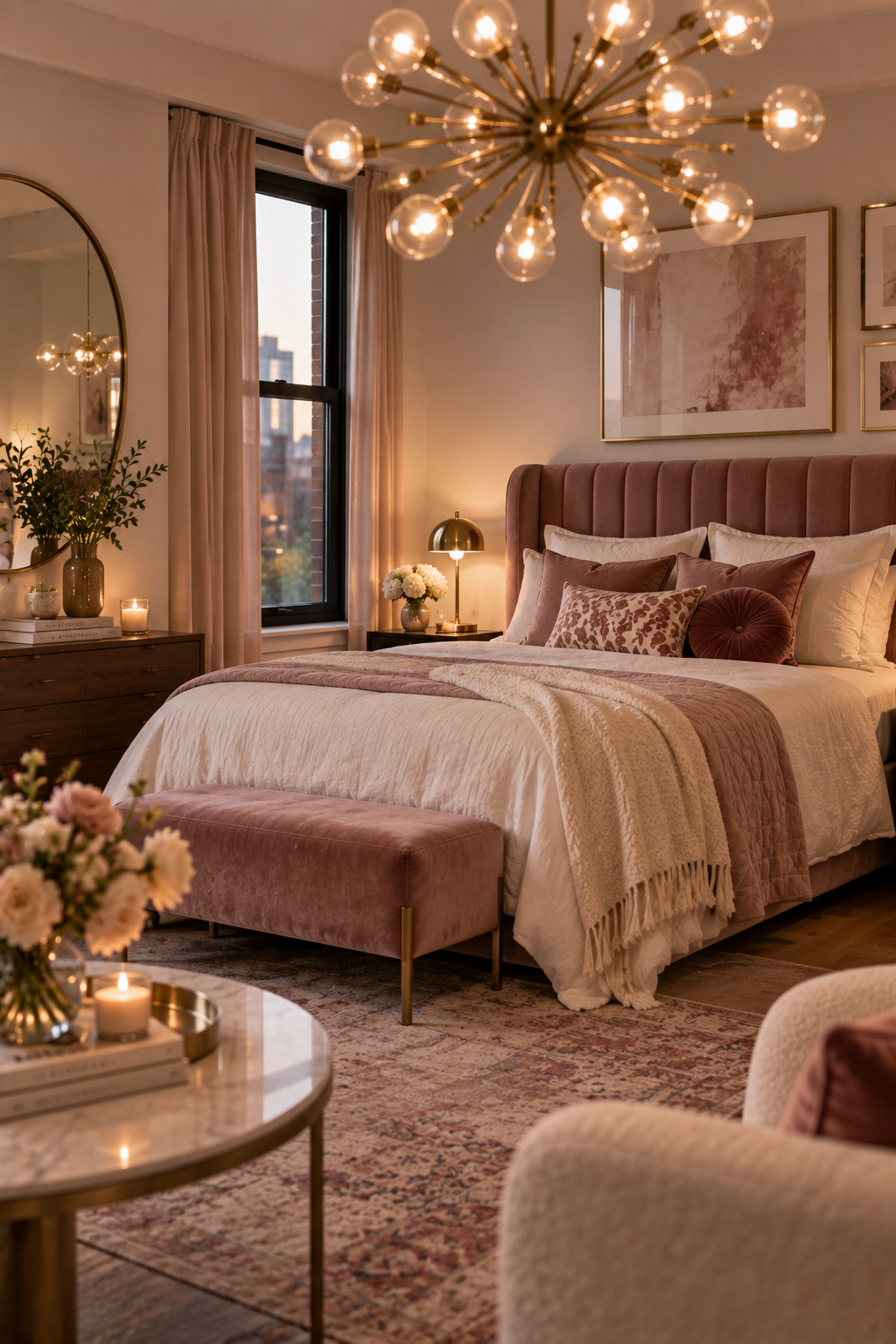
A sculptural light fixture like a sputnik chandelier keeps a pink palette from reading overly sweet — the metal and geometric shape add an edge that balances the softness of the color. Position it as the room’s single “statement” object and keep everything else (bedding, walls) in muted, dusty tones so the fixture has room to stand out.
14. Boho Plant-Filled Studio with a Kallax Divider
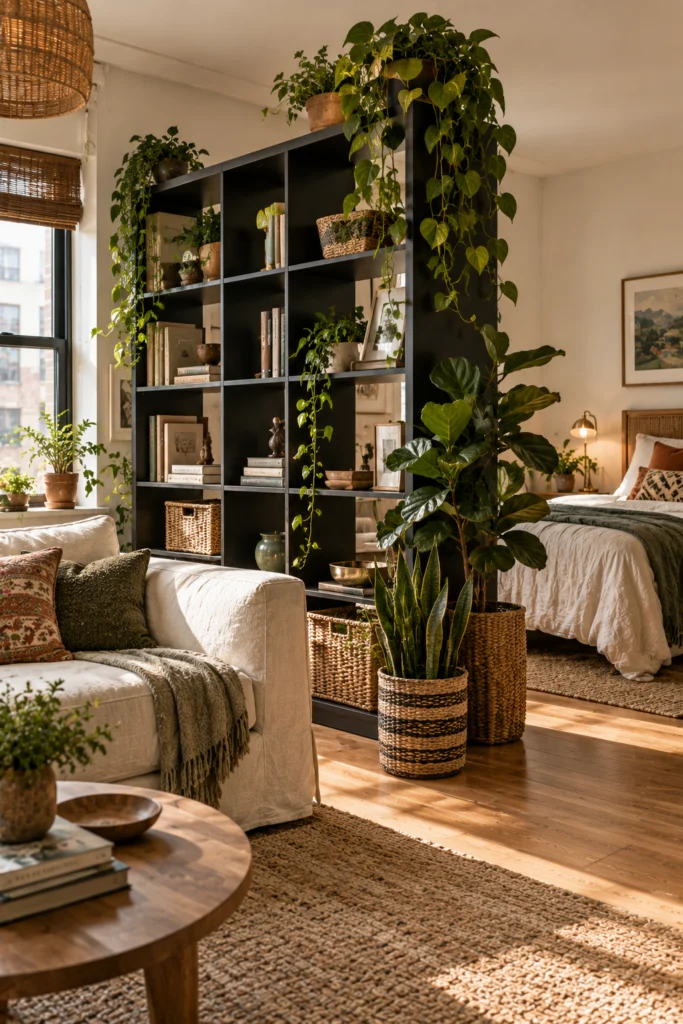
Plants clustered directly at a shelving divider do double duty — they soften the hard lines of the furniture and add a second layer of visual separation on top of the shelf itself. Stick to two or three plant sizes (one tall, one trailing, one small) rather than scattering single plants around the whole room, or the effect reads cluttered instead of lush.
Common studio layout mistakes to avoid
- Buying a full-size sofa before measuring the walkway. Leave at least 30 inches of clear path between major furniture pieces.
- Using only one overhead light for the whole room. Every zone needs its own light source — a lamp, not just the ceiling fixture — or the divisions disappear at night.
- Matching every piece of furniture to one set. A matched bedroom set in a studio reads like a showroom. Mix at least two wood tones or finishes.
- Skipping a divider entirely because the room feels too small for one. Even a sheer curtain or a rug boundary reads as a zone; and check these studio apartment divider ideas for small spaces before ruling it out.
- Overfilling an open shelf divider. Leave a third of it empty so light and sightlines still pass through.
Quick answers
What’s the easiest way to divide a studio apartment without a wall?
A curtain on a tension rod is the fastest and cheapest option — no drilling, fully reversible, and it reads as a zone the moment the fabric moves.
Does a studio apartment need a room divider to feel like a real home?
Not strictly — color, lighting, and furniture placement can define zones on their own, though a physical divider like a bookshelf or curtain makes the separation clearer at a glance.
What colors make a studio apartment look bigger?
Light, warm neutrals on the walls, with one accent color kept to textiles rather than paint, tend to read larger than a fully saturated scheme.
Is a glass partition worth the cost in a small studio?
It’s worth it specifically if your studio has only one window, since a glass partition is the only divider that adds separation without blocking any natural light.
How do I zone a work-from-home desk in a studio?
Give the desk its own light source and, if possible, a single accent wall color behind it — a visual signal is often enough without a physical partition.
Can a maximalist color scheme work in a small studio?
Yes, as long as the palette commits fully rather than mixing bold colors with hesitant pastels — anchor it with a patterned rug and repeat two or three of its colors in the furniture.
What’s the best lighting setup for a studio apartment?
Skip a single overhead fixture and use two or three warm-toned lamps placed at the edge of each zone — it does more to define the room than color alone.
I switched from a single ceiling light to three lamps in my own studio and it changed how the room read more than any furniture move did — the zones finally looked like separate rooms after dark, not just during the day. For more layout ideas by room size, see these small studio apartment layout ideas.