
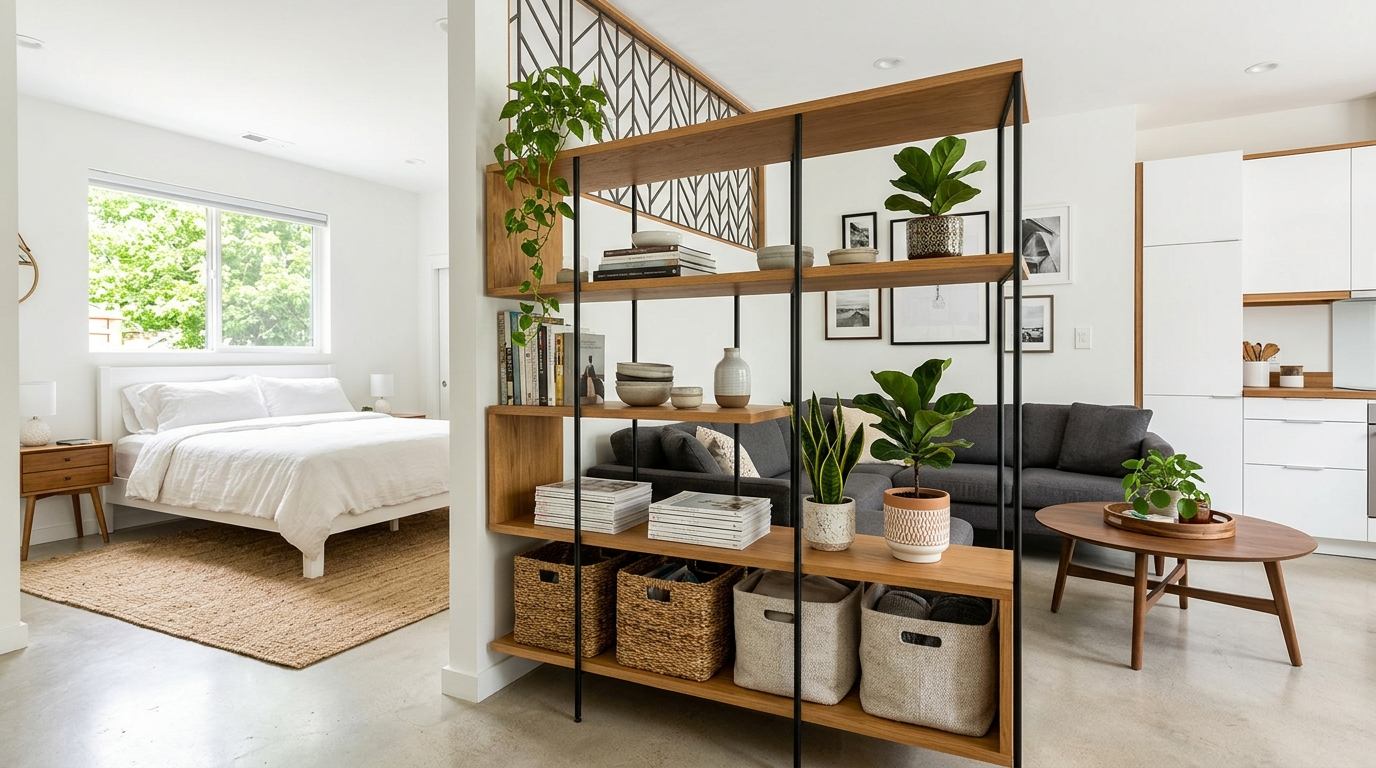
An open shelf divider works when it separates the sleeping area from the living area, holds real storage, and still lets light through. Style both sides, anchor it to the wall, and pick a height that matches how much privacy you want. Here are 15 examples in different styles.
1. The Plant-Lover’s Bookshelf Wall
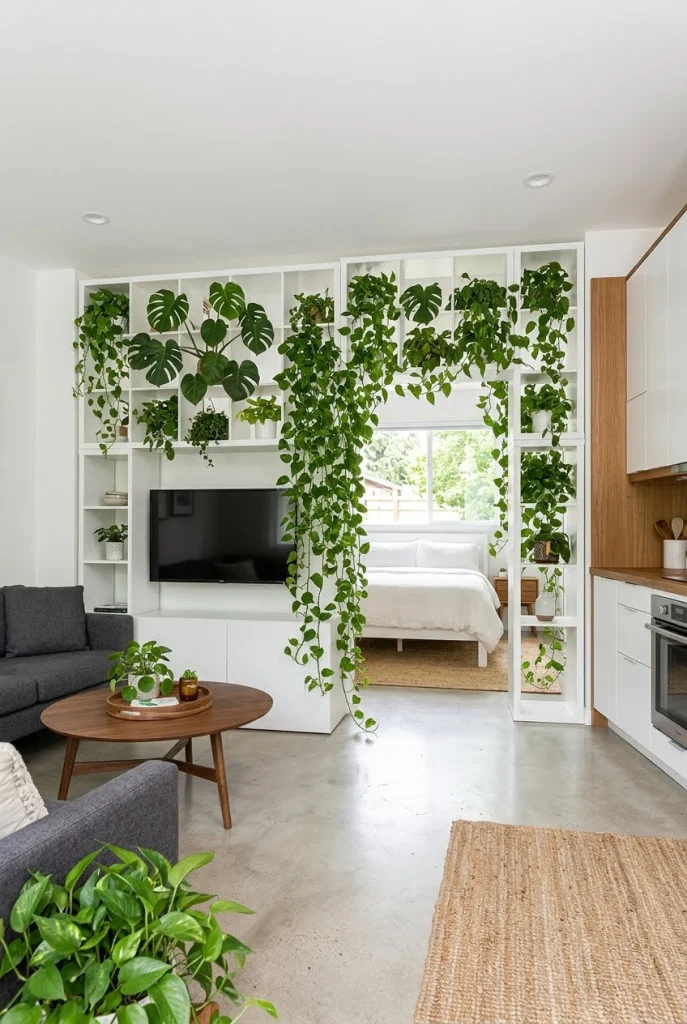
A shelving unit packed with plants stops being furniture and becomes a feature. This white cube unit works as a TV console, book storage, and a living divider all at once, with trailing pothos and monstera leaves softening the grid. The bedroom stays visible beyond, but the greenery creates real separation. For more plant placement ideas, see mini studio apartment plant ideas.
Pro tip: Top shelves get the best light, so save them for trailing pothos or monstera and keep shade-tolerant plants lower down.
2. The All-White Airy Divider
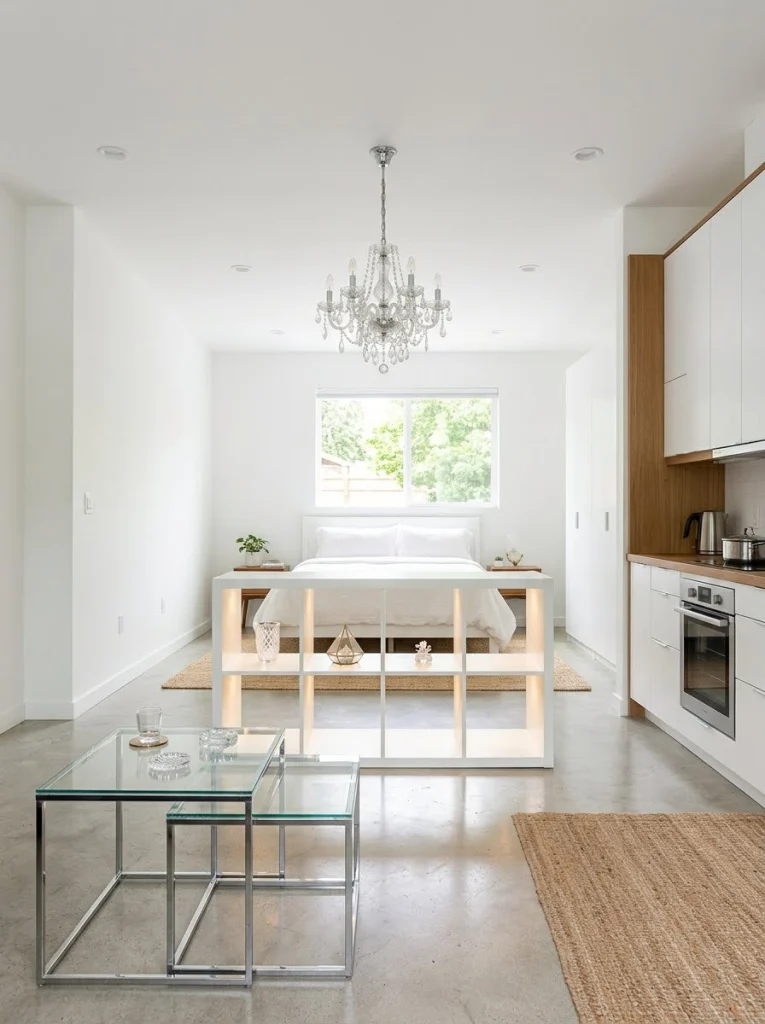
In a studio that’s already bright and white, a small open shelf keeps the airiness intact. A 2×4 cube unit makes just enough of a visual break between the living and sleeping zones without feeling heavy. A crystal chandelier and glass nesting tables keep things light, and a warm glow tucked inside the cubes adds atmosphere at night.
Pro tip: A chandelier in a studio sounds extra, but it draws the eye up and makes a small space feel taller.
3. The Scandinavian Classics Shelf
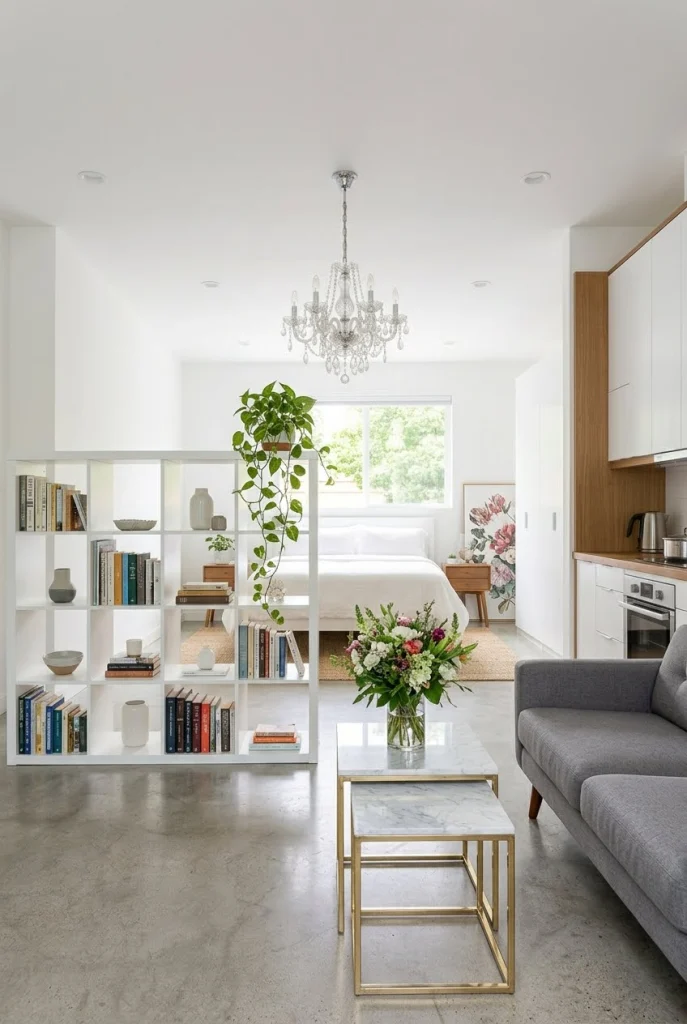
A 4×4 white cube unit styled with books, ceramics, and a single trailing plant splits a Scandinavian-style studio cleanly. A gray sofa and marble nesting tables anchor the living zone, and framed floral art leaning on top of the shelf adds a collected feel instead of a staged one. Fresh flowers on the coffee table finish it, and the whole room looks like someone actually lives there.
Budget vs. splurge: Save on the shelf itself and spend a little on a few quality ceramics to style it, since they make an inexpensive shelf look intentional.
4. The Personality-Packed Shelf
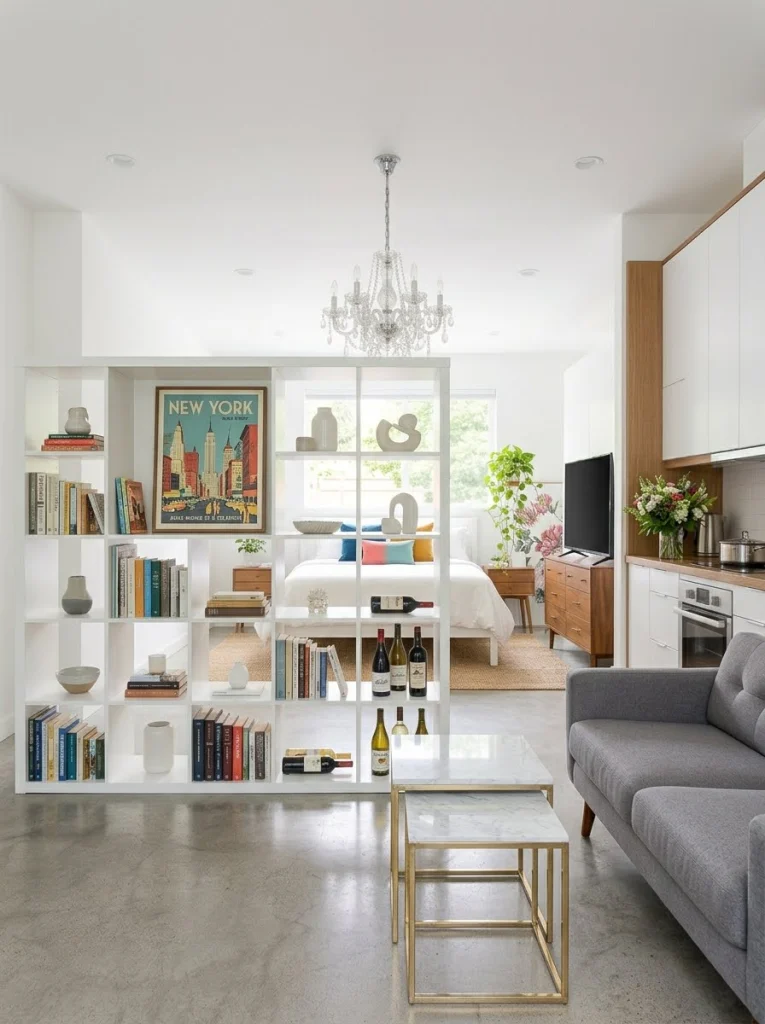
Not every shelf has to look like a showroom. A 5×4 unit with a city poster, wine bottles, stacked books, and small ceramics gives plenty of cubes to fill with things you actually own, and that makes the apartment feel personal. The living side holds the TV and dresser, and the bedroom sits quietly behind it. For more layouts built around this setup, see studio apartment layout ideas using bookshelf room dividers.
Pro tip: Secure a top-heavy cube unit with an anti-tip strap anchored to the wall. Small anchors are usually allowed for safety.
5. The Color Story Shelf
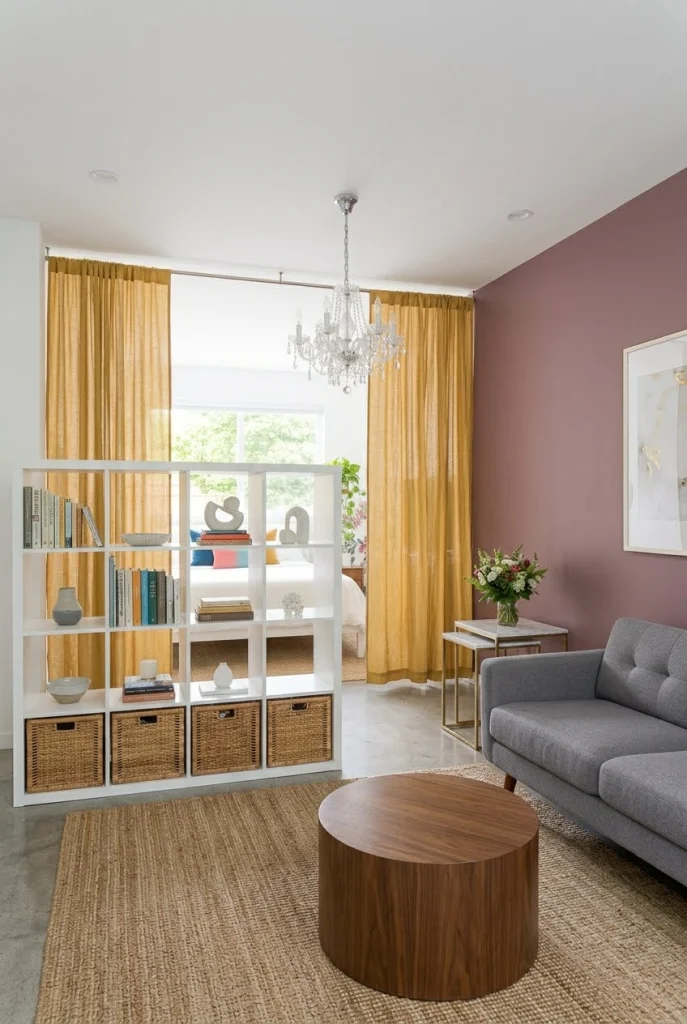
Color on both sides of the divider defines the zones. Warm yellow curtains cocoon the sleeping area, a dusty mauve accent wall grounds the living space, and a white cube unit sits in the middle like a neutral referee. Wicker baskets in the lower cubes hide storage, and a jute rug with a walnut coffee table adds warmth below. The studio ends up feeling like two different rooms without a wall.
Pro tip: Use the shelf as a color transition point, and give each side its own palette so the zones feel distinct, not just divided.
6. The Gallery Wall and Bookshelf Combo
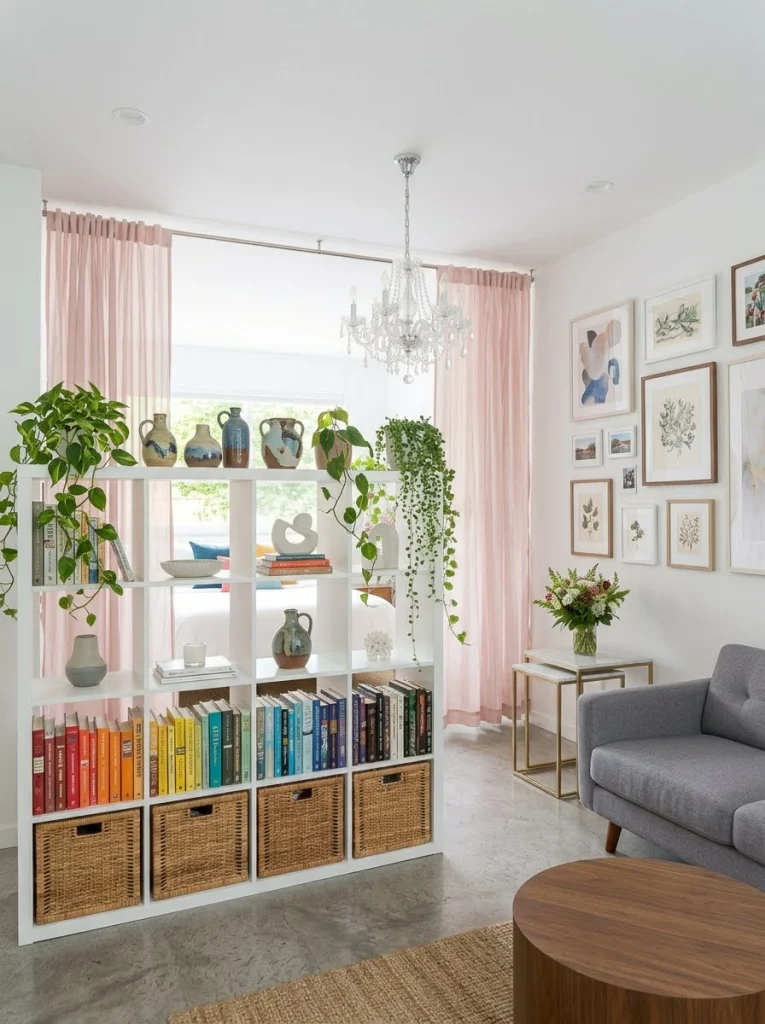
A gallery wall on the living side, pink curtains and white bedding on the bedroom side, and a fully loaded 5×5 cube unit holding it together in the middle gives each zone its own identity. The shelf is packed with colorful book spines, ceramic jugs, and trailing plants, so it works as a feature wall in its own right.
Pro tip: If a shelf looks boring, the books are usually the problem. Arranging them by color makes the whole unit look curated.
7. The Two-Tone Minimalist Shelf
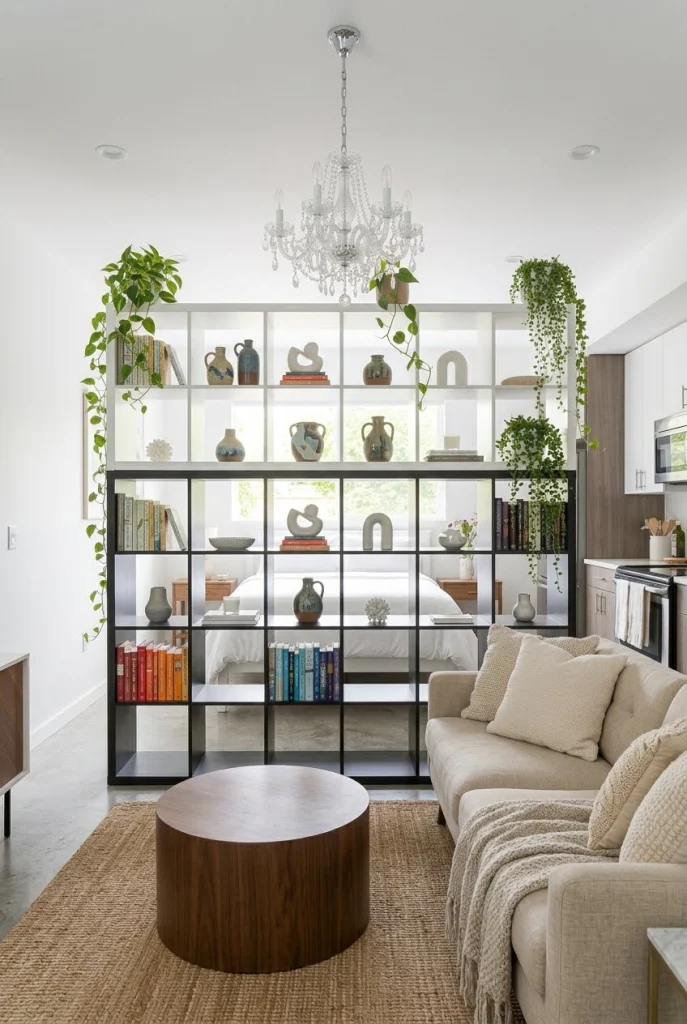
Two cube units stacked, white on top and black on the bottom, make a striking two-tone divider that looks custom-built. Trailing pothos cascading down both sides softens the contrast. The dark base grounds the unit so it doesn’t feel like it’s floating, and the lighter top keeps things open. On the living side, neutral textiles and a jute rug balance the boldness of the shelf.
Pro tip: When stacking two units, secure them to each other and to the wall. A falling bookshelf is not a design moment.
8. The Full Library Wall
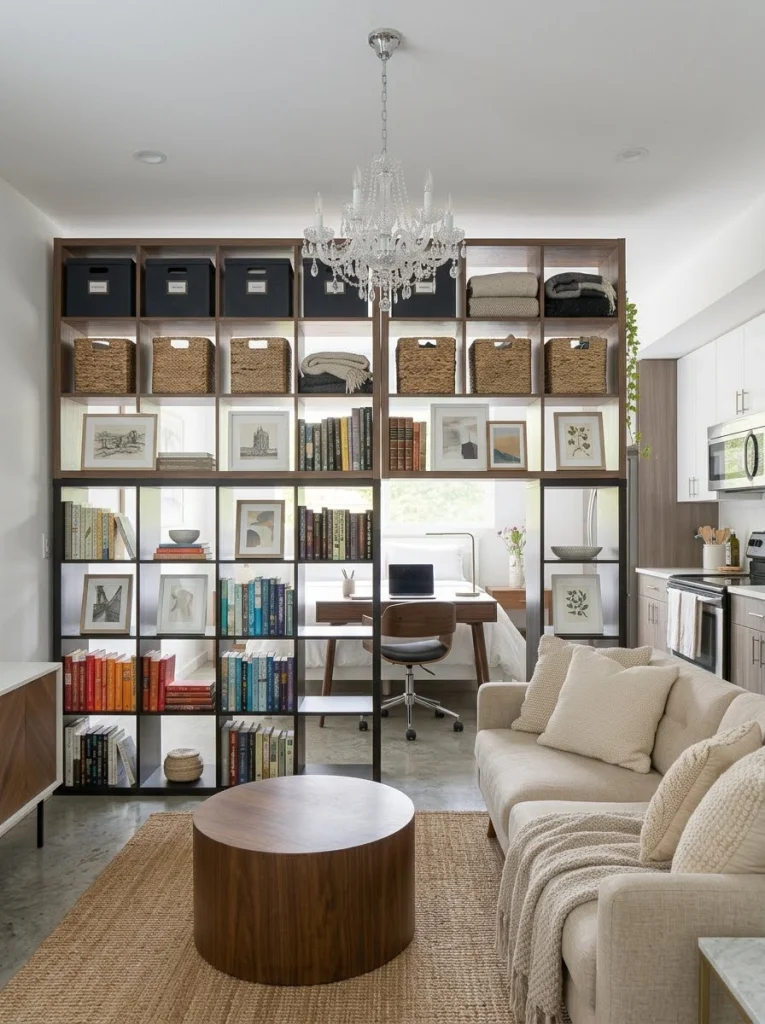
When one cube unit isn’t enough, two side by side make the most substantial zone division you can build without construction. The top rows hold storage boxes and folded blankets, the middle rows hold books and framed prints, and the lower cubes stay flexible. A workspace tucked behind it on the bedroom side feels like a separate room. For more ideas that add storage to a divider, see smart room dividers with storage for studio apartments.
Budget vs. splurge: Save on matching storage boxes. The consistency makes a packed shelf look intentional instead of chaotic.
9. The View-Through Shelf
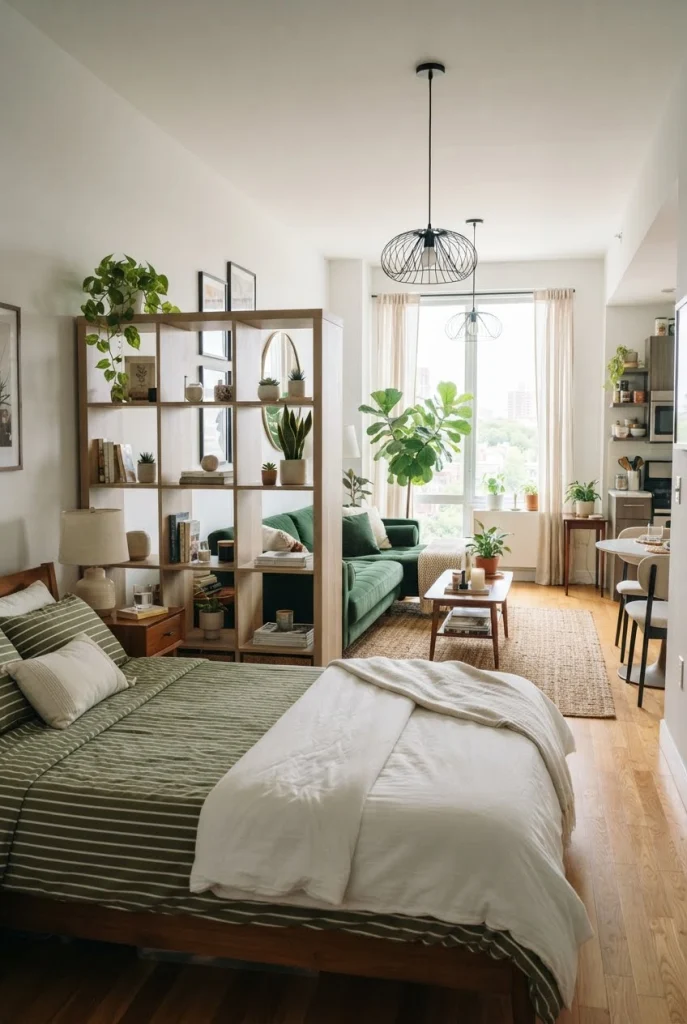
Seen from the bedroom side, a shelf divider doesn’t block the view, it frames it. The living area beyond, with its green sofa, pendant lights, and plants, stays visible, and that visual connection makes both zones feel bigger. Striped olive-and-white bedding in the foreground anchors the bedroom without cluttering it. An open unit gives the room depth instead of making it cramped.
Pro tip: Fill only every other cube to keep the view-through effect strong. Empty cubes read as breathing room, not neglect.
10. The Lit-Up Shelf Divider
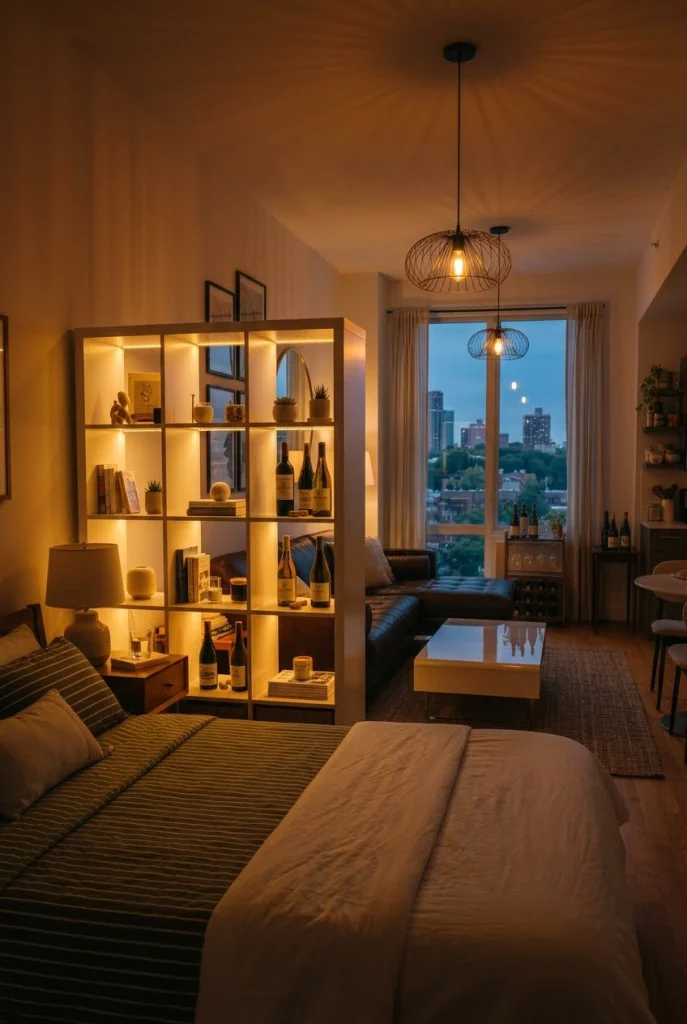
LED strip lights inside a white shelving unit shift a setup from functional to atmospheric. This polished studio has a dark leather sectional, a glossy white coffee table, and wine on display, and the lit shelf reinforces the look. The cubes glow softly after dark, turning the divider into a mood piece, and it’s an easy upgrade that takes under an hour. For more lighting ideas, see studio apartment lighting decor ideas.
Pro tip: Use warm white LEDs, around 2700K to 3000K, inside the shelves. Cool white makes the space feel clinical, not calm.
11. The Ceramic Gallery Shelf
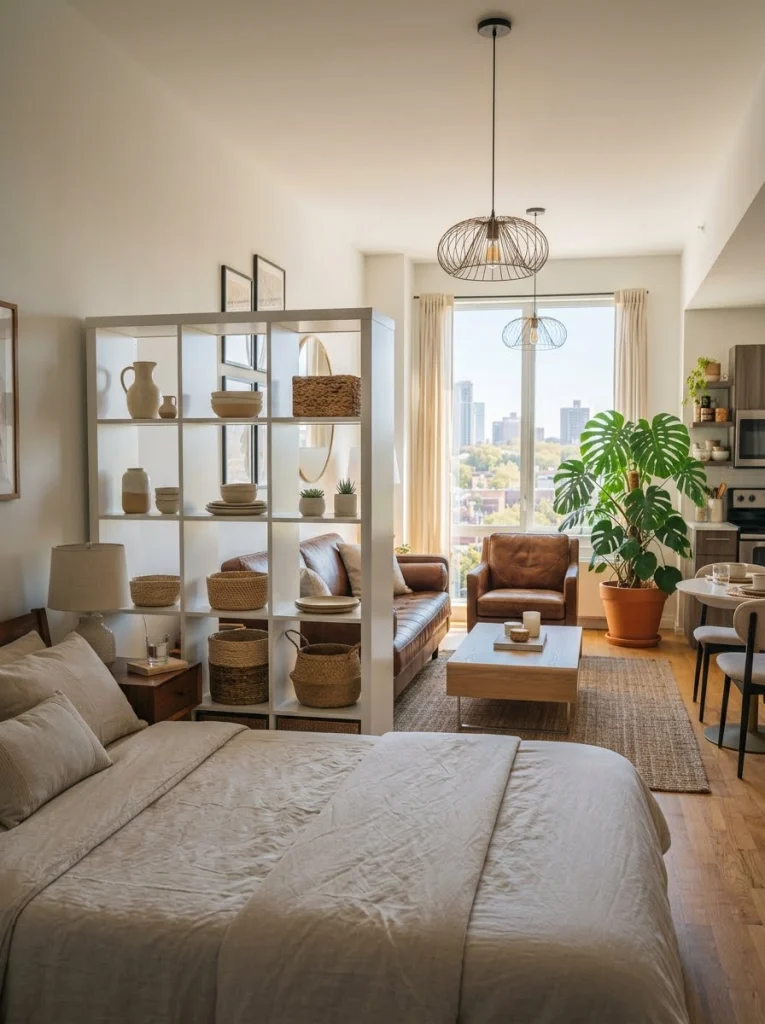
For collectors, skip the books and plants and style the shelves entirely with neutral ceramics, jugs, bowls, sculptural pieces, and woven baskets. A thin white grid frame keeps the unit visually light so the objects take center stage. A brown leather sofa and armchair bring warmth, and an oversized monstera beside the sofa grounds the composition. It feels like a gallery instead of a storage unit. For more styling ideas, see studio apartment shelf decor ideas.
Pro tip: Odd numbers work best on shelves. Style in groups of three or five instead of four or six.
12. The Floor-to-Ceiling Tension Pole Shelf
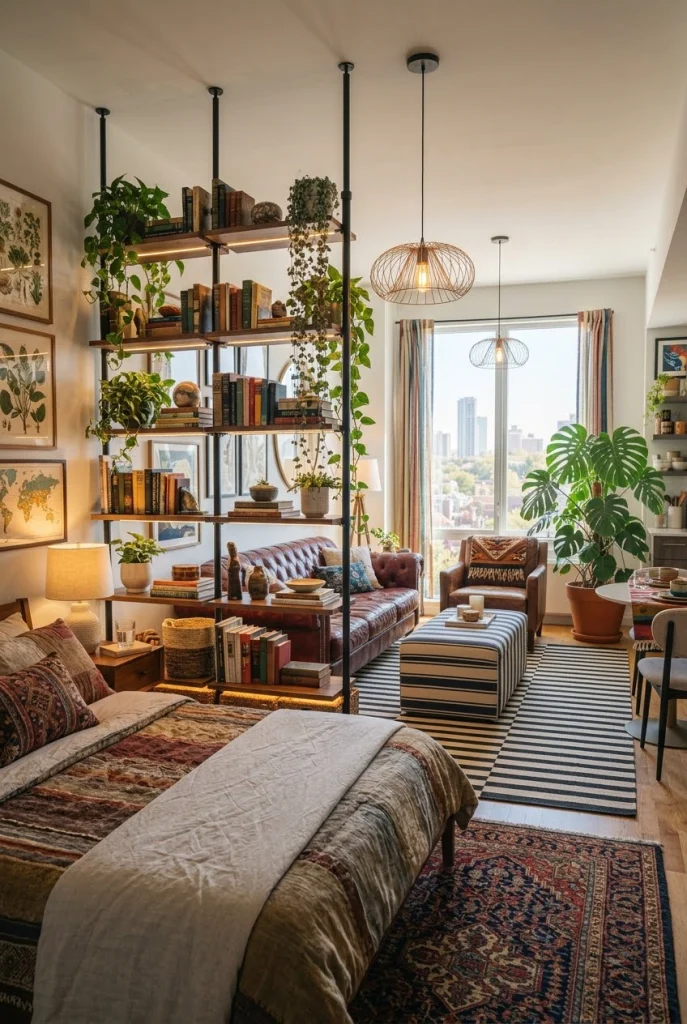
A tension pole shelving system, the kind that braces between floor and ceiling, is the ultimate renter-friendly divider, since it needs no drilling. A black metal frame with warm wood shelves, loaded with books and trailing plants, adds vertical drama without touching a wall. The warm, eclectic room around it layers a Persian rug over a striped flat-weave, with a striped bench ottoman grounding the living zone.
Pro tip: Check the weight rating per shelf before loading it. Most tension systems hold plenty for books, plants, and decor.
13. The Natural Wood Shelf Divider
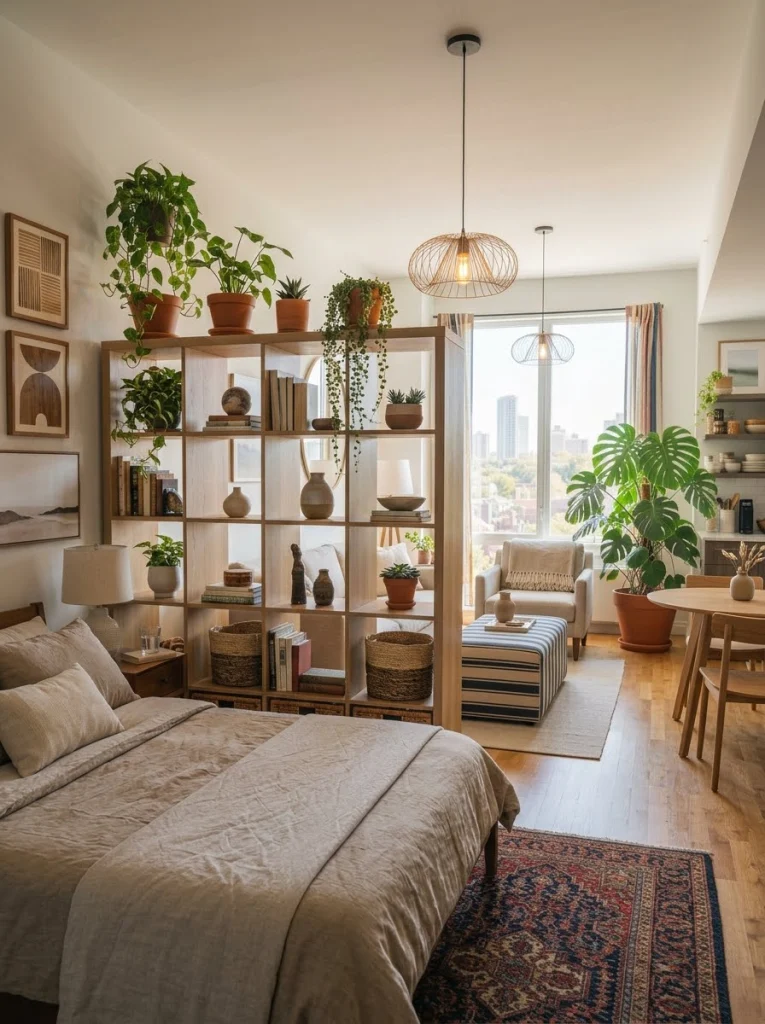
White shelving is the default, but warm wood is worth considering. A natural oak cube unit adds texture and warmth a white one can’t, and it ties to a matching round dining table and honey-toned floors. Plants in terracotta pots on top, a mix of books and ceramics inside, and woven rattan baskets for hidden storage below finish it, with a beige sofa and linen throw beyond. For more wood options, see studio apartment wood divider ideas.
Pro tip: For solid wood, check secondhand shops. Old bookshelves sand and refinish beautifully.
14. The Platform Bed and Tall Shelf Pairing
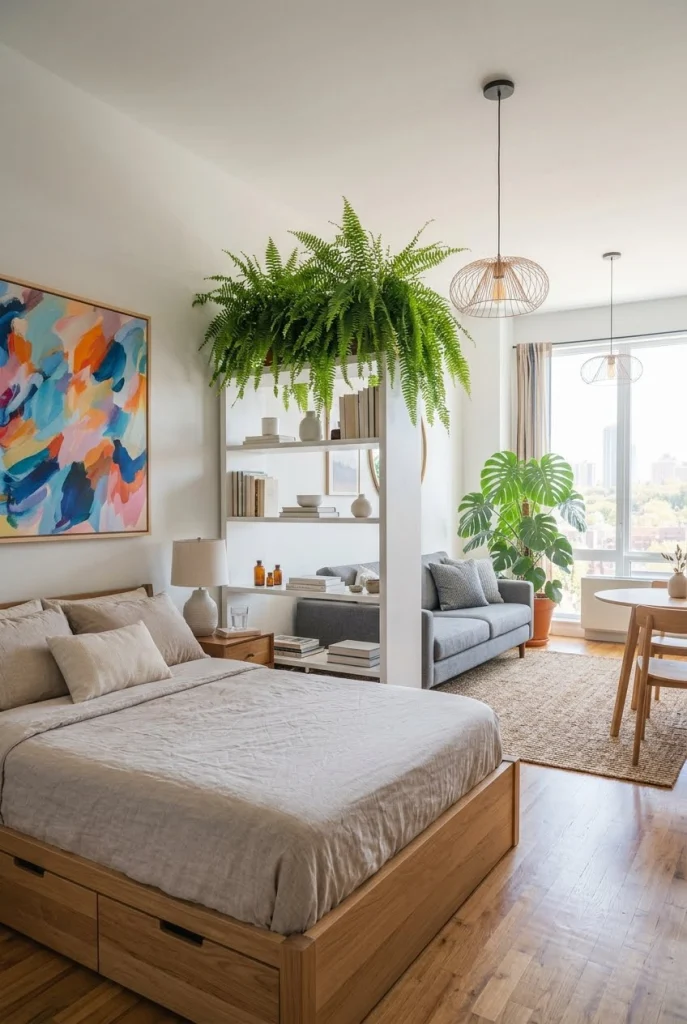
A platform bed with built-in under-bed drawers paired with a full-height white shelf beside it is smart design. The drawers add real square footage in storage, and the shelf defines the sleeping zone clearly. Colorful abstract art above the bed and a lush fern on the shelf add energy to what could have been a cold white-on-white setup, and a gray sofa with a jute rug keeps the living side grounded.
Pro tip: A platform bed with drawers can replace a whole dresser. Measure before buying, since every inch of clearance matters.
15. The Living-Dining Divider
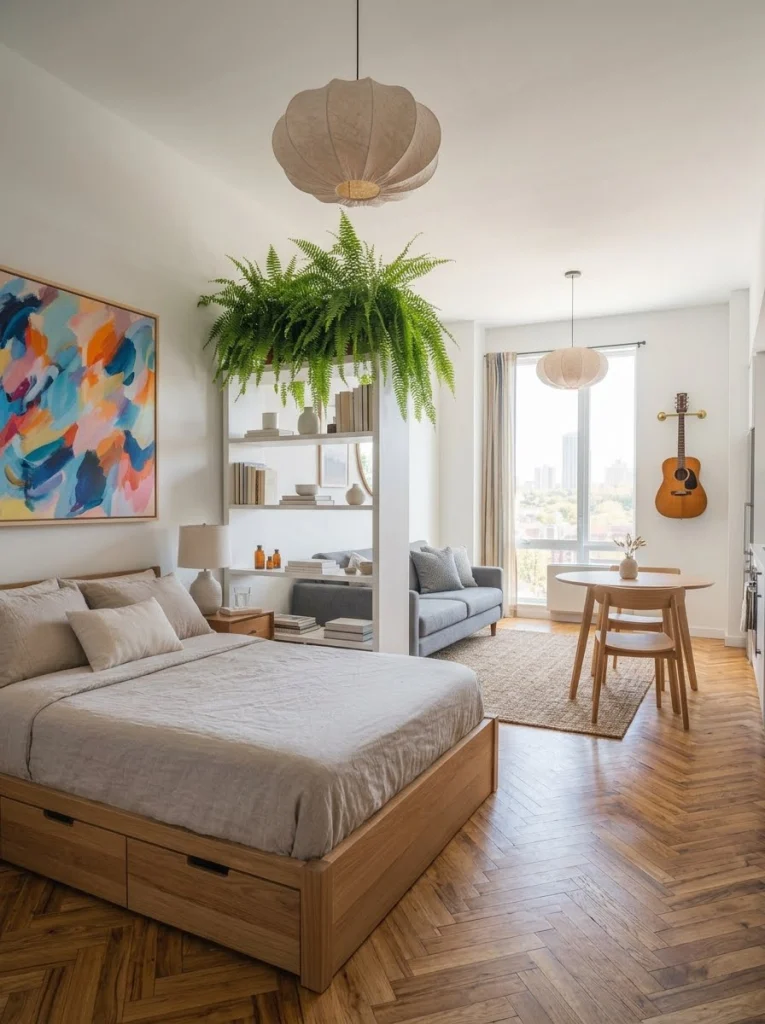
A shelf divider doesn’t have to separate only the bedroom from the living room. Here the bedroom sits behind the shelf, while the other side holds both a seating area and a small dining table with chairs. A guitar on the wall, a paper pendant light, and herringbone parquet floors tie it together. A studio has three zones, sleeping, living, and dining, and the shelf can be the hinge for all of them.
Pro tip: Don’t style both sides of the shelf the same way. Face the display toward the zone where guests spend the most time, and keep the bedroom side more functional.
Common open shelf divider mistakes
- Skipping the wall anchor. A tall unit loaded with books needs to be secured to the wall or to a matching unit, especially beside a bed.
- Filling every cube. Leaving some cubes empty keeps light moving and stops the shelf from reading as pure storage.
- Styling only one side. Both sides get seen, so the bed side needs the same care as the living side.
Quick answers
What’s the best height for an open shelf divider in a studio?
Waist height keeps sightlines and light open, while floor-to-ceiling gives full separation between the bed and living area.
Do I need to anchor an open shelf divider?
Yes, if it’s tall or loaded with books. Use an anti-tip strap or secure it to a matching second unit.
Can an open shelf divider work in a rental?
Yes, a freestanding cube unit or a tension pole system needs no drilling and can be moved or taken apart when you leave.
Will an open shelf make my studio feel smaller?
Usually not. See-through shelves let light and sightlines pass, and they often make both zones feel deeper.
What should I put in the cubes of a shelf divider?
A mix of books, baskets, plants, and a few ceramics, with some cubes left empty so it reads as styled.
Can I add lighting to a shelf divider?
Yes, warm white LED strips inside the cubes make it glow softly at night and turn the divider into a mood feature.
Is white or wood better for a shelf divider?
White keeps a small studio airy, while wood adds warmth and works well in earthy or Japandi-style rooms.
Final Thoughts
An open shelf divider separates zones, carries storage, and gives you a surface to style, all without closing off light. You don’t need to buy and style everything at once. Start with the unit, anchor it safely, and fill it slowly with things worth displaying.